Jewelry Store Payment Processing: Why High Tickets Cost You More
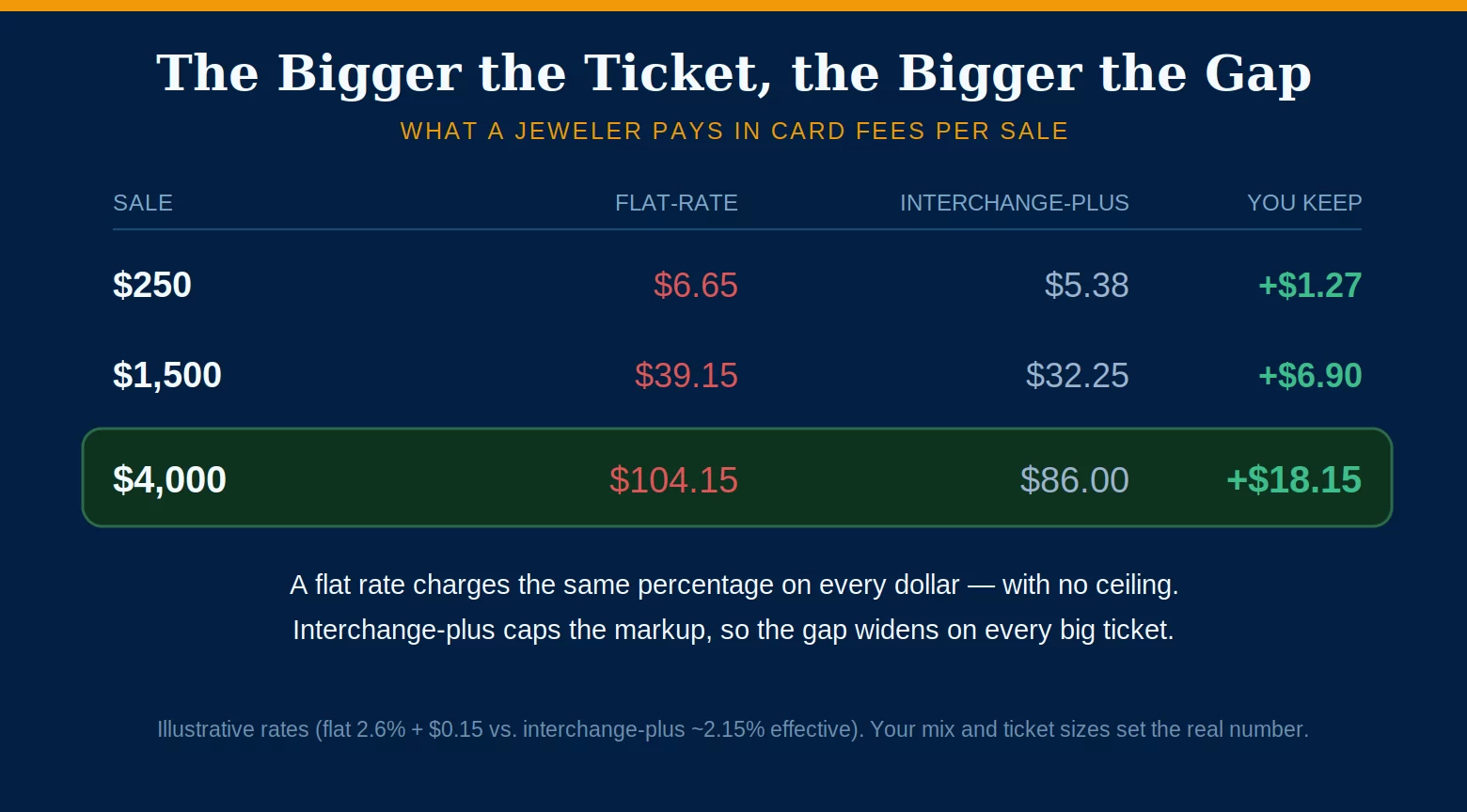
Jewelry store payment processing sits on some of the largest average tickets in retail — and that is exactly where flat-rate card pricing quietly costs the most. When a single sale is $3,000 or $8,000, a percentage-based rate turns into real money on every swipe, and the difference between a bundled flat rate and transparent interchange-plus stops being rounding error. Jewelry store payment processing is worth getting right precisely because the tickets are big enough that small rate differences compound into thousands of dollars a year.
This is a plain look at why high tickets punish flat-rate pricing, how interchange-plus caps what you actually pay, and where a jeweler can cut card costs without touching the customer experience. The short version: the bigger your average sale, the more a transparent rate is worth to you.
Why Big Tickets Punish Flat-Rate Pricing
A flat rate charges the same percentage on every dollar of the sale. That feels simple, but the percentage never stops climbing as your ticket grows — there is no ceiling. On a coffee shop’s $5 sale the difference between pricing models is pennies; on a jeweler’s $4,000 sale it is real money, every single time.
At a flat 2.6% + $0.15, a $250 sale costs about $6.65 in fees. The same rate on a $4,000 engagement ring costs about $104. The percentage looks identical on paper, but the dollars scale straight up with your ticket — and jewelry stores live at the high end of that curve. Over a few hundred high-ticket sales a year, the flat-rate premium runs into the thousands.
High-ticket jewelry payment processing also skews toward premium rewards cards, because affluent buyers carry them. Those cards carry higher interchange, and a flat rate simply buries that in one blended number — you never see what you are actually paying the networks versus the processor.
Interchange-Plus Caps What You Pay on Every Sale
Interchange-plus splits your cost into the two parts it was always made of: the wholesale interchange the card networks set, which no processor can change, and a small, fixed markup on top that you actually get to see. On a high ticket that structure matters enormously, because the markup is thin and transparent instead of a full percentage stacked on the whole sale.
The interchange on that sale is roughly the same no matter who processes it. Under a flat rate, the processor pockets a fat, hidden markup on top of it. Under interchange-plus, the markup might be a fraction of a percent plus a dime — so more of that $4,000 stays with you. The bigger the ticket, the wider that gap grows, which is why jewelry store payment processing is one of the clearest cases for leaving flat-rate pricing behind.
Because the markup is fixed rather than a rising percentage, your effective rate actually drops as your tickets climb — the opposite of what flat-rate does to you. For jewelry store payment processing, where tickets are large and premium cards are common, that structure is the whole game.
Where Jewelry Store Payment Processing Actually Cuts Costs
Beyond the pricing model itself, a few levers move the needle for jewelry merchant services specifically. Getting jewelry store payment processing right usually means pulling two or three of them together.
The single biggest win is moving off a bundled flat or tiered rate and onto interchange-plus, so your markup is fixed and visible. On high-ticket volume this is where the recurring savings come from.
On a $6,000 purchase, compliantly passing the processing cost to the card-paying customer — or discounting for cash and wire — can eliminate the fee on that sale entirely. Many jewelers apply this selectively above a dollar threshold so it never touches everyday small purchases. It is a lever, not a default, and worth weighing against the buying experience.
Jewelry point-of-sale and inventory systems often bundle a payment processor at a non-negotiable rate. If your software forces a flat rate you cannot move off of, that is where a jewelry store merchant account on transparent pricing usually beats the convenience of the built-in option.
Frequently Asked Questions
Because fees are percentage-based and jewelry runs high tickets, the dollar cost of every sale is large — and jewelry buyers skew toward premium rewards cards that carry higher interchange. On a flat rate, all of that is bundled into one number with a fat markup. Moving jewelry credit card processing to interchange-plus exposes the true cost and caps the markup, which is why jewelry store payment processing rewards transparency more than almost any other retail category.
Usually, yes — and the advantage grows with your ticket size. Because interchange-plus adds a small fixed markup instead of a full percentage on the whole sale, your effective rate falls as tickets climb. A flat rate does the reverse, charging the same percentage on every dollar with no ceiling.
Yes, within the card network rules and applicable state law. Many jewelers apply a compliant surcharge or a cash-and-wire discount only above a set dollar amount, so a big-ticket buyer covers the processing cost while small everyday sales are untouched. It is worth weighing against the customer experience on a purchase that is already emotional and considered.
Send Us a Statement. We’ll Find the Overpay.
High tickets mean the money hides in the markup. Send us a recent statement and we will show you, line by line, what you are paying the networks versus the processor on your jewelry store payment processing — and what interchange-plus would keep in your pocket. Learn more about card processing consumer protections from the CFPB.
Get a Free Statement ReviewNo obligation • No pressure • Response within one business day
See what a statement review looks like →