Property Management Payment Processing: Card vs ACH
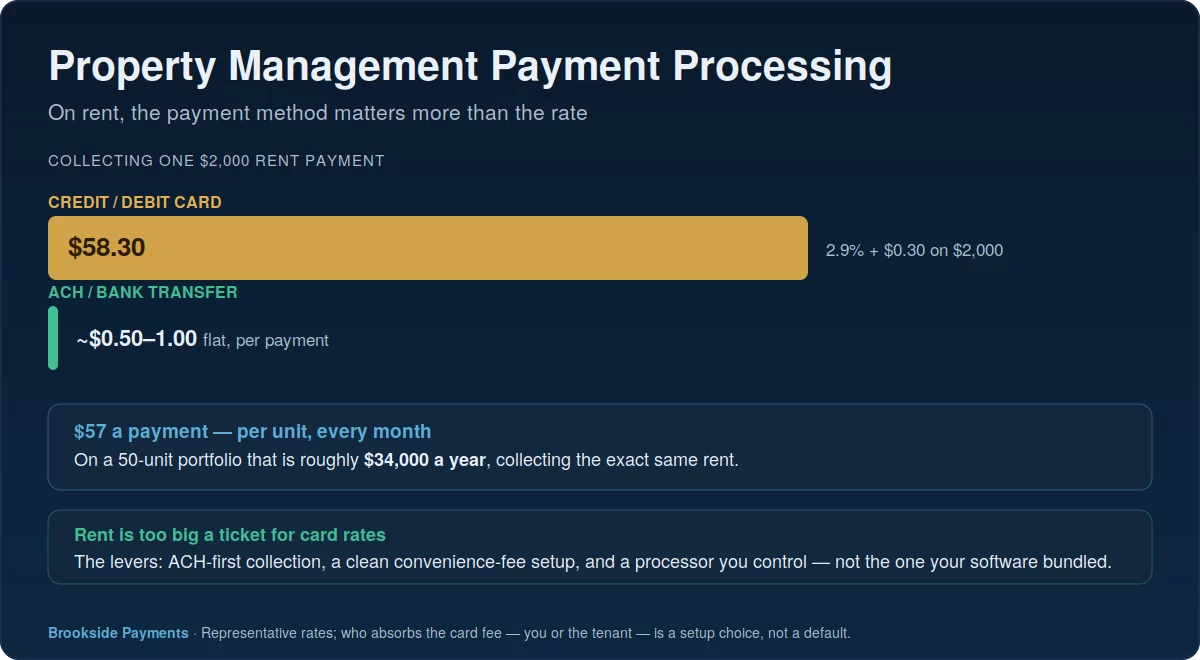
On Rent, the Payment Method Beats the Rate
Property management payment processing breaks the usual rules because of one number: the size of the ticket. Rent payment processing is a big-ticket business, and that single fact changes the math. A rent charge isn’t a $40 retail sale — it’s $1,500, $2,000, or more, paid every month by every tenant. At that size, the difference between accepting a card and accepting a bank transfer isn’t a rounding error; it’s the single biggest cost decision a property manager makes, and it has almost nothing to do with the processing rate you were quoted.
Run the math once and it’s obvious. A $2,000 rent payment on a card at 2.9% plus $0.30 costs about $58. The same payment by ACH costs well under a dollar. Multiply that gap across a portfolio and a full year and it reaches tens of thousands — on the exact same rent. So the first question in this business isn’t “what’s my rate,” it’s “how is the money actually moving.” Getting property management payment processing right starts there, with the rail. Visa and Mastercard, it turns out, publish what that card payment actually costs them — and for a rent payment it is a flat $0.75 with no percentage at all.
Percentage-based card pricing is tolerable on a coffee or a $40 sale. On a $2,000 recurring charge it’s punishing — which is why the rail you collect on matters more than the rate printed on your statement.
ACH Should Be the Default, Not the Afterthought
Because rent is a large, predictable, recurring charge, ACH bank transfer is almost always the right default. It’s a flat fee — commonly well under a dollar per payment — instead of a percentage, so it doesn’t scale up with the rent amount the way a card does. For a manager collecting fifty units of rent a month, routing rent collection through ACH instead of cards is the difference between a few hundred dollars a year in fees and tens of thousands.
Cards still have a place — some tenants want the float or the rewards, and offering the option can reduce late payments — but they should be the exception you’ve priced deliberately, not the default that quietly eats your margin. The goal is a setup where ACH is the easy, free path and cards are available for those who choose them with eyes open.
The whole reason ACH wins on rent is that its cost doesn’t grow with the payment. A $0.50 flat fee on $2,000 is nothing; a 2.9% card fee on the same $2,000 is $58. Same rent, hundredfold difference in cost.
Passing the Fee to Tenants: And Its Limits
The natural next thought is to simply hand the card cost to the tenant, and it’s a fair one — in fact most property management platforms already do exactly this, making ACH free while a card payment carries a fee, which quietly steers tenants onto the cheaper rail. But passing the fee is a regulated move, not a free switch, and on rent the limits bite harder than people expect.
A surcharge — the percentage version that recoups credit-card cost — applies to credit cards only; you cannot surcharge a debit card anywhere, and plenty of tenants pay rent by debit. A handful of states ban credit-card surcharging outright, several cap it (Visa’s own ceiling is 3%, and a number of states hold it to 2% or your actual cost), and some jurisdictions specifically limit what a landlord can add to rent and require the fee be disclosed before the tenant pays. The brands also won’t let you stack a surcharge and a convenience fee on the same transaction, and surcharging requires advance notice to the card networks. A true “convenience fee,” meanwhile, is a flat charge for an alternative payment channel and is mostly reserved for government and utility-type billing, which makes it an awkward fit when paying online is the standard way your tenants pay.
So passing the fee decides who absorbs the cost; it doesn’t make the cost disappear. A 2%-capped surcharge on a $2,000 rent is roughly $40 the tenant pays, still short of a 2.9% card cost and with friction added. That’s why the fee is best used as the nudge toward ACH — the same logic as a dual-pricing setup — rather than as a way to keep cards as the default. Just confirm what your state actually allows before you switch it on.
Surcharge and convenience-fee law differs by state and has seen active legislation and court rulings. Treat any pass-the-fee setup as something to confirm for your specific jurisdiction — this is general information, not legal advice.
Your Software Probably Picked Your Processor
Most managers run rent through a property platform — AppFolio, Buildium, RentManager, PayProp — and those platforms bundle the payment processing, often through a behind-the-scenes processor you never chose. The convenience is real, but the rate baked into the built-in option was set for the platform’s economics, not yours, and the ACH pricing in particular is often higher than it needs to be. On a business where ACH is the main rail, an extra fifty cents a transaction is not a small thing.
You can usually keep the software your team already knows and bring your own processor underneath it, or at least negotiate the bundled rate with real numbers in hand. The point isn’t to abandon the platform — it’s to stop treating its default payment rate as the only option, especially on the ACH volume that carries your portfolio. Unbundling is the most overlooked win in property management payment processing.
How to Audit Your Property Management Payment Processing
Start with your real effective rate, split by rail: what you pay to collect rent by ACH versus by card, pulled from your processing statement and platform reports. Then ask the questions that actually move money: is ACH the free, default option for tenants; if you accept cards, who covers the fee and is that setup legal in your state; and is your platform bundling a processing rate you could beat by bringing your own. Association billing — HOA dues and assessments — runs a related but different profile; this is the landlord-and-tenant version.
Make ACH the default, price cards deliberately and legally, and unbundle the processor from your software. On a rent roll, those three moves dwarf anything you’d gain haggling over a card rate alone.
Frequently Asked Questions
ACH bank transfer. It’s a flat fee — usually well under a dollar — instead of a percentage, so it doesn’t scale with the rent. A card at 2.9% costs about $58 on a $2,000 rent; ACH costs a fraction of that. Make ACH the default, and price card acceptance deliberately for the tenants who want it.
Often yes, but it’s regulated. Surcharges apply to credit cards only — never debit — a few states ban them outright, many cap them at 2% or your actual cost, and some places specifically limit landlord fees on rent and require disclosure before the tenant pays. Confirm what your state allows before setting it up. This is general information, not legal advice.
It’s convenient, but rarely the cheapest. Platforms like AppFolio or Buildium bundle a processing rate set for their margin, and the ACH pricing especially is often higher than it needs to be. You can usually keep the software and run your own processor underneath — compare the all-in cost, particularly on ACH, before defaulting to the built-in option.
Send Us One Statement. We’ll Split Card vs ACH.
Most property managers have never seen what they pay to collect rent by card versus by ACH, side by side. Send Brookside a recent statement and a sense of your rent roll and we’ll compute your real cost on each rail, show whether your card setup is priced — and passed along — the way your state allows, and flag any rate your platform bundled that you could beat. The read takes us about fifteen minutes. Learn more about payment processing consumer protections from the CFPB.
Check Our Rent Processing CostNo obligation • No pressure • Response within one business day
See what a statement review looks like →
Surcharge, convenience-fee, and dual-pricing rules vary by state and card network and have been subject to recent legislation and court rulings. Figures shown are representative and vary by processor and plan. This article is general information, not legal advice; confirm current rules for your jurisdiction before passing any fee to tenants.