Merchant Statement Review: See One Before You Send Yours
Waiting on a swipe-fee law to lower your rate means waiting years for a saving worth only a few dollars. A merchant statement review takes one recent processing statement and turns it into a single honest number: what you actually pay. Nobody should send a stranger their financials without knowing what comes back, so here is the whole thing, start to finish — the same review we’d run on yours.
The merchant below is not a real client. It’s a composite built from a typical card-present business, using real interchange, real assessments, and the real fee names that appear on tiered statements. We won’t publish a customer’s statement to win your business — including yours.
The Merchant in This Statement Review
Every merchant statement review starts with the business, not the rate. This one is a card-present retail shop — nothing exotic — the kind of business that gets a merchant services call twice a month.
| Monthly card volume | $50,000 |
| Average ticket | $65 |
| Transactions per month | ~769 |
| Current pricing model | Tiered |
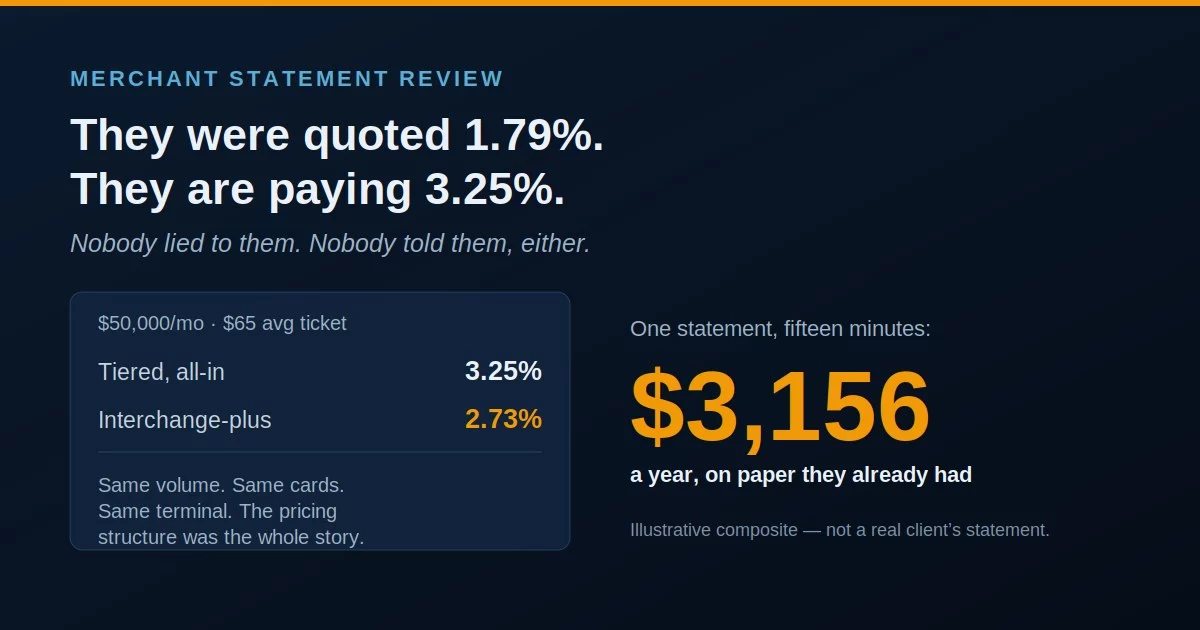
When they signed, they were quoted a 1.79% qualified rate. That’s the number they think they pay. It is not the number they pay.
What a Merchant Statement Review Finds First
This is the first thing a merchant statement review does: add up every line the way the statement never presents it — as one total, divided by one volume.
| Line item | Monthly |
|---|---|
| Discount — blended across qualified, mid-qualified, and non-qualified tiers (2.45%) | $1,225.00 |
| Authorization fee — $0.30 × 769 | $230.77 |
| "Network access" — $0.0295 × 769 | $22.69 |
| Monthly fees — statement, PCI, PCI non-compliance, monthly minimum, batch, gateway, IRS regulatory, terminal, annual fee | $148.60 |
| Total paid to the processor | $1,627.06 |
$1,627.06 divided by $50,000. Not 1.79%. The quoted rate described one tier on one kind of card — everything else on the statement was never part of the conversation.
The Same Merchant on Interchange-Plus
Here is where a merchant statement review earns its keep. Nothing about the business changes — same volume, same tickets, same cards, same terminal. Only the pricing structure changes — and now every line is either a real wholesale cost or one visible markup.
| Line item | Monthly |
|---|---|
| Interchange — passed straight through, no markup | $976.92 |
| Card brand assessments — passed straight through | $100.62 |
| Brookside markup — 0.40% + $0.08 | $266.54 |
| Monthly — PCI and gateway | $20.00 |
| Total | $1,364.08 |
Notice what’s gone: no tiers, no non-qualified surprise, no monthly minimum, no PCI non-compliance penalty, no "network access" line. And notice what’s still there — our markup, stated in one line, where you can argue with it. That’s the whole difference.
What the Statement Review Actually Changed
A merchant statement review almost never finds savings in a heroic rate negotiation. They came from deleting fees that were never a cost in the first place.
- The tiers. Non-qualified isn’t a card problem, it’s a pricing structure. On interchange-plus it stops existing.
- The junk fees. PCI non-compliance, monthly minimum, statement fee, "network access" — nearly $150 a month of pure margin, most of it avoidable.
- The markup became visible. Same profit, one line, negotiable. Nothing hidden inside a tier.
| Monthly savings | $262.98 |
| Annual savings | $3,155.82 |
The Rate You Remember Is Not the Rate You Pay
The single most useful thing a merchant statement review does is kill a number you have been carrying around. Most merchants keep an advertised rate in their head — Square is 2.6%, Stripe is 2.9% — and quietly assume that’s the cost. But an advertised rate has a fixed per-transaction fee bolted to it, and on a normal ticket that fee is worth real percentage points.
Those percentage points land hardest on a thin margin — see what the real rate is doing to your profit before deciding it is worth fixing.
Here is the same $50,000-a-month, $65-ticket merchant, priced every way:
| What they’d tell you | What you’d actually pay |
|---|---|
| Tiered processor — "1.79% qualified" | 3.25% |
| PayPal — "3.49% + 49¢" | 4.24% |
| Stripe — "2.9% + 30¢" | 3.36% |
| Square — "2.6% + 15¢" | 2.83% |
| Brookside — interchange + 0.40% + $0.08 | 2.73% |
That’s the honest comparison, and it’s the only one that matters: effective rate against effective rate. Not headline against headline.
If You’re Under $10,000 a Month, Stay on Square
A merchant statement review should also tell you when to walk away, so we’d rather say this now than waste your afternoon. Interchange-plus wins on volume, because the fixed monthly costs — PCI, gateway — don’t shrink when your volume does. Below roughly $10,000 a month they eat the advantage:
| Monthly volume | Effective rate on interchange-plus |
|---|---|
| $5,000 | 3.09% — worse than Square |
| $10,000 | 2.89% — roughly a wash |
| $25,000 | 2.77% |
| $50,000 | 2.73% |
| $100,000 | 2.71% |
Under $10,000 a month? Square’s flat rate and free tooling are genuinely the better deal, and we’ll tell you that on the phone. Over $10,000 and climbing? That’s where a real merchant account starts paying for itself, and where this review is worth your fifteen minutes.
What This Sample Assumes
Every rate depends on the business, which is why a merchant statement review uses your statement instead of an average. Here is exactly what is behind the numbers above — and what would change them.
- Interchange-plus pricing. These figures don’t describe flat-rate, tiered, or a fee-offset program like cash discount or dual pricing — those change the math entirely, and often for the better.
- Over $10,000 a month in card volume, and mostly card-present.
- A $65 average ticket. Smaller tickets push the effective rate up, because the fixed per-transaction fee is a bigger slice of a smaller sale.
- Interchange is a pass-through cost. It’s set by Visa and Mastercard, not by us, and nobody — including us — can discount it. You can read the published Visa interchange rates yourself. The only line any processor actually controls is the markup.
Your card mix, ticket size, and channel will move these numbers. That’s precisely why the review uses your statement instead of an average.
Send One Statement. Get This Back.
One recent processing statement is all a merchant statement review takes. We’ll calculate your true effective rate, itemize the fees that are markup rather than cost, and show you the same before-and-after with your own volume in it. It takes us about fifteen minutes.
- Lee reads it — not a call center, not a rep working a quota.
- Black out the account number if you like. We don’t need it to do the math.
- It isn’t shared with any processor, and it isn’t published. Ever.
- If the answer is "you’re already on a good deal," we say that and you owe us nothing.
No obligation • No pressure • Response within one business day