Electrical’s Two Payment Rhythms: The Service Call and the Staged Project
Electrical’s Two Payment Rhythms: The Service Call and the Staged Project
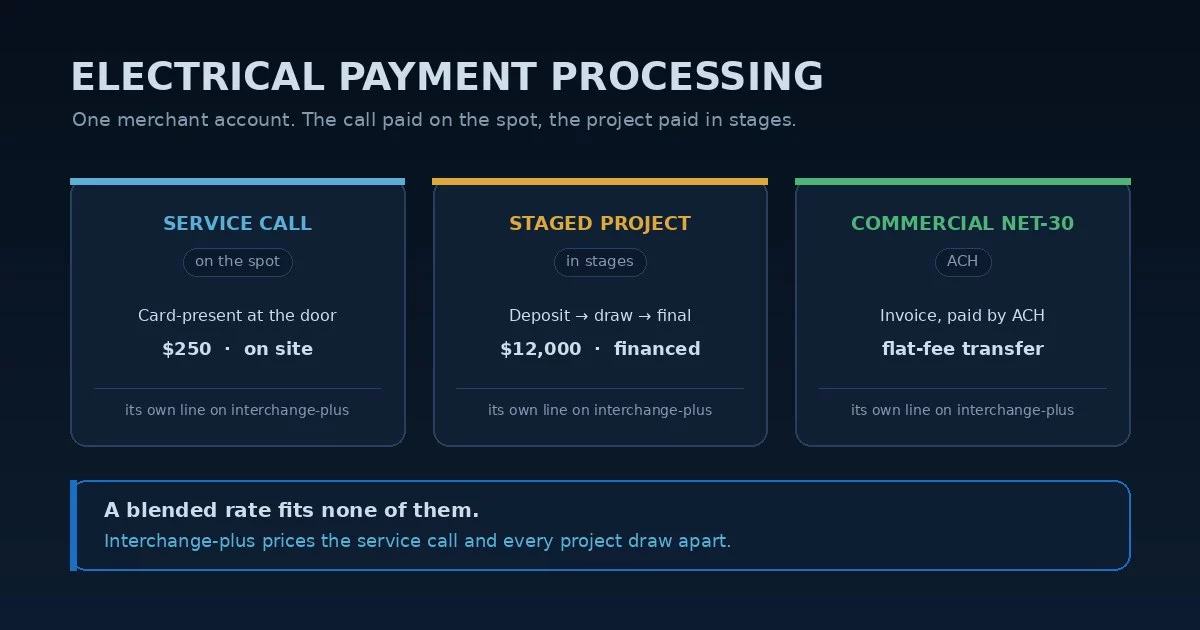
Electrical payment processing looks like a rate problem and is really a two-rhythm problem. An electrical company collects money two structurally different ways through the same account: the service call, paid on the spot — a troubleshoot, an outlet, a fixture, charged to a card at the door; and the staged project — a panel upgrade, a whole-home rewire, an EV charger, a backup generator — where the electrician floats five to fifteen thousand dollars in materials and gets paid in stages, a deposit up front, a progress draw at rough-in, and the balance after inspection. Those two rhythms cost a processor very different amounts to run, and a blended rate can only ever be tuned for one of them. The headline percentage your software quotes is built around one of those rhythms — and quietly overcharges the other — the half of electrical payment processing nobody quotes.
That single fact reshapes how an owner should think about the whole setup. Get electrical payment processing wrong and a rate that looks fine on a $250 service call is silently expensive on a $12,000 panel-and-EV job billed across three draws. Get it right and both rhythms are priced on what they actually cost, instead of an average that fits neither.
Your Electrical Software Usually Picks Your Processor
Most electrical payment processing decisions get made by accident. Almost every operator runs a field-service platform — ServiceTitan, Housecall Pro, Jobber, FieldEdge — and most ship with an integrated payments product that bundles card processing, consumer financing, and deposit-and-progress billing right into the app. ServiceTitan runs payments and financing inside the job and lifts ticket size on service upgrades and EV installs; Housecall Pro and FieldEdge bundle in-field collection, deposits, partial payments, and progress billing for multi-phase work. The convenience is real: the service call, the deposit, the progress draw, and the final invoice all reconcile inside one system.
The cost of that convenience is leverage. When the processor comes attached to the software, the rate is usually a single blended number, and you rarely get to shop it without the vendor’s blessing. It means your electrical payment processing rate was set by whoever your software vendor partnered with, not by you — and that same vendor now decides your financing offer and your surcharge tool too. As with any home services payment processing setup, the bundled processor is rarely the one you’d have chosen, and the only way to know whether the rate is fair is to put it next to an interchange-plus quote on your real volume.
A blended rate charges the same percentage on a $250 service call and on each draw of a $12,000 panel-and-EV project, even though those cost the processor very different amounts. Interchange-plus breaks out the network cost and the processor’s markup as separate lines — the only view that shows what each of your two rhythms actually costs.
The Service Call and the Staged Project Are Priced as One
Here is the structural problem at the center of electrical payment processing. The service call is mid-sized and high-frequency, taken card-present at the door, where the per-transaction fixed fee carries real weight. The staged project is the opposite: rare, but large, and split into a deposit, a progress draw, and a final — each one a separate charge where the percentage is everything and the fixed fee rounds to nothing. A blended rate is a single compromise stretched across both, so it is never actually right for either — it is set for one rhythm and merely tolerated on the other.
On interchange-plus, those two rhythms stop fighting each other. The card-present service call shows up on its own line, and each large-ticket draw on a financed project shows up on its own line, and you can read and shop each instead of trusting one number to cover both. For an electrical contractor running steady service volume alongside panel and EV work, separating the two is where electrical payment processing stops leaking. An electrical merchant account priced this way shows the two rhythms apart instead of burying them in a blend. Priced apart, electrical payment processing stops letting the service call subsidize the project, or the reverse.
A blended rate optimized for the $250 service call is quietly expensive on every draw of a $12,000 project; one tuned for the project overpays on every service call. There is no single percentage that is fair to both, which is exactly what a bundled blended price hides.
Where the Percentage Actually Bites
On the project side, a fraction of a percent stops being rounding — and it bites three times, once on each draw. A few points on a $12,000 panel-and-EV job, charged across a deposit, a progress payment, and a final, is real money every time, which is why the staged project is where electrical payment processing deserves the most attention. The levers here are the ones a bundled setup usually decides for you. Consumer financing lets a homeowner spread a rewire or an EV install over monthly payments while you get paid upfront — Affirm, Wisetack, and similar partners fire the offer inside the quote, and on electrification work it materially lifts how many jobs get approved instead of deferred.
Two more levers belong on the project side. On commercial and new-construction work invoiced net-30, paying by ACH bank transfer instead of card turns a percentage into a flat fee — a real saving on a five-figure draw. And surcharging passes the card cost to the customer on a large credit-card job, though it is state-regulated, capped, disclosure-bound, and never allowed on debit, so the rules matter; we keep those in the surcharge legality and dual-pricing guides. The point is that financing, ACH, and surcharging are real decisions worth making deliberately on the project side, not defaults your software flips for you. On the big ticket, electrical payment processing rewards a deliberate hand.
When the financing offer and the surcharge button both live inside your electrical software, they apply the vendor’s partner, rate, and rules — not necessarily the ones that fit your margin or your state. Financing, ACH, and surcharging are all legitimate big-ticket levers; the decision should be yours, not a default toggle.
You Float the Materials, So You Get Paid in Stages
The thing that makes a panel upgrade or a rewire different from a service call is the cash you front before the customer pays a dime, and electrical payment processing has to fit it. Materials get bought, a permit gets pulled, and the job runs for days or weeks before final inspection — so the money comes in a deposit at scheduling, a progress draw after rough-in, and the balance after inspection. A thirty-to-fifty-percent deposit stops you from floating the customer’s materials, a card on file carries the draws cleanly across the project, and card-present capture at the door beats keying a deposit in over the phone on both rate and risk. None of that requires a special account; it requires a rate structure that prices each draw honestly instead of burying it in a blend.
One classification detail is worth a look. An electrical contractor codes under MCC 1731, Electrical Contractors — a standard special-trade code, not a high-risk one. Confirming you’re coded as the contractor you are is a free check, since a miscode can carry the wrong interchange profile. But it’s standard-risk either way; nothing about electrical payment processing freezes accounts the way a true high-risk vertical can. The money is in the rate structure on top of the code, not the code itself — clean electrician payment processing on the service side and disciplined electrical credit card processing across every draw beat any code tweak.
What Actually Lowers an Electrical Company’s Card Cost
The levers that move electrical payment processing are structural, not a tenth of a percent on the swipe. Done right, electrical payment processing prices the service call and the staged project on separate terms instead of one blended average.
- Move to interchange-plus so the card-present service call and each draw of a financed project are priced on their true cost — the only model where a mid-ticket and a large-ticket draw aren’t forced under one number.
- Price the big ticket deliberately — decide financing, ACH on net-30 commercial work, and surcharging (where compliant) on the project side yourself, instead of letting your software’s defaults decide for you.
- Keep the processor shoppable — an electrical merchant account you control rather than one rented from your software — so the rate, the financing offer, and the surcharge tool all stay your call.
- Take a real deposit, card-present — a 30–50% deposit captured by tap or dip at the door, with a card on file for the draws, so you stop floating materials and stop paying keyed rates.
Electrical payment processing is a two-rhythm problem before it’s a rate problem. The owner who audits the whole account — the embedded rate, the card-present service calls, the deposit-and-draw project pricing, and the code underneath — almost always finds more in the parts that never appear on the quote than in the one number that does.
Frequently Asked Questions
Not necessarily. A bundled processor like ServiceTitan’s or Housecall Pro’s built-in payments is built for convenience and usually priced on a blended rate that averages your card types together. It may be competitive on small service calls, but the only way to know — especially across the draws on financed panel and EV projects, where electrical payment processing actually bites — is to compare it against an interchange-plus quote run on your real volume.
All three are legitimate on the project side. Financing lets a homeowner spread a panel upgrade or EV install over monthly payments while you get paid upfront; ACH bank transfer on a net-30 commercial draw turns a card percentage into a flat fee; and surcharging passes the card cost to the customer, though it’s state-regulated, capped, disclosure-bound, and never allowed on debit (see our surcharge-legality and dual-pricing guides). The point is to choose deliberately rather than let your software’s default decide.
No. Electrical codes under MCC 1731 (Electrical Contractors), a standard special-trade code, not a high-risk one — worth confirming you’re coded as the contractor you are. It’s standard-risk, so there’s no high-risk fork that freezes accounts. The savings come from pricing the service call and the staged project separately — the way electrical contractor payment processing should be run — not from a special account.
Send Your Statement. We’ll Price the Service Call and the Project Draws Apart.
If your processor came bundled with ServiceTitan, Housecall Pro, or another electrical platform, send Brookside one recent statement. We’ll break it into an interchange-plus view by card type, show you what the card-present service calls and the financed project draws are really costing, and lay out whether financing, ACH, or surcharging fits the project side. The review takes us about fifteen minutes. Learn more about payment processing consumer protections from the CFPB.
Send Your Statement for a Free ReviewNo obligation • No pressure • Response within one business day
See what a statement review looks like →