Catering Payment Processing: Why Restaurant Accounts Don’t Fit
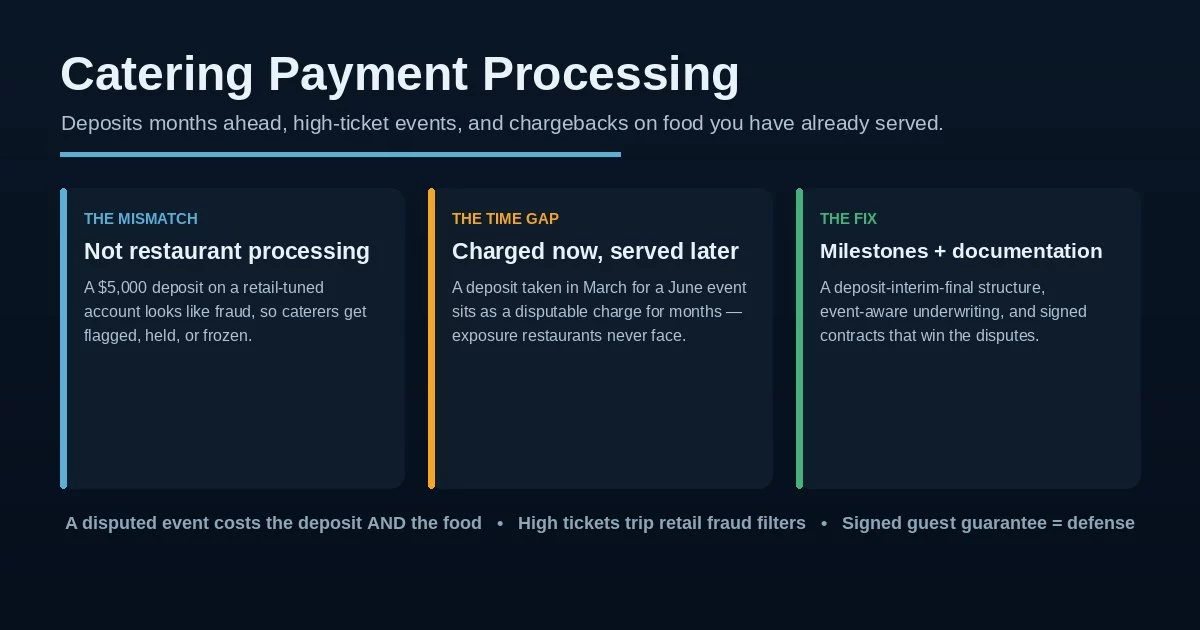
Why Standard Restaurant Processing Doesn’t Fit a Caterer
Catering payment processing gets miscast from the start. Because you serve food, you get lumped in with restaurants and handed a restaurant merchant account — but the money in a catering business moves nothing like the money in a restaurant. A restaurant runs a stream of small same-day tickets. A caterer takes a large deposit weeks or months before an event, collects a balance before the date, and may adjust the final bill afterward for guest count. That pattern is invisible to an account built for $50 dinner checks.
So the trouble starts at underwriting. When your average transaction is a $5,000 corporate event deposit instead of a $50 tab, a retail-tuned processor’s fraud systems read your perfectly normal sale as suspicious — and respond with holds, reserves, or a frozen account right when you need the funds to staff and source the event. The fix isn’t a workaround; it’s an account that expects catering’s shape. A catering merchant account underwritten for event-based, high-ticket, deposit-driven billing treats your business as normal instead of as a red flag. Sound catering payment processing begins by naming the business as event-based at underwriting, so the deposit pattern is expected.
Retail and restaurant accounts assume small, immediate, same-day transactions. Catering is the opposite: large tickets, paid in stages, often long before the food is served. A processor that never planned for that shape sees a five-figure deposit and reaches for the brakes — exactly the wrong response to a legitimate booking.
You’re Charged Now. You Deliver in Two Months.
This is the risk that makes catering payment processing genuinely different from almost any other food business. You collect money for a service you won’t deliver for weeks or months. A deposit taken in March for a June wedding sits on the books as a chargeable, disputable transaction the entire time — and a restaurant, which delivers the meal the moment it’s paid for, simply never carries that exposure. This future-delivery gap is the defining feature of catering payment processing. The longer the gap between payment and plate, the longer the window in which a client can dispute the charge.
And when a dispute or cancellation lands, the math is brutal. If a client cancels a booked event and disputes the deposit, you can lose the deposit you were contractually owed and eat the chargeback fee on top — after you may have already turned away other work for that date. That asymmetry is why documentation discipline matters more in catering than in nearly any other trade: a signed contract with a clear cancellation policy is the evidence that turns a winnable dispute into a win. Tools like Compelling Evidence 3.0 exist for exactly this, but only work if the paperwork was captured at booking. For a catering company, payment processing and dispute defense are the same discipline.
A cancelled, disputed event is not a normal refund. You can lose the deposit you were owed, pay the chargeback fee, and have already blocked the date against other bookings. Three losses from one event — which is why a signed contract and cancellation policy aren’t paperwork, they’re protection.
When the Final Count Doesn’t Match the Quote
Catering is priced per head against a guaranteed minimum, and the final number almost never matches the original quote exactly. Guests get added, menus change, service hours run long, and the final invoice lands higher than the deposit-era estimate. That gap is normal — and it’s also exactly what produces “this is more than we agreed to” disputes when the balance hits the client’s card. The work was delivered and the pricing was fair, but if the agreement lived in a verbal conversation, it’s your word against theirs.
The defense is to make the count and the terms explicit before the event. A signed contract that states the guaranteed minimum, the per-head rate, the policy for additions, and the service charges turns the final adjustment into a documented, agreed-upon number rather than a surprise. Pair that with an itemized final invoice — food, beverage, staffing, rentals, fees, deposit applied, balance due — and the client can see exactly what they’re paying for. Clear catering credit card processing isn’t just about the rate; it’s about charging amounts the client already agreed to in writing.
A guaranteed-minimum clause, a stated per-head rate, and a written policy for added guests convert the inevitable final-count adjustment into an agreement instead of an argument. The itemized final invoice is your receipt — and your dispute evidence if the charge is ever questioned.
What the Right Catering Setup Looks Like
The durable answer starts with milestone billing: a deposit at booking, an interim payment, and a final balance, rather than one large charge. That structure limits your exposure at every stage — if a client goes quiet, you’ve only committed resources proportional to what you’ve collected — and it spreads the chargeback risk across smaller, documented transactions. Pair it with a catering merchant account on interchange-plus pricing so the markup is a visible line you can audit, not a blended rate buried in a restaurant-style tiered plan. Run any quote through an effective rate calculator to see your true all-in cost.
From there, match the tools to how you actually collect: a virtual terminal to take deposits and balances by phone or online, and a mobile reader for day-of charges and on-site additions. For large corporate balances, ACH payment processing pulls a $15,000 balance straight from a bank account for a flat fee instead of a percentage — a meaningful saving at event-sized tickets. And on large card-paid events, a compliant cash discount or dual-pricing program can offset the processing cost that would otherwise eat into thin event margins. The whole point is an account that fits catering’s shape rather than fighting it. That is what event catering payment processing should deliver.
Event-aware underwriting that doesn’t freeze on a five-figure deposit, milestone billing that limits exposure, interchange-plus you can audit, ACH for big balances, and surcharge options for card payers — plus a processor that helps you fight invalid disputes with the documentation you captured at booking.
Staying Approved: And What to Ask Before You Sign
Keeping a catering account healthy comes down to the same discipline that wins disputes: a signed contract with cancellation and guest-guarantee terms, a documented final count, and an itemized invoice for every event. When a client does dispute, the chargeback process rewards the caterer who can show an agreed price and proof of service — and that same paper trail keeps friendly fraud from sticking after the event is over. Reliable catering payment processing is built on that documentation habit. Watch your calendar, too: wedding season and the year-end holidays spike your volume sharply, and a sudden jump in deposits on a thin processing history is a classic trigger for a processor to hold funds — a seasonal merchant account structure anticipates the surge instead of choking on it.
Whether you’re leaving a restaurant-style account or opening your first dedicated one, the questions are concrete. Will the processor underwrite event-based, high-ticket, deposit-driven billing — or treat every large deposit as a fraud flag? Is the pricing interchange-plus with the markup itemized, so your catering payment processing cost is auditable? Does the account support a virtual terminal, mobile day-of charges, and ACH for large balances? Will they help you fight invalid chargebacks with your documentation? And read the merchant agreement closely — reserve terms, rolling-reserve language, and early-termination fees matter most for a business with big tickets and long gaps between payment and delivery. Catering payment processing handled this way stops fighting your business model and starts protecting it. If you also run a fixed venue or a standing restaurant, our wedding venue payment processing and restaurant merchant services guides cover those models.
Frequently Asked Questions
Usually because you’re on an account built for restaurant or retail transactions, not catering. When your average ticket is a five-figure event deposit instead of a $50 check, a retail-tuned fraud system reads the large, advance payment as suspicious and responds with holds or reserves — the core reason catering credit card processing belongs on a purpose-built account. A catering merchant account underwritten for event-based, high-ticket, deposit-driven billing expects that pattern and treats it as normal — which is the real fix.
Document everything at booking and structure payments in milestones. A signed contract with a clear cancellation policy and guaranteed-guest-count terms is the evidence that wins a dispute, and breaking payment into deposit, interim, and final balance limits how much you’re exposed at any one point. Because catering collects money long before the service is delivered, that paper trail matters more here than in almost any other food business — without it, a cancelled event can cost you the deposit and the chargeback fee both.
For large balances — especially corporate events — ACH bank transfer is usually the cheaper choice. Pulling a $15,000 balance from a bank account typically costs a small flat fee rather than a percentage, which at event-sized tickets can save hundreds per event versus a card. Keep cards available for deposits and convenience, and consider a compliant surcharge or cash-discount program on card-paid events to offset the processing cost on the larger transactions.
Get a catering setup that won’t freeze on a five-figure deposit.
Send us a recent statement or your current setup and we’ll show you whether you’re on an account that could hold your deposits, whether milestone billing and ACH would cut your cost on large events, how to build the dispute defense in before the next cancellation, and what event-aware underwriting would look like — no obligation, no sales pressure. Learn more about payment processing consumer protections from the CFPB.
Review My Catering ProcessingNo obligation • No pressure • Response within one business day
See what a statement review looks like →