Cleaning Service Payment Processing: It’s All Card-Not-Present
A Cleaning Business Runs Almost Entirely Card-Not-Present
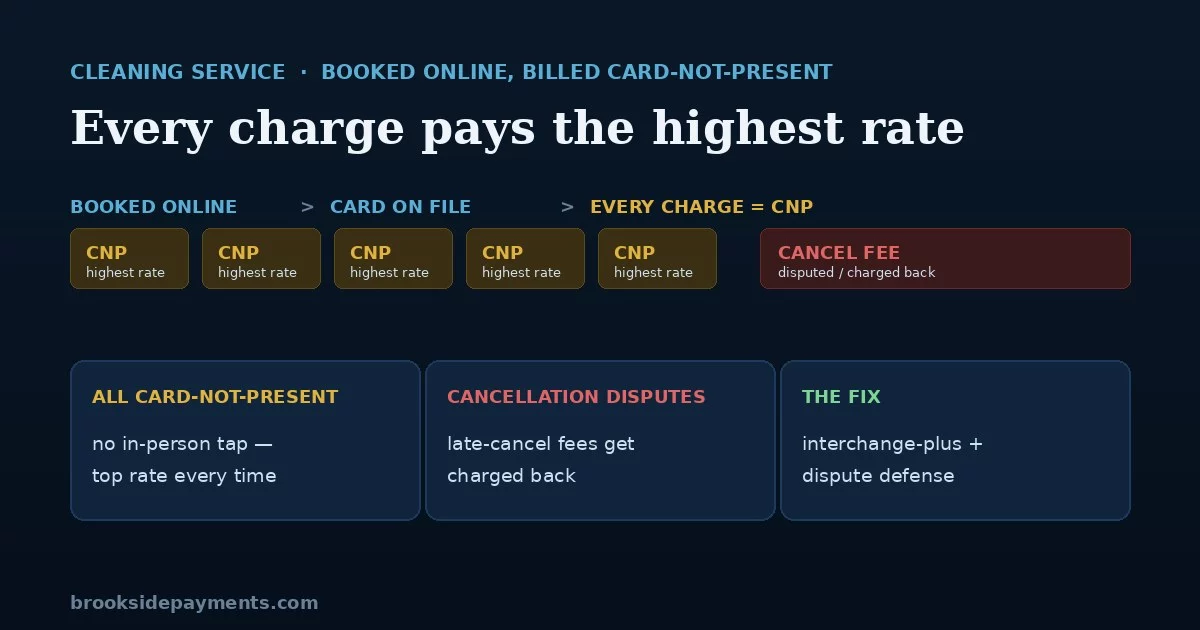
Cleaning service payment processing looks like a rate problem and is really a card-not-present problem. A maid service almost never touches a customer’s card: the job is booked on a website form, the card goes on file, and every clean after that is billed from that stored card while nobody is standing at a counter. There is no in-person tap to earn the cheaper card-present rate — so the entire business runs at the most expensive rate the networks charge, on every single transaction. The headline percentage your booking software quotes is built on top of that, and a flat blended price hides the fact that you never once get the lower rate — the half of cleaning service payment processing nobody quotes.
That single fact reshapes how an owner should think about the whole setup. Get cleaning service payment processing wrong and 100% of your revenue quietly pays the top rate, and the fees you most want to collect — late cancellations and no-shows — are the ones most likely to be disputed. Get it right and the same online-booking workflow runs cleaner and cheaper without changing a thing about how you clean a house.
Your Booking Software Usually Picks Your Processor
Most cleaning service payment processing decisions get made by accident. Almost every operator runs a cleaning service software platform — ZenMaid, Launch27, BookingKoala, Jobber — and the booking form that captures the card usually steers you straight to a flat-rate processor. ZenMaid integrates with Stripe, Square, and Authorize.net; Launch27 and the others lean the same way, and most owners simply take the default, which is a flat blended rate around 2.9% plus a fixed fee on every charge. The convenience is real: a client books, the card lands on file, and the recurring clean bills itself.
The cost of that convenience is leverage. A flat blended number is set by whoever the software partnered with, not by you — and because cleaning service payment processing is essentially all card-not-present, that flat rate applies to your entire volume with no cheaper transactions to average against. What most owners don’t realize is that an interchange-plus merchant account can sit behind the very same booking workflow through a gateway, so you keep the convenience and stop paying a flat retail rate on every job. As with any home services payment processing setup, the bundled default is rarely the cheapest option once you look.
A flat rate quotes one percentage and lets you assume it’s competitive. But interchange-plus breaks out the network cost and the processor’s markup as separate lines — and when every charge is card-not-present, that breakdown is the only way to see how much margin a flat retail rate is quietly taking on volume that never qualifies for a lower tier.
Every Charge Pays the Card-Not-Present Rate
Here is the structural fact at the center of cleaning service payment processing. A retail shop runs most of its cards in person, where the card-present rate is lowest; a cleaning company runs essentially none of them that way. The booking charge is keyed online, the recurring clean is billed from a card on file, the one-off deep clean is invoiced — all of it card-not-present, all of it at the higher rate, with more built-in dispute exposure than an in-person sale carries. There is no point in the workflow where you earn the cheaper rate, which means the card-not-present rate isn’t a slice of your cost; it is your cost.
Priced correctly, that doesn’t have to be a penalty. On interchange-plus the card-on-file rate is its own visible line, and you can see and shop exactly what your card-not-present volume costs instead of trusting a flat number to cover all of it. Because cleaning service payment processing has no cheaper stream hiding in the average, the savings from pricing the CNP volume honestly compound across every clean, every month.
A flat blended rate is built for a mix of card-present and card-not-present sales. Run a business that’s entirely card-not-present on that same flat number and you’re paying a blended average for a stream that never includes the cheap half — the markup hides in plain sight.
The Cancellation Fee You Keep Losing
The most frustrating cost in cleaning service payment processing isn’t a rate — it’s the fee you’re owed and can’t keep. When a client cancels at the last minute or isn’t home, you charge the agreed late-cancellation or no-show fee to the card on file, and a surprising share of those charges come back as disputes. The client tells their bank they cancelled, or that no service was performed, and because it’s a card-not-present charge with no signed receipt and nobody at a counter, the deck is stacked against you. A cancellation fee chargeback is the cleaning industry’s version of friendly fraud — a real charge the customer disputes anyway.
The defense is documentation, not luck. A clear written cancellation policy the client agrees to at the time of booking, a stored authorization on the card on file, and a billing descriptor that shows your recognizable business name rather than a holding-company string are what make the fee defensible when the bank asks. None of that is exotic; it’s the same evidence trail that turns a coin-flip dispute into one you can actually win — the unglamorous half of cleaning service payment processing that still keeps real money.
Customers rarely dispute a clean they were happy with — they dispute the cancellation fee, the no-show charge, the surprise on the statement. Those are exactly the charges where a written policy, a captured authorization, and a clear descriptor decide whether you keep the money or hand it back with a chargeback fee on top.
Tips, Descriptors, and the Code Underneath
Two smaller details round out cleaning service payment processing. The first is tipping: when clients add a gratuity through the card — at booking or after the clean — that tip runs as part of the card charge, so you pay processing on it and then have to route it to the cleaner through payroll. It’s minor per transaction, but on a recurring book of business it adds up, and it’s the kind of thing a flat rate quietly absorbs without you seeing it.
The second is your merchant category code. A residential cleaning or maid service codes under MCC 7349, Cleaning and Maintenance, Janitorial Services — a standard-risk classification, so unlike a high-risk vertical there’s no coding fork that freezes your account. That’s the reassuring part: nothing about cleaning service payment processing puts your account at risk by category. The whole opportunity is in the rate structure on top of the code — the all-card-not-present pricing and the dispute defense — not in the code itself.
What Actually Lowers a Cleaning Company’s Card Cost
The levers that move cleaning service payment processing are structural, not a tenth of a percent on the swipe.
- Move to interchange-plus so your all-card-not-present volume is priced on its true cost instead of a flat retail rate that assumes a card-present mix you don’t have.
- Keep the processor shoppable — a cleaning service merchant account you control behind the booking form (via a gateway) rather than whatever flat-rate default your software steers you to.
- Close the dispute leak with a written cancellation policy agreed at booking, a documented card-on-file authorization, and a recognizable billing descriptor, so cancellation and no-show fees actually stick.
- Handle tips deliberately so gratuity processing and payout are accounted for instead of quietly absorbed into a blended rate.
Cleaning service payment processing is a card-not-present problem before it’s a rate problem. The owner who audits the whole account — the embedded rate, the all-CNP volume, the cancellation-fee disputes, and the descriptor — almost always finds more in the parts that never appear on the quote than in the one number that does.
Frequently Asked Questions
Usually not. Tools like ZenMaid and Launch27 steer you to a flat-rate default (often Stripe at 2.9% + $0.30 or Square at 3.3% + $0.30 online), and because your volume is entirely card-not-present, that flat rate hits every charge. You can often keep the same booking workflow while running an interchange-plus merchant account behind it through a gateway — the only way to know the gap is to compare the two on your real volume, which is where cleaning service payment processing usually has the most slack.
Cleaning service payment processing makes these especially exposed: they’re card-not-present charges the customer can dispute as “I cancelled” or “no service performed,” and without an in-person record the bank often sides with them — it’s a form of friendly fraud. The defense is a written cancellation policy agreed at booking, a documented authorization on the card on file, and a recognizable billing descriptor, which together make a cancellation fee chargeback far easier to win.
No. A residential cleaning or maid service payment processing setup codes under MCC 7349 (Cleaning and Maintenance, Janitorial Services), a standard-risk classification with no high-risk fork that freezes accounts. The savings come from pricing your all-card-not-present volume on interchange-plus and shoring up dispute defense, not from a special account.
Send Your Statement. We’ll Show You What All-CNP Is Costing.
If your processor came bundled with ZenMaid, Launch27, or another booking platform, send Brookside one recent statement. We’ll break it into an interchange-plus view by card type, show you what your all-card-not-present volume is really costing against a flat rate, and flag where cancellation-fee disputes are leaking money. The review takes us about fifteen minutes. Learn more about payment processing consumer protections from the CFPB.
Send Your Statement for a Free ReviewNo obligation • No pressure • Response within one business day
See what a statement review looks like →