Dry Cleaner Payment Processing: You Do the Work First and Get Paid Second
You Do the Work First and Get Paid Second
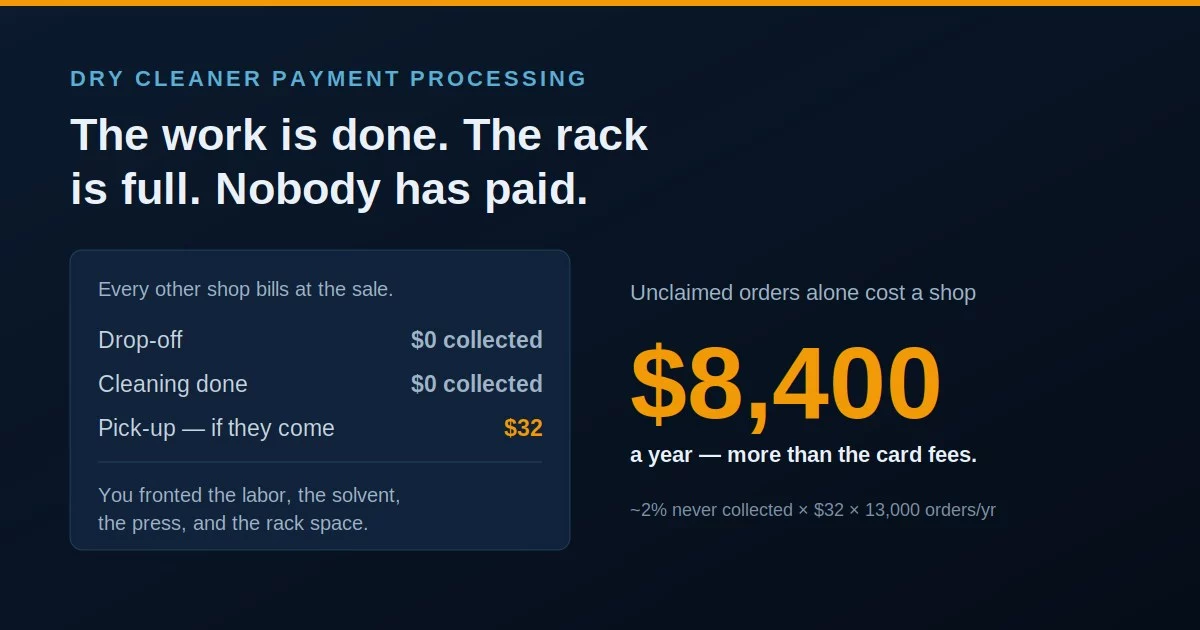
Almost every retail business collects at the moment of sale. A dry cleaner doesn’t. The customer hands you a suit on Tuesday, you clean it, press it, bag it, and hang it on the rack — and then you wait. You’ve spent the labor, the solvent, the machine time, and the rack space before a single dollar has moved.
That gap between doing the work and getting paid is the whole story of dry cleaner payment processing. Everything else — the rate, the terminal, the fees — matters less than the fact that your revenue is sitting on a rack, waiting for someone to remember it.
The Orders That Never Get Picked Up
This is where dry cleaner payment processing stops being about rates. Some customers don’t come back. They move, they forget, the shirt wasn’t that important. And the industry’s dirty secret is that this happens often enough to dwarf what you pay in card fees.
- 13,000 orders a year at a $32 average ticket
- Roughly 2% never collected — conservative; many shops run higher
- That’s about $8,400 a year of work you performed and were never paid for
- For comparison, the card fees on that entire year of volume run around $13,000
So the uncollected orders alone cost you close to two-thirds of your total processing bill — and unlike the processing bill, that money isn’t buying you anything. It’s pure loss, and it’s fixable with the payment setup rather than the rate.
Collect at Drop-Off, Not at Pick-Up
Good dry cleaner payment processing solves this without demanding cash up front and annoy your regulars. It’s to take the card at drop-off, store it securely, and charge it when the order is finished — which is exactly what a hotel does when you check in, and what your customer already expects everywhere else in their life.
- At drop-off, the card is captured and tokenized — you store a token, never the card number, so you’re not holding anything a thief would want.
- When the order is finished, you charge it and text the customer that it’s ready and paid.
- They come in, grab the bag, and leave. No line at the register, no fumbling for a card.
- The order that never gets picked up is still paid for.
That one change does more for a dry cleaner’s revenue than any rate negotiation, because it converts an entire category of loss into collected money.
A Stored Card Is Card-Not-Present: Price It That Way
Here’s the part of dry cleaner payment processing that surprises owners. When you charge a stored card after the customer has left the counter, that transaction is no longer a card-present swipe. It’s a card-not-present transaction, priced in the higher interchange tier, and it carries more chargeback exposure than a tap at the counter.
That is not a reason to avoid card-on-file. The economics still win by a mile — collecting 100% of a slightly more expensive transaction beats collecting 98% of a cheap one. But it means dry cleaner payment processing has to be priced for a card-not-present mix, and a shop that gets moved onto card-on-file without anyone adjusting the pricing will watch its effective rate climb and never know why.
Route Service Is a Subscription Wearing a Van
Route service changes dry cleaner payment processing again. If you run pickup and delivery, you’re not a retail shop anymore — you’re a recurring-billing business. The customer isn’t at a counter, there is no terminal, and the payment has to happen without anybody present. That’s card-on-file again, but now it’s every week, automatically.
Stored cards billed on a schedule, an account updater so an expired or reissued card doesn’t silently kill a weekly customer, and a dunning path for the declines that will happen anyway. A dry cleaner merchant account set up only for counter swipes will not do any of this.
On a $32 Ticket, the Fixed Fee Still Bites
With collection solved, the rate is worth a look. A dry cleaning ticket is small — $20 to $40 — which means the fixed per-transaction fee is doing real damage. On a $32 order, 2.9% + 30¢ comes to $1.23, an effective rate of 3.8%, and the flat 30¢ alone is nearly a full point of it.
Most shops on flat-rate or tiered pricing land near 3.5% to 3.8% blended. On interchange-plus pricing, dry cleaner payment processing typically lands around 2.9% to 3.2% all-in, even with a card-not-present-heavy mix. On 13,000 orders that gap is real money — just not as much as the orders you never collected on.
How to Fix Dry Cleaner Payment Processing
Fix dry cleaner payment processing by solving collection first. It’s worth more than the rate, and almost nobody works it in that order.
- Capture and tokenize the card at drop-off, and charge it when the order is finished.
- Text the customer that the order is ready and already paid — that alone lifts pickup rates.
- Put route customers on scheduled card-on-file billing, with an account updater behind it so a reissued card doesn’t quietly end a weekly route.
- Pull one statement and find your true effective rate, then move to interchange-plus — priced for the card-not-present mix that card-on-file creates.
Done in that order, a shop stops financing work it never gets paid for, and stops overpaying on the work it does.
Frequently Asked Questions
Yes. Capture and tokenize the card at drop-off, then charge it when the order is finished — the same way a hotel authorizes at check-in. You store a token, not a card number, and the customer gets a text saying the order is ready and paid.
Slightly — a stored card charged after the customer leaves is card-not-present, which sits in a higher interchange tier. But collecting 100% of a slightly pricier transaction beats collecting 98% of a cheap one. Just make sure your pricing is set for that mix.
Judge the effective rate, not the quote. On interchange-plus, a dry cleaner typically lands around 2.9% to 3.2% all-in. Because tickets are small, the fixed per-transaction fee matters as much as the percentage — on a $32 order, 30¢ is nearly a full point.
Send One Statement. We’ll Price the Whole Flow.
If you’re cleaning garments before you collect a dollar, the uncollected orders are costing you more than your processor is. Send Brookside one recent statement and we’ll show you your true effective rate, what a card-on-file setup would change, and how to price it for the card-not-present mix that comes with it. About fifteen minutes. Learn more about payment processing consumer protections from the CFPB.
Send Your Statement for a Free ReviewNo obligation • No pressure • Response within one business day
See what a statement review looks like →