The Mastercard Force Post Fee: A New $0.09 Charge for Clearing Without Authorization
Mastercard Now Charges You Every Time a Sale Clears Without an Authorization
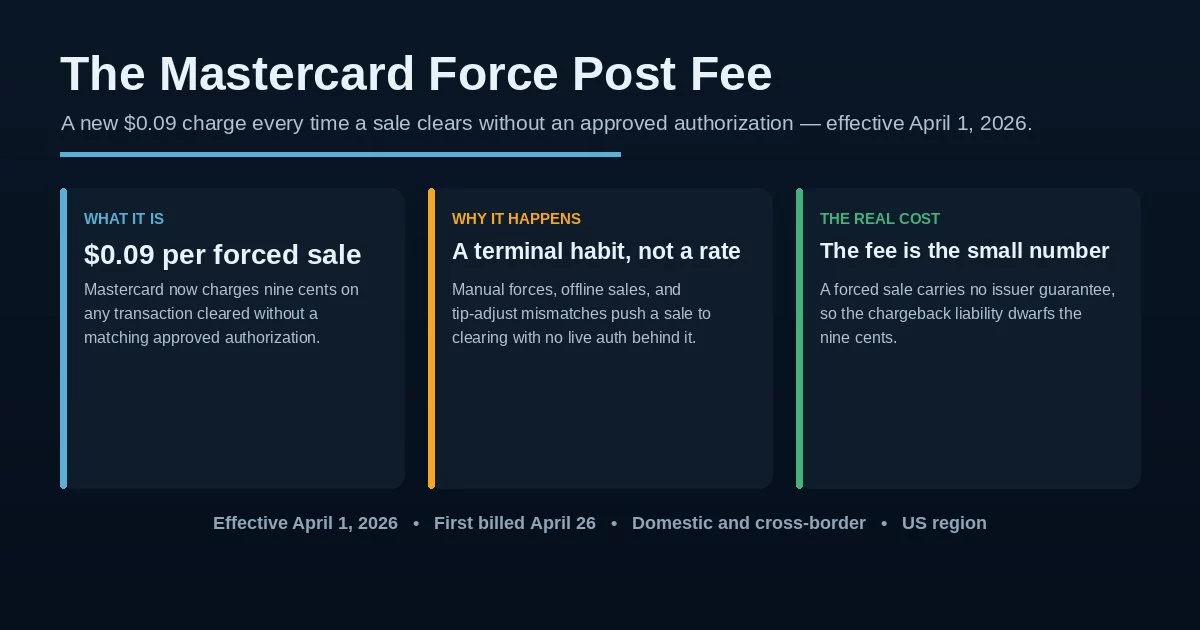
As of April 1, 2026, there is a new Mastercard force post fee: nine cents on every transaction that clears without an approved authorization behind it. It is a small number per sale, and it is easy to miss on a statement — but it is also a signal. A force post fee shows up when your payment setup is pushing transactions through to settlement that the card issuer never actually approved in real time, and that is worth understanding before the line item quietly grows.
Mastercard first started billing the fee on April 26, 2026, and it applies in the US region to both domestic and cross-border transactions. The fee itself is the cheap part. What it is really flagging is a habit — a terminal, a gateway, or a workflow that is clearing sales without a matching authorization — and that habit carries a much larger cost than nine cents, which is the part this post is really about.
A normal card sale authorizes first — the issuer approves the amount in real time — and then clears for settlement. A force post skips that: the transaction is submitted for clearing without a matching approved authorization. Mastercard assesses the fee on any first-presentment clearing transaction it cannot match to a preceding authorization.
The Real Causes of a Forced Transaction
A force post transaction is almost never something a merchant does on purpose. It is a byproduct of how the terminal or workflow is set up, and it usually traces to one of a few causes. The most common is a manual force or override — an authorization was declined or never obtained, and someone keyed the sale through anyway using a force/override function on the terminal. Another is offline or store-and-forward acceptance, where a terminal takes a card with no live connection and submits it later; if it never goes back for a real authorization, it clears as a force post.
The subtler causes are amount mismatches. A tip adjustment, a partial shipment, or any change to the amount after the original authorization can break the match between the auth and the clearing record — and a broken match is a force post in Mastercard’s eyes. Expired authorizations that get re-submitted instead of re-authorized do the same thing. In each case the Mastercard force post fee is the symptom; the cause is a terminal, gateway, or habit that is letting sales reach settlement without a clean authorization attached.
Manual force/override after a decline; offline or store-and-forward sales that never re-authorize; tip adjustments and amount changes that break the auth match; and expired authorizations re-sent instead of re-run. If you see force post transaction fees on a statement, one of these is happening somewhere in your flow.
The Fee Is the Small Number. The Liability Is the Large One.
Nine cents a transaction will not break a business. If the force post fee were the whole story, it would be a rounding error. It is not the whole story. The reason a forced transaction is risky is that it cleared without the issuer ever approving it — which means it carries no authorization guarantee. When a customer later disputes a forced sale, you have no approval code to stand on, and the chargeback process tilts hard against the merchant who forced it through.
That is the real exposure. A normal authorized sale gives you a defensible position in a dispute; a forced one strips that away and shifts the liability squarely onto you. The fee is best read as a smoke alarm: Mastercard is charging nine cents to point at transactions that are also your weakest in a chargeback, and that compounds with the broader tightening of dispute rules under the latest chargeback program changes. The cost of ignoring force posts is not the line item — it is the disputes you cannot win.
No authorization means no issuer guarantee. If a forced transaction is disputed, you are defending a sale the card network never approved — the hardest possible chargeback to win. A run of force posts is a run of transactions you would lose if challenged, which is a far bigger number than nine cents each.
Fixing Force Posts Is a Terminal and Habit Problem, Not a Pricing One
Because the fee is a symptom, you do not negotiate it away — you fix what is producing it. Start with the rule Mastercard itself states: always obtain an approved authorization before submitting a transaction for clearing. In practice that means turning off or tightly restricting the manual force/override function on your terminals so a declined card cannot simply be pushed through, and making sure any offline or store-and-forward acceptance is configured to go back for a real authorization rather than clearing blind. If you run tip adjustments, confirm your setup re-authorizes or properly links the adjusted amount so the match holds.
Then verify it on the statement. Pull a recent one, find the force post transaction fees, and trace each back to the terminal or workflow that produced it — our guide to reading your merchant processing statement shows where these land. The goal is zero, not a lower rate: a clean account should rarely if ever force a post. And while you are auditing fees, it is worth confirming the rest of your pricing is transparent — interchange-plus pricing run against an effective rate calculator tells you whether the force post fee is the only thing worth questioning on the statement.
Authorize before you clear. Restrict manual force on the terminal, make offline sales re-authorize, keep tip-adjust amounts linked to the original auth, and reconcile the statement to zero force posts. It is a configuration-and-habit fix, and it removes both the force post fee and the dispute exposure behind it.
The Force Post Fee Arrived Alongside Several Others
The Mastercard force post fee did not show up alone. It landed in the April 2026 network release — the spring half of the twice-a-year cycle in which Visa, Mastercard, Discover, and Amex revise their fee schedules. The same release changed how Mastercard assesses its mail and telephone order fee (now calculated on authorization volume rather than just cleared volume, which sweeps in declined attempts) and added a $75 cap on that fee for declined transactions over $500, among other adjustments.
The practical takeaway is that April and October are the two windows when new line items appear on your statement, and a forced-transaction charge is exactly the kind of thing that slips in unexamined. If your effective rate crept up this spring, the force post fee may be one small piece of a larger set of changes — the same dynamic we cover in why your processor’s rate went up. The next release lands in October 2026; reading the statement after each one is how you catch these before they compound.
Frequently Asked Questions
It’s a $0.09-per-transaction fee Mastercard introduced effective April 1, 2026 (first billed April 26), assessed on any transaction that clears without a matching approved authorization. A normal sale authorizes in real time and then clears; a force post skips the approval and goes straight to clearing, and Mastercard charges the fee on first-presentment clearing records it can’t match to a preceding authorization. It applies in the US to both domestic and cross-border transactions.
Because something in your setup is clearing sales without a live authorization. The usual causes are a manual force or override after a declined card, offline or store-and-forward acceptance that never re-authorizes, or a tip adjustment or amount change that breaks the link between the authorization and the clearing record. The fee is a symptom — it points at transactions that are also the hardest to defend if they’re ever disputed.
Authorize before you clear. Restrict the manual force/override function on your terminals so a declined card can’t be pushed through, configure any offline acceptance to obtain a real authorization, and make sure tip adjustments stay linked to the original auth. Then check your statement, find the force post line items, and trace each to the terminal or workflow that caused it. A clean setup should almost never force a post, so the target is zero, not a lower rate.
Send your statement. We’ll find the force posts and tell you which terminal is causing them.
Force post fees are small, but they point at your most disputable transactions. Send us a recent statement and we’ll flag every force post line item, trace it to the terminal or workflow producing it, and show you the configuration change that removes both the fee and the chargeback exposure behind it — no obligation, no sales pressure. Learn more about payment processing consumer protections from the CFPB.
Review My Statement for Force PostsNo obligation • No pressure • Response within one business day
See what a statement review looks like →