Interchange Rates by Industry
Interchange is the wholesale cost of accepting a card — what your processor pays the bank that issued your customer’s card, before any markup. Visa and Mastercard publish it twice a year, and it varies by business type. Below are the current interchange rates by industry, transcribed straight from the networks’ own fee schedules.
Visa effective 2026-04-18 · Mastercard effective 2026-04-17 · consumer credit, card present unless noted.
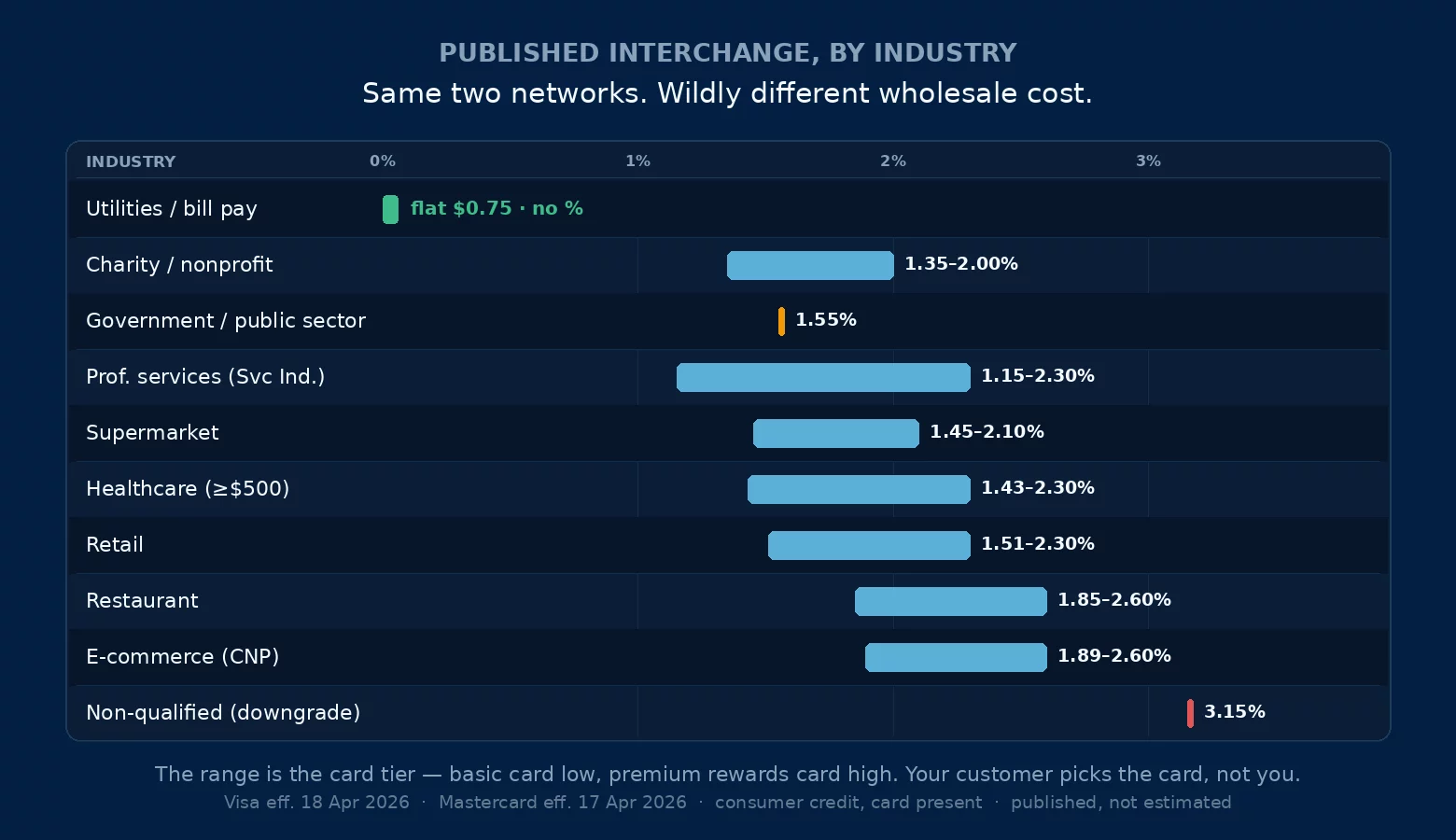
Published Interchange Rates by Industry — Visa and Mastercard
These are the published interchange rates by industry — the wholesale figure the card networks set for each merchant category. They are ranges because interchange varies by card tier — a basic card sits at the low end, a premium rewards card at the high end, and your customer chooses which card to use, not you.
| Industry | Published interchange | Networks |
|---|---|---|
| Supermarket / grocery | 1.45–2.10% + $0.10 | Visa+MC |
| Retail / general merchandise | 1.51–2.30% + $0.10 | Visa+MC |
| Restaurant, bar, cafe | 1.85–2.60% + $0.10 · no fixed fee | Visa+MC |
| Small ticket (avg sale under $15) | 1.65–2.30% + $0.02 | Visa+MC |
| Fuel / service station | 1.15–2.00% + $0.25 · $1.10 cap | Visa+MC |
| Professional services (trades, legal, accounting) | 1.15–2.30% + $0.10 · txns ≥ $100 | Visa+MC |
| Healthcare, dental, veterinary | 1.43–2.30% + $0.05 · txns ≥ $500 | Visa |
| Education / childcare | 1.43–2.15% + $0.10 · txns ≥ $500 | Visa+MC |
| Insurance | 1.43–2.25% + $0.05 | Visa+MC |
| Real estate | 1.43–2.20% + $0.05 · txns ≥ $500 | Visa+MC |
| Hotel / lodging / travel | 1.65–2.55% + $0.10 | Visa+MC |
| Government / public sector | 1.55–1.55% + $0.10 | Visa+MC |
| Nonprofit / charity | 1.35–2.00% + $0.10 | Visa+MC |
| Utilities / recurring bill pay | flat $0.75 0% — no percentage | MC |
| E-commerce / card-not-present | 1.89–2.60% + $0.10 | Visa+MC |
The range is the interchange itself. On top of it sit network assessments (a fraction of a percent, set by the networks, not published in these schedules) and then your processor’s markup — the only part that is negotiable. A rate quoted to you well above the top of your row is not the cost of accepting cards. It is markup. Card-not-present transactions generally run higher than the card-present figures shown; the two rows marked CNP are already card-not-present.
Under $280,000 a Year, Visa Charges You Less — and Your Processor May Be Keeping It
Visa publishes a Small Merchant Fee Program: businesses under roughly $280,000 in annual Visa consumer-credit sales qualify for lower interchange than the standard rates above. Standard retail interchange runs about 1.51–2.30%; the small-merchant equivalent runs closer to 1.29–1.88%.
This matters for two reasons. First, it covers most small businesses. Second — and this is the part that costs money — a merchant on flat-rate or tiered pricing never sees that discount. The lower interchange goes to the processor, not the merchant, because flat and tiered pricing don’t pass interchange through. Only interchange-plus pricing hands you the wholesale rate you actually qualified for. Mastercard, for what it’s worth, has no small-merchant equivalent — its rates only go down as volume goes up.
What Interchange Rates by Industry Tell You That a Sales Rep Won’t
1. Utilities and recurring bill payments have no percentage at all. Visa and Mastercard both price a consumer utility payment at a flat $0.75, zero percent. So if you run an HOA, a municipal billing portal or a property-management operation and you are paying a percentage to accept payments, that percentage is markup on a cost that has no percentage in it. See how that gap plays out across billing software.
2. The “downgrade” rate is the same on both networks: 3.15% + $0.10. When a transaction fails to meet the requirements for its category — missing data, late settlement, a keyed card — it drops to the non-qualified rate, and that rate is identical on Visa and Mastercard for a basic card and a premium card alike. This is the mechanism behind tiered pricing: a processor advertises a low “qualified” rate, then routes much of your volume to this one. How downgrades work →
3. The cheapest published rates aren’t available to you. The lowest tiers in the networks’ schedules require hundreds of millions to billions of dollars in annual volume. When a competitor advertises “rates as low as 1.15%,” that number belongs to a merchant processing $750 million a year. For a real small business, the base rates in the table above are the honest floor.
These Rates Are Republished Every April and October
Interchange is not fixed. Visa and Mastercard publish updated schedules twice a year, in April and October, and they announce the changes in advance. This page of interchange rates by industry reflects the 2026 April schedules. If your processing rate changed in some other month, interchange is not the reason — and that distinction is how you tell a real interchange change from a markup increase.
Frequently Asked Questions
Because interchange varies by card tier within each industry. A basic consumer card sits at the low end of the range and a premium rewards or business card at the high end. The merchant does not choose which card the customer presents, so the honest figure is the range, not a single rate.
Not exactly — interchange is the wholesale cost, and no processor sells at cost. On top of it sit network assessments and the processor’s markup. But on interchange-plus pricing you pay interchange plus a disclosed markup, so you can see the wholesale rate and judge the markup separately. On flat-rate or tiered pricing, the whole thing is bundled and the interchange is invisible.
No. This table covers Visa and Mastercard consumer credit, which is the large majority of most merchants’ card volume. Discover and American Express (including OptBlue) publish separately and are not included here.
See where your own rate sits against these numbers.
Send one processing statement and we will calculate your true effective rate, then measure it against the published interchange for your industry — showing you in writing which part is wholesale cost and which part is markup. If your pricing is already fair, we say so and you owe nothing. Or run it yourself first with the effective rate calculator, which now shows your industry’s interchange floor as you type.
Get Your Free Statement ReviewNo obligation • No pressure • Response within one business day