Visa Publishes Lower Interchange for Small Businesses. Your Processor Never Mentioned It.
Small Business Interchange Rates Are Published. They Are Lower. And You May Not Be Getting Them.
Small business interchange rates are not the same as everyone else’s — Visa publishes a separate, lower schedule for merchants under $280,000 in annual Visa consumer credit sales. It is called the Small Merchant Fee Program, it sits on page 10 of the same public PDF that lists every other Visa interchange rate, and it covers a threshold most independent businesses never cross.
Here is the part almost nobody tells you: qualifying for lower small business interchange rates and benefiting from them are two different things. Interchange is the wholesale cost of a card transaction — the part that goes to the bank that issued your customer’s card. When Visa lowers your wholesale cost, someone captures that saving. Whether it is you or your processor depends entirely on your pricing model.
This post covers what the program is, what the published bands look like, the math on a real volume, and the one structural reason a flat-rate or tiered merchant captures none of it.
What Visa’s Small Merchant Fee Program Actually Says
The Visa small merchant fee program appears in the Visa USA Interchange Reimbursement Fees schedule, effective April 18, 2026 — the same document that sets small business interchange rates and everyone else’s. The qualifying line is annual Visa consumer credit volume under $280,000. Below it, Visa publishes a parallel set of rate bands that run materially lower than the standard schedule.
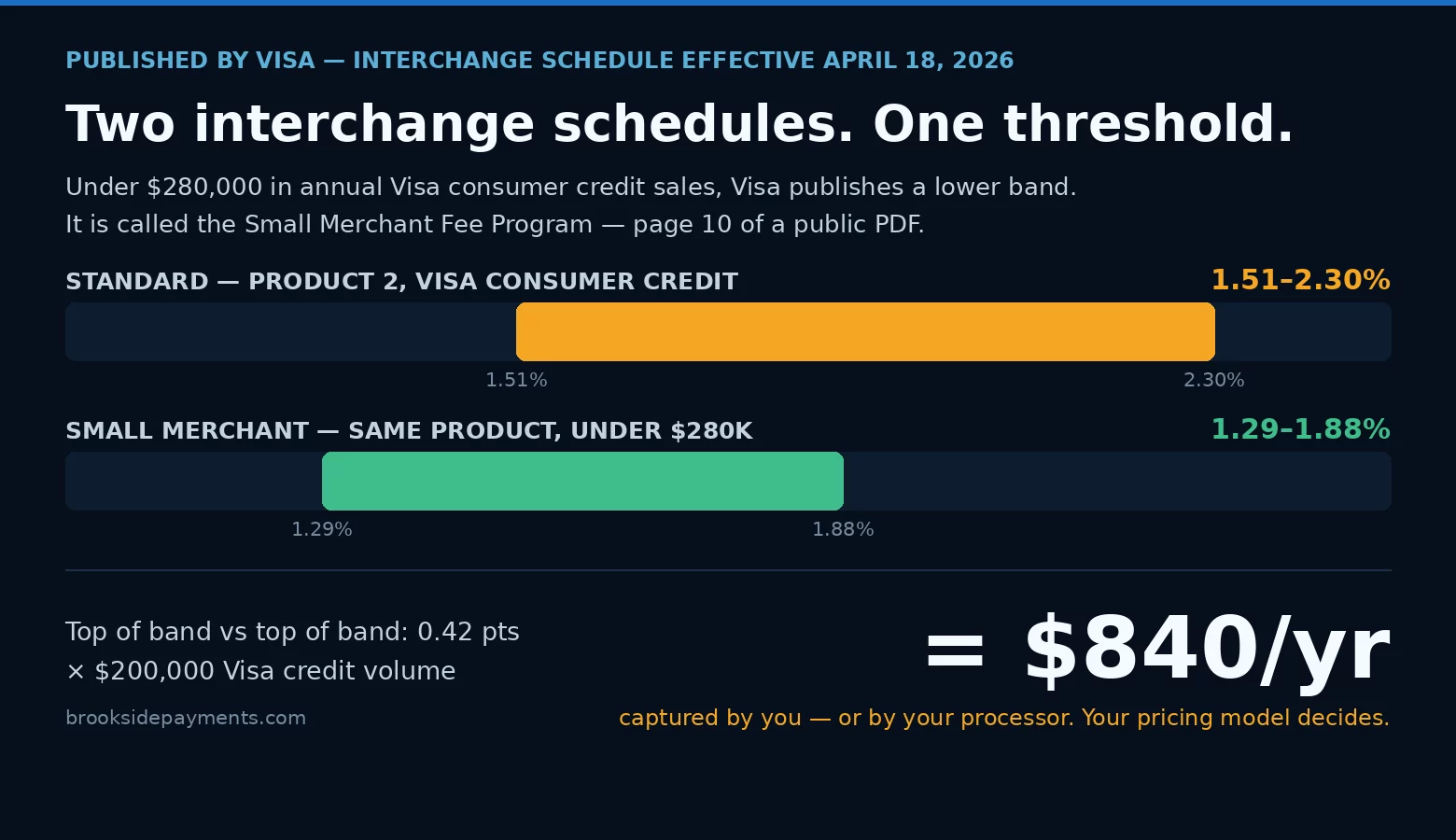
One like-for-like example from the schedule: for the same product tier (Visa’s Product 2 consumer credit), the small merchant interchange band runs 1.29–1.88% where the standard band runs 1.51–2.30%. The spread between the tops of those two bands is 0.42 percentage points — on the identical card, the identical transaction, the only difference being the size of the business accepting it.
Two boundaries matter before any math. First, the program is Visa consumer credit — it does not touch debit, and it does not touch the other networks. Second, the bands vary by program and category the same way all interchange does, which is why this post quotes ranges from the schedule rather than republishing the table. The source document is linked in the footnote at the bottom of this page; the rates in it are republished every April and October.
Published band 1.51–2.30% on Visa consumer credit. This is the schedule every merchant is assumed to be on — and the one most rate quotes are silently built against.
Published band 1.29–1.88% on the same Visa consumer credit, for merchants under $280,000 in annual Visa consumer credit sales. Same card, same transaction, lower wholesale cost.
Why Flat-Rate and Tiered Merchants Capture None of the Discount
This is the structural point, and it is the reason small business interchange rates are worth a whole post rather than a footnote. Your pricing model decides whether small business interchange rates ever reach you at all.
On flat-rate pricing, you pay one advertised rate no matter what the underlying interchange is. A typical rate of 2.9% plus a typical fixed fee of $0.30 on an online or invoiced sale does not move when Visa cuts your wholesale cost by 42 basis points — the platform’s price is the platform’s price. The interchange discount is real, it is being applied at the network level, and every cent of it widens the platform’s margin instead of narrowing your bill. Tiered pricing works the same way: the qualified, mid-qualified and non-qualified buckets are the processor’s invention, and nothing obligates them to move when interchange does.
On interchange-plus pricing, interchange is a pass-through line. When your wholesale cost drops, your statement drops with it, automatically, because the markup is the only fixed part. Lower small business interchange rates flow to exactly one kind of merchant: the one whose pricing passes interchange through.
So the program creates a quiet asymmetry across the small-business economy. The merchants most likely to qualify — independent shops, service businesses, professional practices under $280,000 in Visa credit volume — are also the merchants most likely to be on flat-rate apps or tiered legacy accounts. The discount aimed at them is collected, in bulk, by their processors.
Only Visa Does This — Which Makes Your Statement Stranger
Small business interchange rates are also a one-network story. Mastercard publishes no equivalent small-merchant program in its interchange schedule (effective April 17, 2026). The two networks price the same swipe differently for a qualifying business: on a small merchant interchange schedule, your Visa consumer credit cost can sit materially below your Mastercard cost for the same sale at the same counter.
That asymmetry is invisible on a flat-rate or tiered statement, because those statements never show you interchange at all. On an interchange-plus statement it is visible line by line — and it is one of the quickest honesty checks in a statement review: if a sub-$280K merchant on a retail schedule has Visa credit interchange lines that are not running below their Mastercard lines, something in the setup is not passing the program through. Outside retail that test does not hold — on some categories Mastercard is legitimately the cheaper network, which the next section covers.
On Some Categories, Mastercard Is the Cheaper Network
The asymmetry does not run one way. Visa’s small merchant program is real, but it is a retail-schedule program — and outside retail, the comparison can invert. Measured top of band against top of band on a $50 ticket, with per-transaction fees included:
| Category | Visa | Mastercard | Difference |
|---|---|---|---|
| Retail / Product 2 | 2.50% | 2.50% | Even |
| Non-qualified downgrade | 3.35% | 3.35% | Even |
| Supermarket | 2.14% | 2.30% | Visa lower by 0.16 |
| Small ticket | 2.20% | 2.34% | Visa lower by 0.14 |
| Restaurant* | 2.60% | 2.20% | Mastercard lower by 0.40 |
| Services | 2.50% | 1.25% | Mastercard lower by 1.25 |
*The Mastercard restaurant rate shown applies to its World tier and above. Every figure is consumer credit, card present, top of the published band, from the Visa schedule effective April 18, 2026 and the Mastercard schedule effective April 17, 2026.
The widest gap is not Visa’s discount at all. Mastercard prices Service Industries at 1.15% + $0.05 across every card tier — basic card, premium rewards card, no difference — while the comparable Visa services rate tops out at 2.30% + $0.10. That is a 1.25-point spread in Mastercard’s favor, three times what the small merchant discount is worth in retail.
Which is the part that matters for pricing. A merchant on flat-rate or tiered pricing pays one blended rate no matter which card is tapped, so neither difference ever reaches them — not Visa’s small merchant discount in retail, and not Mastercard’s services rate. Both are collected by the processor. Only interchange-plus pricing makes either one visible.
What the Discount Is Worth on a Real Volume
Take a business running $200,000 a year in Visa consumer credit sales — comfortably inside small business interchange rates territory. Measured conservatively, top of band against top of band: the standard schedule tops out at 2.30% and the small merchant schedule at 1.88%. That 0.42-point spread on $200,000 is $840 a year — on the Visa consumer credit slice alone, before a single fee is negotiated.
The assumptions, stated plainly: the figure covers only Visa consumer credit volume (not debit, not Mastercard, not American Express or Discover); it compares the conservative top of each published band, so a real card mix can only do better against it; and interchange is the wholesale floor, not your all-in rate — a fair interchange-plus setup still lands around 2.9–3.2% all-in for a small-ticket business once markup and fixed fees are counted. The point of the $840 is not that your bill drops by exactly that number. The point is that Visa already granted the reduction — and on the wrong pricing model, it never reaches you.
The honest caveat runs the other direction too. If you process under about $10,000 a month, a flat-rate app is often still the right answer overall — monthly fees on a real merchant account can eat a discount this size. Small business interchange rates change the math most for the merchant in the middle: big enough that 42 basis points is real money, small enough to sit under $280,000 in Visa credit volume.
Frequently Asked Questions
No — qualification is based on your annual Visa consumer credit volume, not an application you file. But qualifying only changes your cost if your pricing passes interchange through. On flat-rate or tiered pricing, your price is fixed regardless of what interchange does underneath it.
No. The program covers Visa consumer credit only — not debit, not Mastercard (which publishes no equivalent), not American Express or Discover. Honest math applies the discount to your Visa credit slice, which is why this post works from $200,000 of Visa credit volume rather than total sales.
Your statement is the only place the answer exists. An interchange-plus statement itemizes interchange by program, so small business interchange rates are visible directly on the page. A flat-rate or tiered statement hides interchange entirely — which usually is the answer: if you cannot see it, you are not receiving it.
Find out who is pocketing your discount.
If your Visa consumer credit volume runs under $280,000 a year, Visa has already priced your transactions lower. Send one processing statement and we will show you whether that discount is reaching you: your true effective rate, which lines are pass-through interchange and which are markup, and what the same volume costs when small business interchange rates flow through instead of stopping at the processor — in writing, with the dollar difference. If your pricing is already competitive, we say so and you owe nothing. Card fee rules and consumer protections are covered by the CFPB.
Get Your Free Statement ReviewNo obligation • No pressure • Response within one business day
See what a statement review looks like →