Debit Routing Is the Part of Every Debit Transaction Your Processor Controls
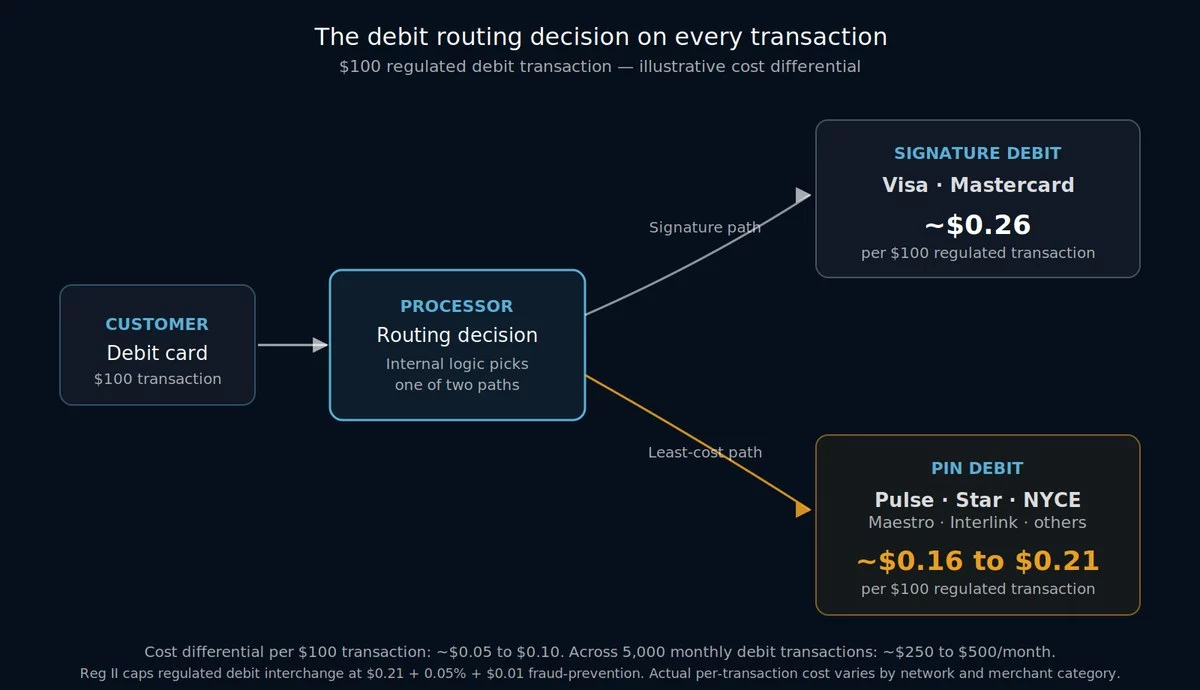
Debit Routing Is the Part of Every Debit Transaction Your Processor Controls and You Almost Never See.
Every debit card transaction in the United States has at least two possible networks that can carry it. Visa and Mastercard each run a signature debit network. Behind them sit the PIN debit networks — Pulse, Star, NYCE, Accel, Shazam, Maestro, Interlink, and around a dozen others. Most debit cards in your customers’ wallets are enabled on at least two of those networks. Which one carries the transaction is called debit routing, and the choice usually belongs to your processor, not to you.
You will not see it on a marketing brochure. You will rarely see it discussed by your sales rep. You will almost certainly see its consequences on your processing statement — but if you do not know what to look for, the cost is invisible to you and entirely visible to your processor.
This is a piece about what the practice actually is, why a 2010 federal law made it a merchant right, what your processor’s choices cost you in basis points, and how the recent Capital One acquisition of Discover reshuffled the routing competitive landscape in ways that are still working through the system. The piece is analytical, not transactional. By the end you should be able to ask your processor one specific question that most merchants never think to ask.
The decision happens inside the authorization request, in microseconds, between your terminal and your processor’s gateway. The merchant never sees the routing choice. The statement shows the final interchange charge, not the network that produced it. Routing is by design a back-end mechanic — and that design is what makes the cost effectively unauditable from the merchant side.
Durbin and Reg II: Why Every Debit Card Has at Least Two Networks
The Durbin Amendment passed as part of the 2010 Dodd-Frank Act. Two of its provisions matter for debit routing. First, it capped the interchange rate that large banks (over $10 billion in assets) can charge merchants on regulated debit transactions: $0.21 plus 0.05 percent of the transaction, plus a $0.01 fraud-prevention adjustment for issuers that meet the Federal Reserve’s standards. That cap has held since 2011 and has not been adjusted for inflation. Second — and this is the routing provision — Durbin required that every debit card be enabled on at least two unaffiliated networks, and gave merchants the legal right to choose which network the transaction is routed over.
The Federal Reserve implemented Durbin through what is called Regulation II, or Reg II. The “two unaffiliated networks” rule is the structural foundation of network competition in the United States. Without it, Visa and Mastercard could have locked debit cards to a single signature network and the merchant choice would not exist. With it, every debit card sold by every covered bank must carry a second network — typically a PIN debit network like Pulse, Star, or NYCE — and the merchant has the right to direct the transaction over whichever option costs less.
The legal right is the merchant’s. The operational mechanism for exercising that right is debit logic at the processor or gateway level. In practice, almost no merchant configures their own debit routing. The processor decides. And the processor’s decision is shaped by its own economics, which are not always aligned with yours.
Reg II’s interchange cap applies only to “covered” debit cards — issued by banks with $10 billion or more in assets. Cards from smaller banks and credit unions are “exempt” and can carry interchange of 0.7 percent or more. The routing rule, by contrast, applies to both categories. A merchant’s choices affect both regulated and exempt traffic, but the cost-savings opportunity is biggest on the exempt cards where interchange is uncapped.
How Debit Routing Actually Decides a Transaction
When a customer taps or inserts a debit card at your terminal, the authorization request includes the card’s BIN (the first six to eight digits, which identify the issuer) and a list of the networks the card is enabled on. The processor consults a routing table — a configuration file that ranks networks by preference. The top-ranked network that the card supports wins the transaction. That network then takes the authorization request, returns a response, and eventually settles the transaction at its own interchange rate.
The interchange differential between networks can be substantial. A regulated debit transaction routed over Visa might cost $0.21 plus 0.05 percent. The same transaction routed over a PIN debit network like Pulse might cost less — sometimes 5 to 15 basis points less, sometimes more, depending on the network’s own pricing and the merchant’s category. For a merchant doing $200,000 a month in debit volume, a 10-basis-point cost differential is $200 a month, $2,400 a year. Multiply that across an industry and the choice becomes meaningful real money.
$100 regulated debit transaction routed over signature network: ~$0.26 interchange
Same $100 transaction routed over PIN debit network: ~$0.16 to $0.21 interchange
Per-transaction savings: ~$0.05 to $0.10
Across 5,000 monthly debit transactions: ~$250 to $500/month differential
Annualized: ~$3,000 to $6,000 of avoidable cost if routing logic favors the wrong network
Whether your processor’s logic actually favors the lower-cost network is the question. Some processors run least-cost logic as a default. Others route based on their own revenue-share agreements with specific networks — Visa and Mastercard pay processors marketing and incentive dollars for sending volume to their networks, and those dollars can tilt the choice away from the cheapest option for the merchant. The processor is making a business decision that you, as the merchant, are unlikely to see disclosed anywhere.
The Numbers Behind Why Debit Routing Matters
The Federal Reserve publishes a biennial report on debit card transactions and interchange. The most recent data, released in December 2025, covers calendar year 2023. Total US debit and prepaid card transactions came in at 100.7 billion, with $4.7 trillion in transaction value. Total debit interchange fees paid by merchants reached $34.12 billion — growing about 3.9 percent per year since 2021 despite the regulated cap on covered issuers being unchanged since 2011.
The $34.12 billion number is the size of the pool that these decisions allocate. A small percentage swing in average network cost across the merchant base — produced by routing-logic shifts, regulatory changes, or competitive pressure — moves billions of dollars per year between merchants, processors, and networks. This is not a marginal mechanic. It is one of the largest single cost levers in the entire merchant payments stack.
The Fed’s same December 2025 report contains another finding worth noting for merchants. Merchants now bear 49.9 percent of debit card fraud losses, up from 46.9 percent in 2021. Banks pay 28.3 percent, down from 33.4 percent. Networks and other parties cover the rest. The cost-shift toward merchants is happening at the same time that debit interchange continues to grow — meaning merchants are paying more in both interchange and fraud absorption while the regulated cap on covered issuers has stayed flat since 2011. The Fed proposed lowering that cap in 2023; a North Dakota federal court stayed the proposal in August 2025, and the Fed appealed in October 2025. The cap remains, for now, where it has been for fourteen years.
If the regulated debit cap is eventually lowered, signature debit will get cheaper for covered cards. If it stays where it is, the choice between signature and PIN networks remains the biggest controllable debit cost variable a merchant has. Either outcome makes the choice more important than it was five years ago, not less.
What the Capital One Acquisition of Discover Did to Debit Routing
Capital One closed its acquisition of Discover in May 2025. The deal made Capital One the sixth-largest US financial institution by assets and brought Discover’s two networks — the Discover credit card network and the Pulse PIN debit network — under Capital One ownership.
Pulse is the relevant asset here for the routing question. Pulse is one of the major PIN debit networks competing with Visa’s Interlink and Mastercard’s Maestro. Pulse processes a significant share of US PIN debit volume and is the routing alternative on a meaningful percentage of debit cards in the market. Bringing Pulse under Capital One ownership creates, for the first time, a US bank that owns both a credit card issuer at scale, a credit network (Discover), and a PIN debit network (Pulse).
What this does to debit routing is still working through the system. The structural prediction is straightforward: a Capital One that owns Pulse has direct economic incentive to push debit volume through Pulse rather than through Visa Interlink or Mastercard Maestro on transactions where its cards are involved. The competitive prediction is that Visa and Mastercard will respond — either with sharper interchange pricing, more aggressive routing-logic incentives to processors, or both. The merchant-facing prediction, twelve to twenty-four months out, is that cost differentials between networks will widen before they compress. This is speculative; the underlying business event is real and the implications are still developing.
The slug for the post that originally documented this merger event lives at capital-one-discover-debit-interchange — the merger’s direct consequence on the interchange side. Debit routing is the parallel question on the network-selection side. Both will move in 2026 and 2027 as Capital One integrates Discover operationally.
The One Question Most Merchants Never Think to Ask
Most merchants will never configure debit routing themselves. The mechanics are too deep in the processor’s stack and the configuration is genuinely complex. But there is one question every merchant should ask their processor, in writing, and keep the response on file:
“What is your debit routing logic, and does it route every regulated and exempt debit transaction over the lowest-cost available network for that transaction?”
The answer you want is some version of: “Yes — we route every debit transaction over the least-cost available network on a per-transaction basis.” That is least-cost logic, sometimes called intelligent routing. It is what your processor should be doing if it is acting in your interest on debit volume.
The answer you do not want is some version of: “We have network partnerships that we believe deliver optimal merchant outcomes,” or “Our network choices reflect a balance of cost, reliability, and partner relationships.” Both of those are processor-side language for “we route based on what is best for our economics, which may or may not match yours.” That is not automatically a fraud or a violation — Reg II gives the merchant the choice, not the cost-minimization guarantee — but it tells you the processor is making choices that benefit them at the margin.
If you want to verify what your processor actually does, the next layer is to pull three months of merchant processing statements and look at the network breakdown. Most statements report interchange by network — Visa Interlink, Mastercard Maestro, Pulse, Star, NYCE, and so on. The mix tells you what is actually happening. A processor running honest least-cost logic will show meaningful volume on the PIN debit networks because they are usually cheaper. A processor running revenue-share-driven routing will show most or all volume on signature networks. Both patterns exist in the wild. Both are visible if you know what column to read.
Frequently Asked Questions
Debit routing is the decision of which network — Visa, Mastercard, Pulse, Star, NYCE, or others — carries a debit card transaction from authorization through settlement. Every US debit card is enabled on at least two unaffiliated networks under the Durbin Amendment’s Reg II rule. The merchant has the legal right to choose the network, but in practice the processor makes the decision via internal logic, and the choice affects how much the merchant pays in interchange.
Technically yes, under Reg II — the routing right belongs to the merchant. In practice, configuring custom routing requires processor cooperation and typically only happens at large-enterprise scale. Small and mid-sized merchants generally accept the processor’s default logic. The actionable lever for SMBs is choosing a processor whose default routing is least-cost rather than revenue-share-driven.
Capital One’s acquisition of Discover closed in May 2025 and brought the Pulse PIN debit network under Capital One ownership. Pulse is a major competitor to Visa Interlink and Mastercard Maestro on the routing side. The structural prediction is that Capital One will favor routing through Pulse on its own card volume, and that Visa and Mastercard will respond competitively. Twelve to twenty-four months out, the debit routing landscape is expected to shift — but the precise impact on merchant pricing is still developing.
Send Three Months of Statements. We Will Show You the Network Mix.
If you want to know whether your processor is running least-cost routing or revenue-share logic, the statement tells the story. Send Brookside three months of processing statements and we will pull out the per-network interchange breakdown, calculate what the same volume would cost under least-cost routing, and tell you the differential in dollars per month. The math takes us about thirty minutes. The conversation about what to do with it takes another fifteen. Learn more about Regulation II from the Federal Reserve.
Send Your Statements for Free ReviewNo obligation • No pressure • Response within one business day
See what a statement review looks like →