AllPaid Turned a $100 Court Fine Into $109
The Fee You Don’t See Until Checkout
The AllPaid complaints follow a pattern. Pay a traffic ticket, a court fine, or a bail amount online and a service charge — usually around 4% — lands on top of the total at the final screen, paid by the person clearing the fine, not the agency collecting it. AllPaid, formerly GovPayNet, is the company behind thousands of county and court payment pages, and that markup is the grievance that shows up again and again.
For most people it is a one-time annoyance on the way to clearing a fine. For a county finance director or a clerk of court, it is something else: a 4-to-5% convenience fee stapled to every card payment your residents make, set by a vendor you may have inherited and rarely shopped. It is worth knowing exactly what that convenience fee is, who keeps it, and whether you have to accept it as the default.
What AllPaid Fees Actually Cost
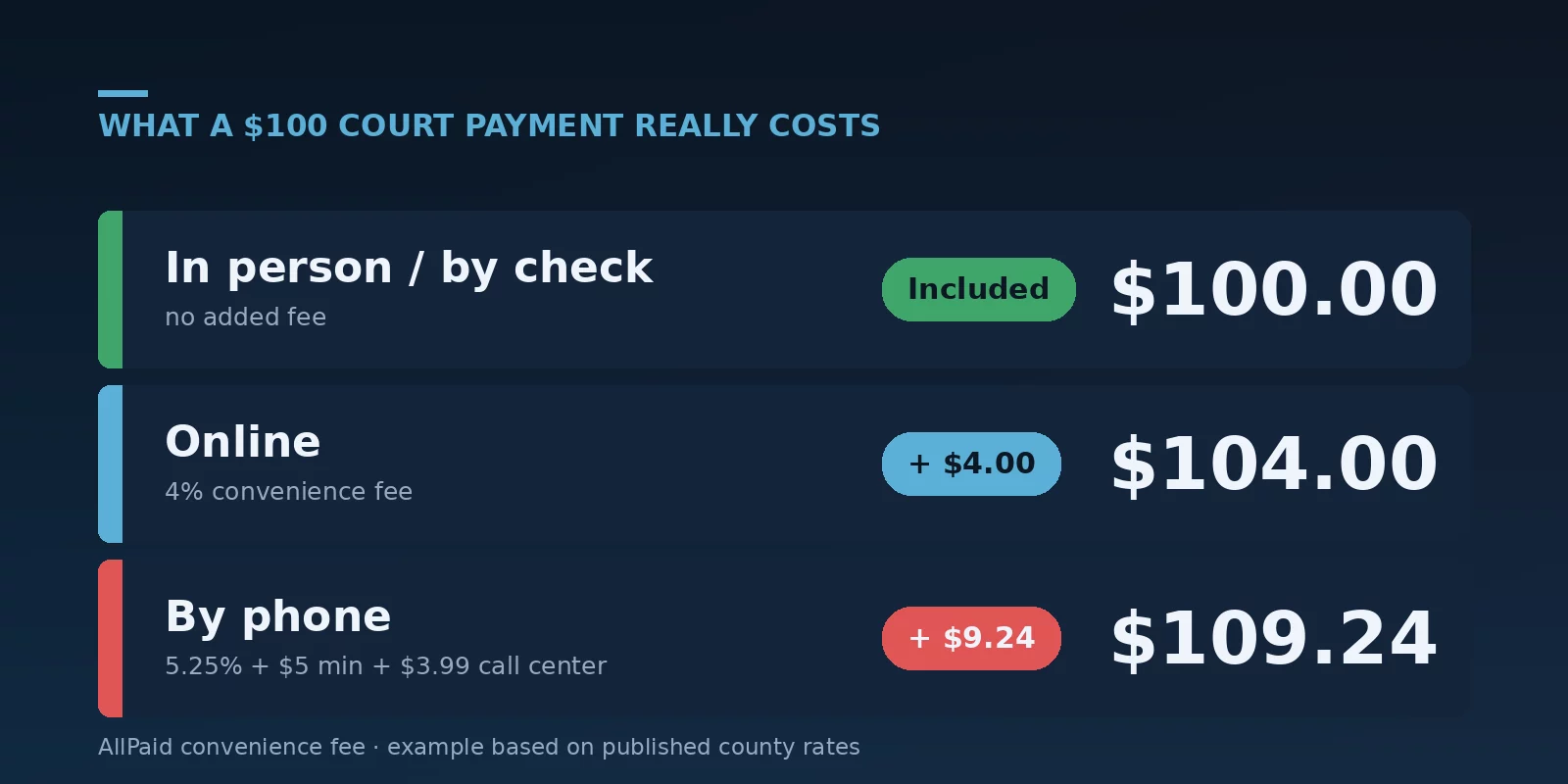
The published rates tell the story. Albany County, New York, routes its probation payments — restitution, DWI costs — through AllPaid at 4.00% online with a $3.99 minimum, and 5.25% by phone with a $5.00 minimum plus a separate $3.99 call-center charge. Pay a $100 obligation by phone and you hand over $109.24. Other agencies sit in the same band: a 3.5% rate through another court-payment platform, 5% in some California courts.
Set that against ordinary card processing, where a private business pays somewhere around 2 to 3% all in. The court payer is charged more than a retailer pays — and the steepest rate falls on the phone channel, used most by the people least likely to have a card on file or reliable internet. The markup is described as a “convenience” or “service” charge, but for someone paying restitution or bail it is rarely optional and never convenient.
Paying by phone can cost 5.25% plus a $5 minimum plus a $3.99 call-center charge. The channel used by people without easy online access carries the highest markup of all.
Who Pays the Fee — and Who Doesn’t
The reason the rate never seems to fall is structural. In this model the agency pays the vendor nothing; the entire cost is shifted onto the resident as a service charge. That arrangement removes the one force that normally drives a price down — a customer who feels the bill. The county signs the contract but never sees the markup on its own books, so there is little reason to negotiate it, and the vendor has little reason to lower it.
The person on the other end has no leverage at all. Someone paying a fine, restitution, or a bail amount cannot shop for a cheaper processor; they pay whatever the court’s page presents. It is a captive transaction, and a captive transaction is exactly where an inflated charge survives longest. The framing matters too — call it a “convenience fee” and it sounds like a courtesy, when for most payers it is simply the price of compliance.
When the agency never feels the cost and the payer cannot shop, nobody at the table is pushing the price down. That is the whole reason a 4-to-5% charge has outlived every round of payment-cost compression elsewhere.
What’s Behind the AllPaid Complaints
It helps to know who you are dealing with. GovPayNet was founded in 1997 by a former sheriff to take cash bail by card, then expanded across courts, jails, probation, traffic citations, and restitution until it served thousands of agencies; it later rebranded to AllPaid and has been passed between owners since. In 2018 it drew national attention for a security lapse that left roughly 14 million payment receipts exposed through guessable web links — a reminder that the “convenient” middleman is also holding your residents’ data.
The rest of the field looks similar. nCourt has since been absorbed into a larger govtech platform that consolidated several court-payment vendors. And PayGOV, another government card processor, is facing an April 2026 class action that alleges it charged consumers undisclosed “junk fees” on government payments — squarely inside the current regulatory push against surprise charges. None of this is unique to one logo; it is how the category has operated.
Roughly 14 million GovPayNet receipts sat reachable through sequential URLs. Beyond the fee, an outside vendor on your payment page owns a copy of who paid what — and the security of it is theirs to get right.
What a County Can Do Instead
An agency is not required to hand its residents a 4-to-5% convenience fee. With its own merchant account and a payment page it controls, a county or court sets the terms: it can absorb the processing cost into its budget, hold any convenience charge to the true cost of acceptance, or offer a low-flat-fee bank-debit option for people who cannot afford a percentage on top. The page can still post in real time to the case-management system; the difference is who sets the price and who keeps the margin.
That is the work behind government payment processing done in-house rather than farmed out — and the same logic drives the standalone government payment portal, where the agency, not a third-party aggregator, owns the rate and the data. The point is not that accepting cards should be free; it is that a public payment page should not quietly cost a resident more than a card costs a store down the street.
The agency sets or absorbs the fee, owns the transaction data, and can drop a phone payer from 5.25% to something humane. The vendor’s margin becomes the agency’s choice instead of the resident’s burden.
Questions to Ask Your Current Vendor
If your agency is on AllPaid, PayGOV, or a similar contract, a short list of questions surfaces what you are actually signing for. What is the all-in cost to a payer online versus by phone, including every minimum and add-on charge? Who owns and secures the payment data once it leaves your page? What is the contract term, and is acceptance exclusive? And is there a low or no-fee path — a flat-fee bank debit — for residents who cannot absorb a percentage on a court debt?
The answers usually reveal whether you are buying a service or just renewing a toll — and whether the AllPaid complaints you have heard are a contract problem you can fix. Neither is wrong on its face — but you should know which one it is before the next term auto-renews.
Frequently Asked Questions
The recurring ones are about cost and transparency: a service charge of roughly 4% online and up to 5.25% by phone — each with a minimum, plus a call-center charge — paid by the person making the payment, not the agency. Older complaints also cite the 2018 data exposure under the GovPayNet name.
The citizen. In the standard arrangement the agency pays the vendor nothing and the full markup is passed to the payer as a convenience or service fee — which is the structural reason the rate rarely comes down.
AllPaid is the rebranded GovPayNet. nCourt has since been absorbed into a larger govtech platform. PayGOV is a separate government processor currently facing a class action over alleged undisclosed junk fees. Different logos, same broad category of third-party government payment vendors.
Yes. By running its own merchant account and payment page, an agency can absorb the cost, hold any convenience fee to the true cost of acceptance, or add a low-flat-fee bank-debit option — and keep control of the data instead of handing it to an aggregator.
Find Out What Your Residents Are Really Paying.
If your agency’s payment page hands citizens a 4-to-5% convenience fee, send Brookside the vendor agreement and a recent statement. We’ll break down the true all-in cost your residents pay, what the same volume would cost in-house, and whether you can cut the charge — or own the page outright — before the contract renews. The review takes about fifteen minutes and commits you to nothing. For background on surprise-fee protections, see the CFPB’s consumer guidance.
Get Your Free Payment Cost ReviewNo obligation • No pressure • Response within one business day
See what a statement review looks like →