Reduce SAP Business One Payment Processing Fees Without Leaving SAP
Reduce SAP Business One Payment Processing Fees Without Leaving SAP
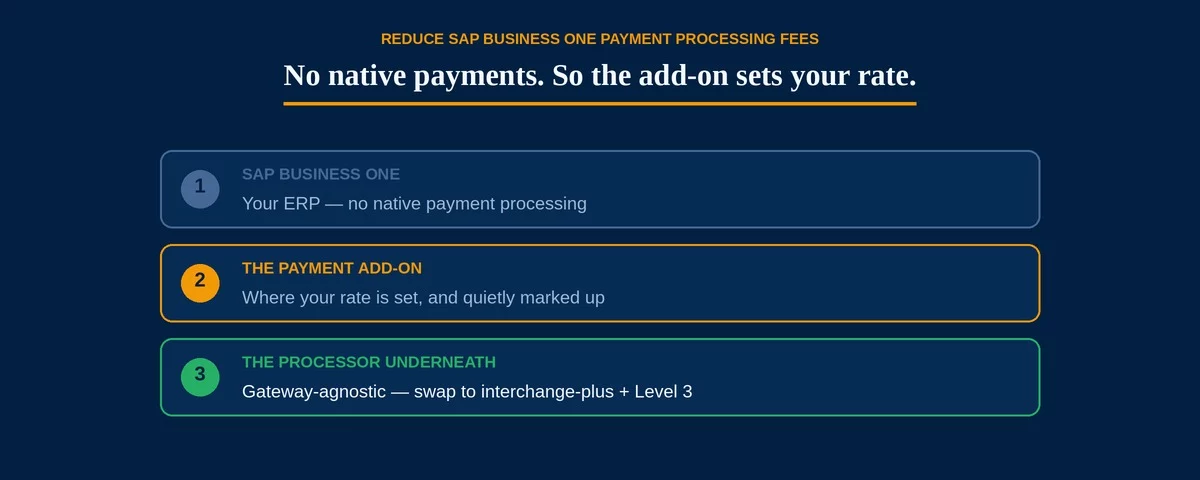
SAP Business One runs the operation — inventory, purchasing, accounts receivable, the general ledger. But it ships with no way to take a card on its own, so at go-live you bolted on an add-on to close the gap. That add-on, not SAP, set your rate. It got approved once and has priced every card sale since. That is exactly where the markup hides in SAP Business One payment processing, and it is why you can cut the cost without touching B1 itself.
The fix is not a re-implementation. The add-ons that handle SAP Business One payment processing are built to connect to whichever processor you choose, so the money is in the rate that add-on quietly locked in — and in the card data your transactions do or do not carry.
To accept cards inside Business One you install a third-party payment add-on — EBizCharge, REPAY, Third Wave, iCharge, and others. The add-on connects B1 to a gateway and a merchant account, and it is the add-on and the processor behind it, not SAP, that decide your rate.
The Add-On Set Your Rate, and Marked It Up
Most B1 add-ons are sold as a bundle: the add-on vendor either is the processor or resells one, at a flat, blended rate that is easy to approve and rarely cheap. Once payments start posting cleanly against invoices, nobody re-examines the number — the add-on works, so the rate stops being a question. On a small ticket that blend is harmless. On a large B2B invoice it is real money, every time.
A bundled, one-size rate is built for convenience, not for cost. It folds the network’s true cost into a single percentage you cannot see inside, which is the gap you are closing when you set out to lower your SAP Business One payment processing fees.
The add-on that was fastest to install at go-live is rarely the one priced for your volume. Convenience and a competitive rate are not the same thing — and the moment payments reconcile cleanly, the rate stops getting looked at.
Large B2B Invoices Carry the Most Markup
Business One’s core market is mid-market manufacturing, wholesale, and distribution — companies that bill other companies on large purchase orders and net terms. That is precisely where a flat percentage does the most damage. A $40,000 order on a 2.9% bundled rate costs $1,160 in fees; the same order on interchange-plus pricing, with Level 2 and Level 3 data attached, can land far lower, because qualifying a commercial card unlocks the B2B interchange built for exactly these transactions.
- Flat bundled rate at 2.9%: $1,160 in fees
- Interchange-plus with Level 3 data, roughly 1.9% all-in: about $760
- Difference on a single invoice: about $400 — illustrative, and the real figure moves with card mix and margin
Most B1 add-ons never pass Level 2/3 data by default, so commercial cards drop to the most expensive interchange the network offers. Several add-ons support enhanced data natively — they simply ship with it switched off. Closing that gap across a year of orders is the single biggest lever in SAP Business One payment processing, and it is the same problem the manufacturing and wholesale guides describe; B1 is simply where it lives for ERP-run businesses.
How to Cut SAP Business One Payment Processing Fees
The lever that makes this easy is a fact most B1 shops never use: the add-ons are gateway-agnostic — they will connect to the processor of your choosing. So you keep Business One, you keep the add-on workflow your team already knows, and you change the economics underneath. There are three moves that lower your SAP Business One payment processing fees.
One: place an interchange-plus processor behind the add-on. You do not rip out the add-on or retrain anyone; you reconfigure it to run on a processor priced at the network’s real cost plus a transparent margin, instead of a blended flat rate.
Two: turn on Level 2 and Level 3 data. Submitting line-item detail qualifies your commercial-card transactions for materially lower B2B interchange. This is the most valuable lever and the one most setups leave switched off, so it is worth understanding exactly how Level 2 and Level 3 data work before you choose a processor.
Three: route your largest invoices to ACH. Business One handles ACH and eCheck directly, and a flat-dollar bank-rail fee beats a percentage on a five- or six-figure order.
A B1 shop running a few million a year in card volume typically leaves five figures on the table under a bundled add-on rate. An interchange-plus processor, Level 3 data, and an ACH path for the biggest invoices recover most of it — and your team keeps working entirely inside Business One.
Re-pointing an add-on to a new processor is routine but not instant. Reconfigure the add-on’s processor credentials, test in a B1 sandbox before going live, and keep the old processor active long enough to settle pending authorizations and process refunds on transactions it already handled.
Running a different ERP changes the details. If you are on NetSuite, see reduce NetSuite payment processing fees; if you are on QuickBooks rather than a full ERP, start with reduce QuickBooks payment processing fees instead.
Frequently Asked Questions
Yes. B1 add-ons are gateway-agnostic, so you can keep Business One and the add-on your team already uses and simply place a cheaper, interchange-plus processor behind it. You change the rate and the data, not the platform.
No — B1 has no native card acceptance. You add a third-party add-on to accept cards inside the system, and it is that add-on plus the processor behind it, not SAP, that set your rate. That structure is what makes SAP Business One payment processing yours to re-price.
Yes, with the right setup. Several B1 add-ons apply Level 2 and Level 3 enhanced data automatically to qualify commercial cards for lower interchange — most simply ship with it switched off. Turning it on is the single biggest saving on large B2B invoices.
Send Us One SAP Statement. We’ll Show You the Add-On Markup.
If your SAP Business One payment processing runs through a bundled add-on and the rate hasn’t been looked at since go-live, there is a good chance you’re overpaying on every large invoice. Send Brookside one recent processing statement and a sample invoice, and we’ll calculate your real effective rate, flag whether Level 2/3 data is being passed, and show you what an interchange-plus processor behind your existing add-on would save — without re-implementing B1. The math takes us about fifteen minutes. Learn more about payment processing consumer protections from the CFPB.
Send Your Statement for a Free ReviewNo obligation • No pressure • Response within one business day
See what a statement review looks like →