Manufacturing Payment Processing: The ERP Markup
Manufacturing Payment Processing Is a Markup Problem Hiding in Plain Sight
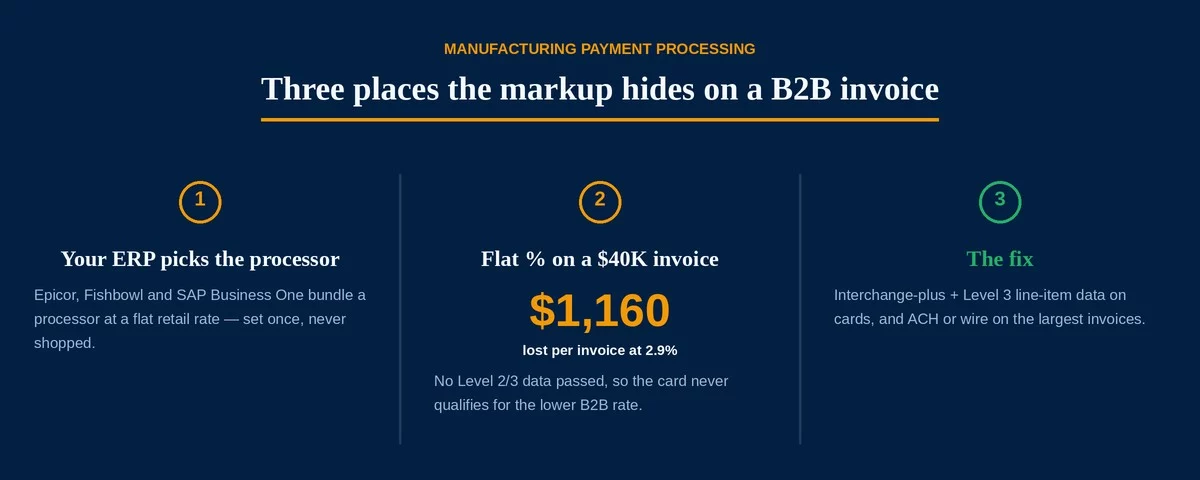
A manufacturer’s money moves differently from a retailer’s. You sell to other businesses, you bill against purchase orders, and your customers pay on net-30, net-60, sometimes net-90 terms. When one of those invoices gets paid by card, the fee is not a rounding error — a 2.9% rate on a $40,000 order is $1,160 gone — the same math that hits freight carriers on every card-paid load. That is the corner of manufacturing payment processing that rarely gets a second look, because the rate was set years ago and nobody has touched it since.
The pattern repeats across plants, fabricators, and machine shops: the processing rate was inherited, not chosen. It came bundled with the accounting system, it was approved once during implementation, and it has quietly skimmed every card payment since. Fixing manufacturing payment processing starts with seeing where that markup lives — and who put it there.
Commercial and purchasing cards carry higher interchange than the consumer cards a store swipes all day. Without enhanced transaction data attached, those business cards default to the most expensive rate the networks offer — and a manufacturer’s customers pay with business cards.
Your ERP Picked Your Processor: And the Rate Came With It
Most manufacturers run on an ERP or accounting platform: Epicor, Fishbowl, SAP Business One, Sage, Microsoft Dynamics, NetSuite, Acumatica, or QuickBooks Enterprise. Each ships with a payments module, and that module routes card transactions through a default processor at a flat retail rate. It is convenient, because payments reconcile straight into the ledger. It is also where manufacturing payment processing costs quietly inflate, since the embedded rate was never measured against an alternative.
A flat rate is engineered to average costs across thousands of small swipes at a coffee counter. Drop a plant’s large, infrequent, business-card invoices into that same bucket and the math runs the wrong way — you end up subsidizing the small merchants the model was built for. The software made the choice easy, which is precisely why the rate goes unexamined for a decade.
You can usually spot the bundled arrangement on a statement in under a minute. If your effective rate sits near a round number like 2.9% or 3.5% across every transaction regardless of card type, you are on a flat retail plan — the network’s wholesale cost is hidden behind a single blended figure, and a factory paying that way has never seen what its transactions actually cost.
The processor your ERP recommends is rarely the cheapest one it can integrate with. The integration is real; the rate attached to it is negotiable. Treating the two as a single package is how a factory overpays for years without ever seeing a reason to look.
Why Flat-Rate Pricing Punishes Big Invoices
The clearest way to see the problem in manufacturing payment processing is to run a single invoice two ways. A $40,000 order paid by commercial card on a flat 2.9% rate costs $1,160 in fees. The same order on interchange-plus pricing — where you pay the card network’s actual cost plus a small fixed processor margin — with proper Level 2 and Level 3 data attached, can settle for far less, because qualifying a business-card transaction unlocks interchange built specifically for B2B.
- Flat retail rate at 2.9%: $1,160 in fees
- Interchange-plus with Level 3 data, roughly 1.9% all-in: about $760
- Difference on a single invoice: about $400 — illustrative, and the real figure moves with card mix and processor margin
Multiply that single gap across a year of orders and the number that looked like a rounding error becomes a line worth a controller’s full afternoon. The savings in manufacturing payment processing are not exotic — they come from pricing the transaction correctly and handing the network the data it already asks for.
Three Levers That Lower Manufacturing Payment Processing Costs
Once you can see the markup, the fixes are concrete. There are three levers, and most plants can pull all three at once.
One: move off flat-rate and onto interchange-plus. Interchange-plus separates the network’s true cost from your processor’s margin, so the markup stops hiding inside a single blended percentage and becomes a number you can negotiate.
Two: pass Level 2 and Level 3 data on every commercial-card transaction. This is the most manufacturing-specific lever there is, and the one most processors never bother to switch on. Submitting line-item detail — tax amount, customer code, item descriptions — qualifies business cards for materially lower interchange. It is worth understanding exactly how Level 2 and Level 3 data work before your next processor conversation, because plenty of merchants are sitting on the savings without knowing it.
Visa retired its long-standing Level 2 commercial rate in April 2026 and folded B2B incentives into its Commercial Enhanced Data Program. Manufacturers who were never told are quietly paying more, not less. The details of the Visa Level 2 sunset are worth a read if your data setup hasn’t been reviewed this year.
Three: route your largest invoices off cards entirely. For a five- or six-figure order, ACH or wire settles for a flat fee of a few dollars instead of a percentage. When a buyer insists on a card for the float or the rewards, a compliant B2B surcharge moves that cost to the party choosing the expensive rail.
A plant running a few million a year in card volume typically leaves five figures on the table under a bundled flat rate. Interchange-plus, Level 3 data, and an ACH path for the biggest invoices recover most of it — without changing how a single customer prefers to pay.
The same playbook holds whether you run a contract machine shop taking deposits on custom jobs or a fabrication plant billing national accounts. Wholesale and distribution operations face a related version of this with their own volume-and-terms twist, but the spine of manufacturing payment processing stays constant: price the transaction honestly, pass the data, and match the rail to the size of the invoice. Reviewing manufacturing payment processing once a year — the pricing model, the data being passed, and the rail each invoice rides — is usually the difference between a competitive rate and a decade of quiet overpayment.
Frequently Asked Questions
It centers on large-ticket, business-to-business orders paid by commercial and purchasing cards, often against invoices on net terms rather than at a counter. That changes which interchange rates apply, makes Level 2 and Level 3 data genuinely valuable, and makes ACH a serious option for the largest invoices.
Usually because the rate is a flat retail percentage bundled through your ERP, applied to large invoices it was never designed for, with no Level 2/3 data passed. Each of those three things inflates the bill on its own, and stacked together they can roughly double what you should be paying.
Both, used deliberately. Accept cards on interchange-plus pricing with Level 3 data so they qualify for the lowest B2B rate, and steer the biggest invoices to ACH or wire, where a flat-dollar fee beats any percentage. A surcharge program covers the card cost on the orders where a buyer still prefers plastic.
Send Us One Statement. We’ll Show You Where the Markup Hides.
If your processing rate came bundled with your ERP and nobody has touched it since implementation, there is a good chance your manufacturing payment processing is overpaying on every large invoice. Send Brookside one recent statement and a sample invoice, and we’ll calculate your real effective rate, flag whether Level 2/3 data is being passed, and show you what interchange-plus plus an ACH path would actually cost. The math takes us about fifteen minutes. Learn more about payment processing consumer protections from the CFPB.
Send Your Statement for a Free ReviewNo obligation • No pressure • Response within one business day
See what a statement review looks like →