Wholesale Payment Processing: The Volume Penalty
Wholesale Payment Processing Punishes the Thing You Do Best
Distribution runs on volume and thin margins. You move large orders to other businesses, you usually carry them on net-30 to net-90 terms, and your customers settle across cards, ACH, checks, and wires — the same spread that shapes trucking payment processing, where the card is the smallest slice. The catch in wholesale payment processing is that the pricing model most distributors inherit — a flat percentage — quietly turns your biggest strength into your biggest leak. The more you process, the more a flat rate costs you relative to what the transaction is actually worth to the card networks.
A distributor running a few million dollars a year in card volume on a flat rate is usually overpaying by a five- or six-figure annual sum, and almost never knows it. That gap is the heart of wholesale payment processing, and closing it rarely requires changing how a single customer prefers to pay.
A flat rate blends the network’s real cost across thousands of transactions. High-volume B2B orders sit at the cheap end of that blend — so under a flat plan, your large account payments quietly subsidize the small merchants the model was built to serve.
Flat-Rate Pricing Averages You Down
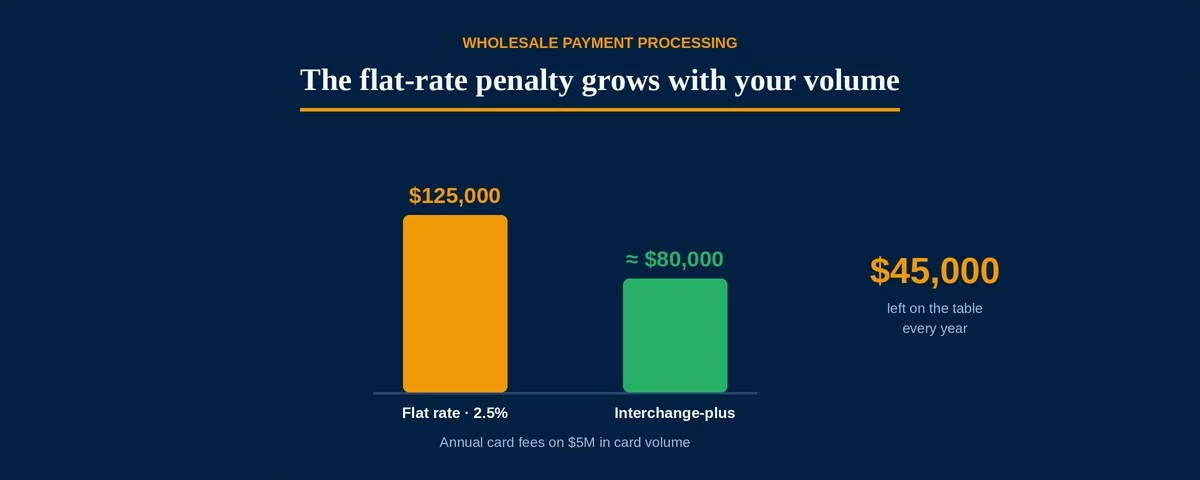
The math is easier to see at scale than to argue with. Take a distributor running $5 million a year in card volume. On a flat 2.5% rate, that is $125,000 in annual fees. The same volume on interchange-plus pricing — where you pay the network’s true cost plus a small fixed processor margin — typically lands around $80,000, depending on card mix. That is a $45,000 difference on identical revenue, coming straight off a thin distribution margin.
The savings in wholesale payment processing are not a discount someone grants you — they are the spread you stop overpaying once the network’s cost and your processor’s markup are shown as separate numbers. At distribution volume, that spread is almost always five figures or more a year.
That is why wholesale payment processing rewards a pricing review more than almost any other line on a distributor’s books. The volume that makes a flat rate expensive is the same volume that makes interchange-plus, and the data behind it, pay off fastest.
Volume Isn’t the Only Cost: Days Sales Outstanding Is
Distributors do not just process a lot; they wait a long time to get paid. A wholesale operation commonly carries 40 to 50 days of sales outstanding because it sells on account and on terms. When a large invoice finally gets paid by commercial card to “close it out,” the percentage fee on a five-figure order can erase the margin on the sale entirely. Sound wholesale payment processing treats the rail as a decision, not a default.
For your largest invoices, ACH or wire settles for a flat fee of a few dollars instead of a percentage, and modern accounts-receivable tools can present a customer portal, automate the reminder cadence, and post payments straight back into your accounting system. The card stays available for buyers who want it; it just stops being the reflexive way every big balance gets cleared.
This is where receivables automation earns its keep in wholesale payment processing: a self-service portal lets each buyer pay the way they prefer, presents ACH as the no-fee option on large balances, runs the reminder cadence without anyone chasing it, and reconciles cleared payments straight into your ledger. You collect faster and pay less at the same time — the uncommon case where the cheaper rail is also the one that gets you paid sooner.
Letting a buyer pay a $30,000 balance by card to clear an aging invoice feels like a win for cash flow. At a flat 2.9%, it just cost you $870 in fees on a sale that may have carried less margin than that. On a large balance, the rail you accept is a pricing decision — not a formality.
Four Moves That Lower Wholesale Payment Processing Costs
Once the leaks are visible, the fixes are straightforward, and most distributors can make all four.
One: move to interchange-plus so the network cost and the processor markup stop hiding inside a single blended rate. Two: pass Level 2 and Level 3 data on every commercial-card transaction — at distribution volume this is one of the largest single levers, and most processors never enable it. It is worth knowing how Level 2 and Level 3 data work before your next pricing conversation.
Distributors rarely price every customer the same way — a national account on net-60 is not your walk-up cash buyer. If you run tiered terms, a compliant B2B surcharge has to follow card-brand and state rules account by account, so set it up deliberately rather than flipping it on globally.
Three: route large invoices to ACH or wire and lean on AR automation to make that the easy path for buyers. Four: surcharge the buyers who still choose the expensive rail, so the cost lands with the party making the choice. If you also make what you distribute, the same leak shows up on the production side — the companion guide to manufacturing payment processing covers the ERP-bundled version of the problem. Across both, the discipline of wholesale payment processing is identical: price the transaction honestly, pass the data the network rewards, and match the rail to the size of the balance.
Frequently Asked Questions
It centers on high-volume, large-ticket orders sold to other businesses on terms, paid largely by commercial cards, ACH, and wire rather than at a point of sale. That makes flat-rate pricing especially costly, makes Level 2 and Level 3 data valuable, and makes ACH the better rail for your biggest invoices.
Because a flat rate works against volume, not for it. It averages the network’s cost across all merchants, so your high-volume B2B transactions subsidize smaller ones. Add commercial cards with no Level 2/3 data passed, and the bill climbs further. Interchange-plus reverses the first problem; enhanced data reverses the second.
For large invoices, yes — make ACH the easy default through your AR portal, since a flat-dollar fee beats a percentage on a five-figure balance. Keep cards available on interchange-plus with Level 3 data for buyers who prefer them, and use a surcharge where the rules allow to cover the card cost.
Send Us One Statement. We’ll Show You the Spread at Your Volume.
If your wholesale rate is a flat percentage, your volume is working against you on every order. Send Brookside one recent statement and a sample large invoice, and we’ll calculate your real effective rate, flag whether Level 2/3 data is being passed, and show you what interchange-plus plus an ACH path would actually cost across a year. The math takes us about fifteen minutes. Learn more about payment processing consumer protections from the CFPB.
Send Your Statement for a Free ReviewNo obligation • No pressure • Response within one business day
See what a statement review looks like →