Nail Salon Payment Processing: The Small-Ticket Tax
Nail salon payment processing is shaped by a pattern most retail categories never deal with: a high volume of small, tipped tickets from clients who come back every few weeks. A $35 fill, a $55 mani-pedi, a $20 add-on — dozens of them a day, most with a tip on top. That mix looks harmless, but it is exactly where flat-rate pricing quietly costs a salon the most. And because so many of those clients are regulars on a two- or three-week cycle, small inefficiencies repeat hundreds of times a month.
This is a plain look at why the flat per-transaction fee is a hidden tax on small tickets, why tips and repeat clients need a processor that handles them cleanly, and where a nail salon can actually cut card costs. Getting nail salon payment processing right comes down to the fixed fee that larger-ticket businesses barely notice.
Why Flat Per-Transaction Fees Punish a Nail Salon
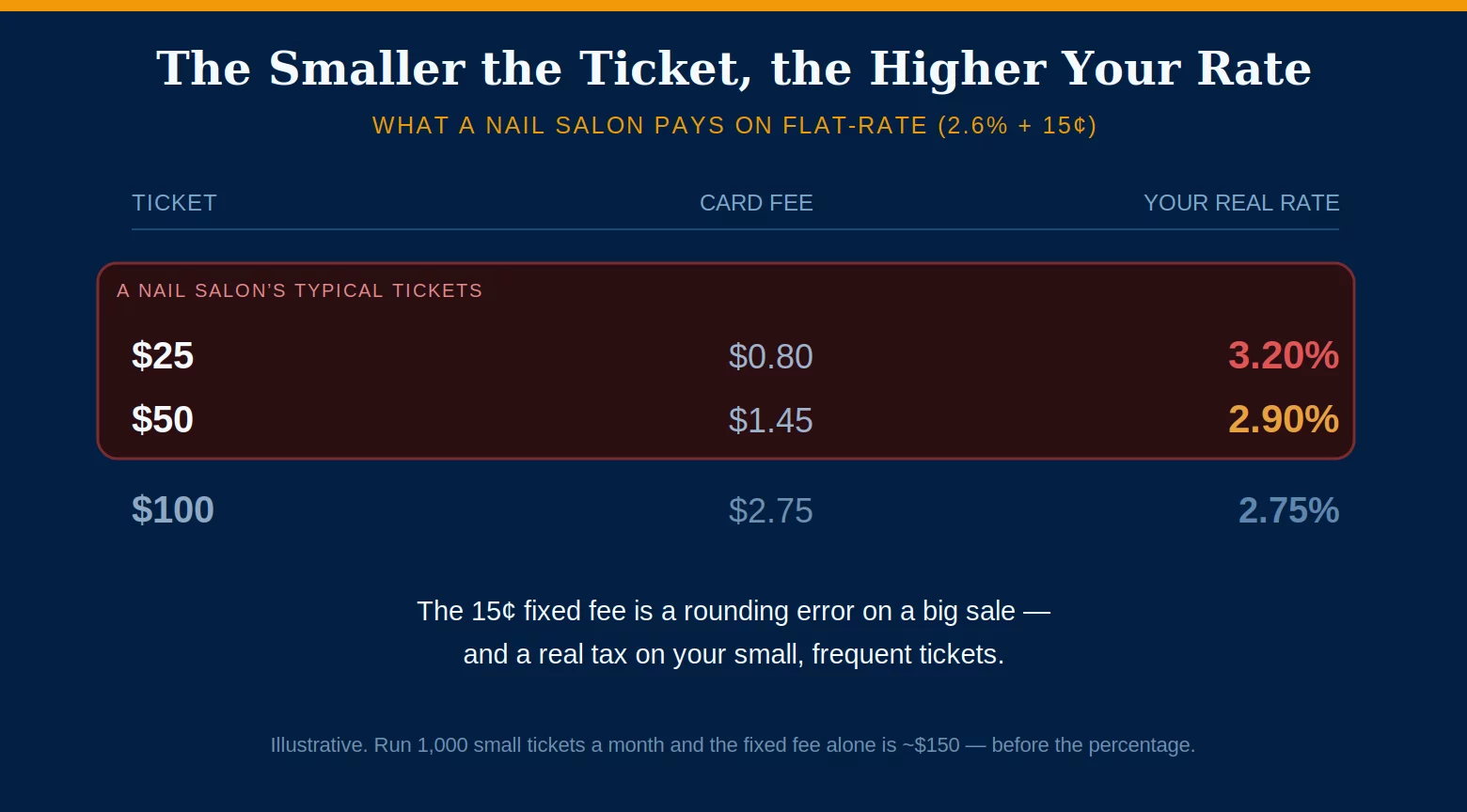
Every flat rate has two parts: a percentage and a fixed per-transaction fee — commonly something like 2.6% plus 15¢. On a large sale that fixed fee disappears into the total. On a nail salon’s small ticket, it does the opposite: it becomes a real slice of the sale, every single time.
On a $35 fill, a flat 2.6% + 15¢ works out to about $1.06 — an effective rate above 3%, because that 15¢ alone is nearly half a percent on a ticket that size. The smaller the ticket, the higher your real rate climbs. Run a thousand small tickets in a month and the fixed fee by itself is $150 — before a single percentage point of the actual rate. Most owners never see it broken out that way. That is the math that makes nail salon payment processing worth getting right.
A busy salon lives at the small-ticket, high-frequency end of the curve — the exact spot where flat-rate’s fixed fee is most expensive as a share of each sale. For nail salon payment processing, that fixed fee is the whole game, and it is the first thing to fix.
Nail Salon Card Processing Has to Handle Tips Cleanly
Tips are not a side detail in a salon — they are a large share of what runs through the terminal, and they get added after the service, not before. Handling that well is a real part of nail salon payment processing that generic flat-rate setups often get wrong. Your setup needs proper tip adjustment so a technician’s tip can be added to an already-authorized sale without a second charge or a re-swipe, and so the tip-out to your techs reconciles cleanly at close.
Nail salon clients come back on a schedule — every two to three weeks for most regulars. That makes card-on-file and stored-profile billing genuinely useful: faster checkout, easier rebooking, and support for deposits on higher-value appointments. Good nail salon merchant services should make repeat-client billing effortless, not an afterthought.
Where Nail Salon Payment Processing Cuts Costs
Two levers move the needle most for nail salon credit card processing, and both target the small-ticket problem directly.
Moving off a bundled flat rate and onto interchange-plus — true cost plus a small, fixed markup — lowers what you pay on every one of those small tickets. Across a high daily count, that difference compounds into real monthly savings a small shop can actually feel.
Many salon booking and point-of-sale apps bundle a processor at a locked flat rate with no room to negotiate. If yours does, a nail salon merchant account on transparent pricing — with clean tip adjustment and card-on-file — usually beats the convenience of the built-in option once your volume is real, and it puts the pricing back in your control.
Frequently Asked Questions
Because the tickets are small and the flat per-transaction fee is fixed. A 15¢ fee is a rounding error on a $500 sale but nearly half a percent on a $35 fill — so your effective rate climbs on small tickets, and a salon runs hundreds of them. Moving nail salon payment processing to interchange-plus lowers that per-transaction bite.
Yes — with a setup that supports tip adjustment. The service is authorized first, the client adds a tip, and the final amount captures without a second charge or re-swipe. A processor and point-of-sale built for tipped businesses also make the end-of-day tip-out to your technicians reconcile cleanly.
A very low-volume shop can start on an aggregator. But once you are running a high daily count of small, tipped tickets, a dedicated nail salon merchant account on interchange-plus usually wins — it lowers the per-transaction cost that hurts most on small tickets and gives you cleaner tip and card-on-file handling.
See What Those Small Tickets Are Really Costing You.
On a high count of small, tipped tickets, the fees hide in the per-transaction fee and the markup. Send us a recent statement and we will show you your true effective rate on your nail salon payment processing — and what interchange-plus, clean tip handling, and card-on-file would keep in your pocket. Learn more about card processing consumer protections from the CFPB.
Get a Free Statement ReviewNo obligation • No pressure • Response within one business day
See what a statement review looks like →