Coffee Shop Payment Processing: The Small-Ticket Trap
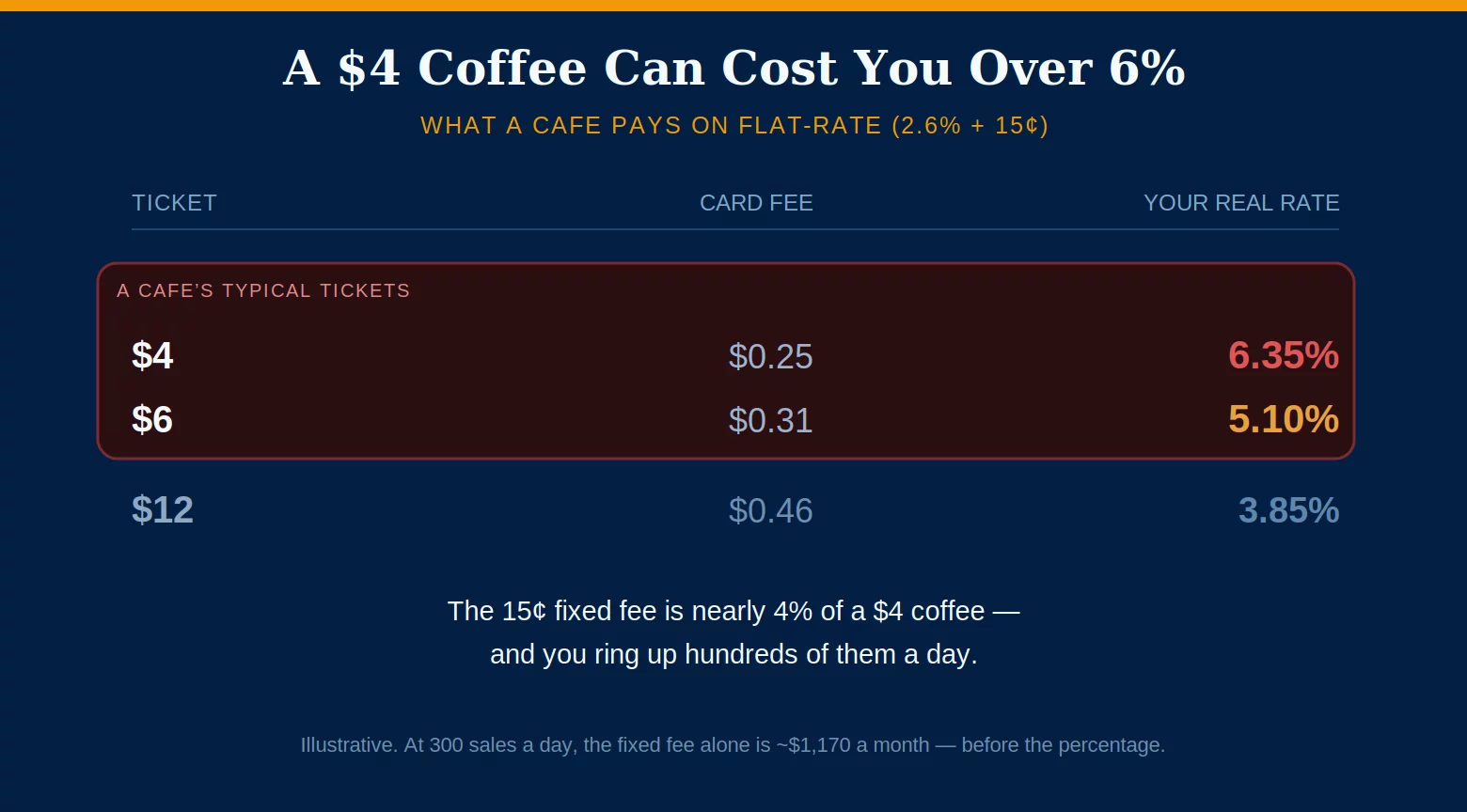
Coffee shop payment processing is the most extreme version of a problem every low-ticket business faces: when the average sale is a few dollars, the flat per-transaction fee stops being a rounding error and becomes the single biggest line in your cost of accepting cards. A $5 latte, a $4 drip, a $9 pastry-and-coffee — hundreds of them a day, almost all on a card or a phone. That combination is where flat-rate pricing quietly costs a cafe the most.
This is a plain look at why the fixed fee is brutal at coffee prices, why your daily volume turns pennies into real money, how to handle the counter tip screen without annoying regulars, and where a coffee shop actually cuts card costs. Getting coffee shop payment processing right comes down to one line item: the fixed fee that bigger-ticket businesses barely notice.
Why the Fixed Fee Is Brutal at Coffee Prices
Every flat rate has two parts: a percentage and a fixed per-transaction fee — commonly around 2.6% plus 15¢. On a large sale, that 15¢ disappears. On a $4 coffee, it does the opposite: it becomes the dominant cost, bigger than the percentage itself.
On a $4 sale, a flat 2.6% + 15¢ works out to about 25¢ — an effective rate above 6%, because the fixed 15¢ alone is nearly 4% of the ticket. The smaller the drink, the higher your real rate climbs. This is the sharpest small-ticket math anywhere in retail, and it is exactly why coffee shop payment processing deserves more attention than a default Square account.
No other common business lives this far down the small-ticket curve. A cafe runs its entire day at the price point where the flat-rate fixed fee is most expensive as a share of each sale.
Daily Volume Turns Pennies Into Real Money
The fixed fee feels small on one cup. It does not stay small, and it sits at the heart of coffee shop payment processing economics. A busy cafe runs several hundred transactions a day, and the per-transaction fee applies to every single one regardless of size.
At 300 transactions a day, six days a week, that is roughly 7,800 sales a month. The flat 15¢ fixed fee alone — before a single percentage point — is about $1,170 every month. That is the number most owners never see broken out, and it is the core of why coffee shop merchant services are worth getting right. Speed matters too: at a line out the door, fast tap-and-contactless acceptance keeps the queue moving, and slow processing costs you sales during the morning rush.
Handling the Coffee Shop Tip Screen Without Annoying Regulars
Coffee counters are ground zero for tip-screen fatigue. The prompt that swivels around after a $4 order is the exact moment customers report feeling pressured — and a regular who feels guilt-tipped every morning is a regular you can lose.
For counter service, suggested amounts should stay modest and the “No Tip” option should be easy to find — inflated 25/30/35% prompts on a coffee order read as a cash grab. Your point-of-sale controls all of this, and getting it right protects the goodwill that keeps regulars coming back. See tip screen best practices for how to configure the prompt by service type.
Where Coffee Shop Payment Processing Cuts Costs
Two levers move the needle most for coffee shop credit card processing, and both target the small-ticket problem head-on.
Moving off a bundled flat rate and onto interchange-plus — true cost plus a small, fixed markup — lowers what you pay on every one of those tiny tickets. Across thousands of monthly sales, that difference is the single biggest saving available to a cafe.
Second, match the hardware to the traffic: fast contactless and mobile-tap acceptance on a coffee shop merchant account keeps the morning line moving, where a slow or bundled built-in reader can bottleneck your busiest hour. If your cafe point-of-sale locks you into a flat processor with no room to negotiate, that is usually where a dedicated account on transparent pricing wins, and where coffee shop payment processing finally works in your favor.
Frequently Asked Questions
Because your tickets are tiny and the flat per-transaction fee is fixed. A 15¢ fee is nothing on a $100 sale but nearly 4% on a $4 coffee — so your effective rate climbs steeply on small drinks, and a cafe rings up hundreds of them. Moving coffee shop payment processing to interchange-plus lowers that per-transaction bite.
You can, but keep it light. Counter service is where tip-screen fatigue is worst, so use modest suggested amounts and a clearly visible “No Tip” button rather than inflated prompts. Aggressive tip screens spike short-term tips but cost you regulars over time.
A low-volume cafe can start on an aggregator. But once you are running hundreds of small tickets a day, a dedicated coffee shop merchant account on interchange-plus usually wins — it lowers the per-transaction cost that hurts most on tiny tickets and gives you faster, more reliable acceptance during the rush.
See What Those $4 Tickets Are Really Costing You.
On hundreds of small tickets a day, the fees hide in the per-transaction fee and the markup. Send us a recent statement and we will show you your true effective rate on your coffee shop payment processing — and what interchange-plus and faster hardware would keep in your pocket. Learn more about card processing consumer protections from the CFPB.
Get a Free Statement ReviewNo obligation • No pressure • Response within one business day
See what a statement review looks like →