← All Payment Processing Calculators
How much of your profit does card processing take?
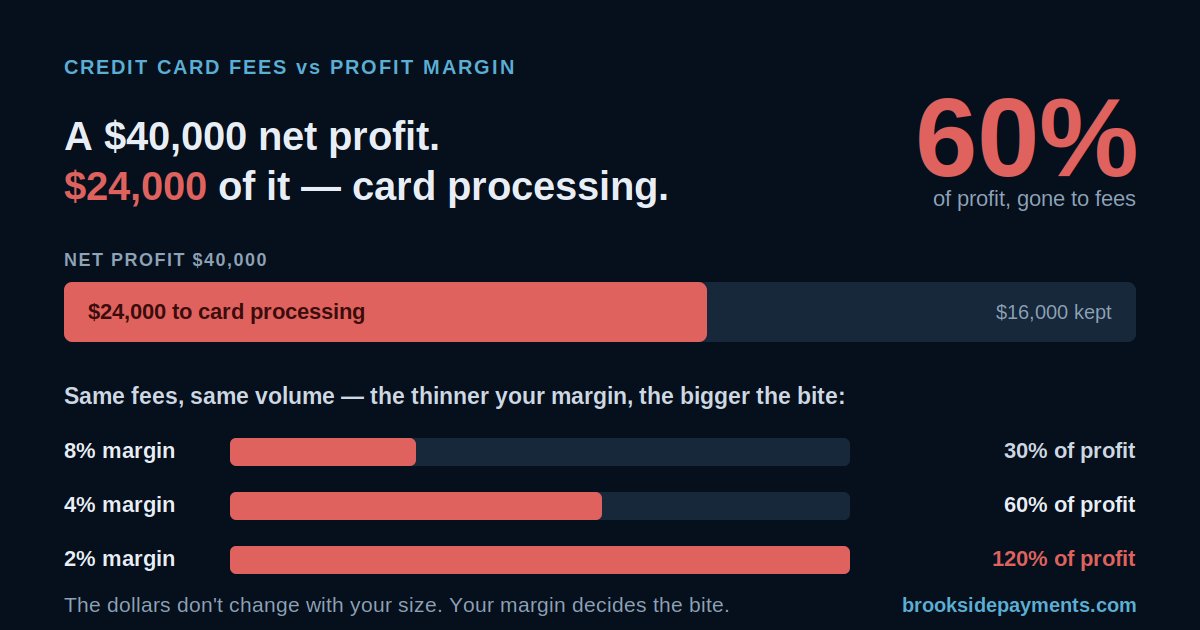
Credit card fees vs profit margin is the comparison that actually matters: fees look small against sales, alarming against profit. Enter your margin to see the real share.
Calculate Your Margin Impact
Your net margin after all costs… card fees included.
Not sure? Start from a typical figure for your industry
Typical net margins. Sources: NYU Stern / Damodaran 2026, NACS, gas stations NAICS 447110. Edit to your actual.
All fees divided by total card volume.
Do not know it? Work it out here.
The card total on your monthly statement.
Most retail and restaurants run 75–90%. Default is 80% if you are not sure.
What if your costs rise? (Work It Out Here)
Costs do not ask permission. A jump in food, product, or labor does not shave a few points off your margin… it can halve it. Here is the same business after a cost shock it did not cause.
Prime cost (product plus labor) runs ~55–65% of revenue for most thin-margin businesses. Adjust to your biggest cost line.
There is a way to move this cost
Today
—
of profit goes to processing
— / year
With dual pricing or cash discount
≈0%
to you… the fee shifts to customers who choose to pay by card
— back in profit
The fee does not vanish… it moves to the customer who chooses to pay by card. Dual pricing and cash discounting are legal in all 50 states and cover debit too; surcharging is the limited option… state caps, credit only.
Want a second set of eyes?
Send your statement for a free review
No obligation • No pressure • Response within one business day
Credit card fees vs profit margin: why the share matters more than the rate
A merchant on a 15% margin can look at 3% and shrug. A merchant on 4% is handing over most of what the business keeps. That is how card fees affect your profit margin: the same rate lands as a nuisance in one business and an existential cost in another, and the only thing that changed is the margin. Understanding card processing as a share of profit is what tells you which one you are… and it is the honest question to answer before anyone pitches you a program.
For a business already on a thin margin, the fee-offset options exist for exactly this reason. Zero-cost processing, surcharging, and cash discounting move the cost of acceptance off the business… and surcharging carries state-by-state disclosure rules you are required to follow, which the CFPB’s consumer credit-card guidance speaks to. None of that is worth the effort if the calculator above tells you fees are not your problem. If it tells you they are, that is what thin margin credit card processing strategy is built to fix.
Common questions
Why look at credit card fees vs profit margin instead of just the rate?
Because the rate is the same number for everyone and the impact is not. A 3% effective rate takes 3% of a sale, but somewhere between 20% and well over 100% of your profit depending on your margin. The margin is what makes the fee a shrug or a threat.
How do card fees affect your profit margin exactly?
Your reported margin already has processing in it. Eliminating the fee adds the full amount straight back to profit… so on a 4% margin, cutting a $24,000 annual card bill is the same as finding $600,000 in new sales. That is why fee-offset adoption rises fastest where margins are thinnest.
What can a thin-margin business do about it?
If the numbers say it is material, the fee-offset lane (surcharging, dual pricing, cash discounting, or interchange-plus pricing) is what stops credit card fees eating into profit. If they say it is not, the honest answer is to leave it alone and fix something with more leverage.