Your Software Chose Your Processor. Here Is When You Can Overrule It.
Your Software Chose Your Processor for You
Whether you can bring your own processor is not a question most merchants ever get asked. Almost nobody sits down and picks a payment processor any more. They pick software. They pick the thing that schedules the jobs, books the appointments, prints the tickets, or runs the storefront — and the processor arrives in the box, already switched on, at whatever rate the software company negotiated for itself.
That is payment processor lock-in, and whether you can bring your own processor instead is now the single biggest variable in what a merchant pays. Not a bad salesperson. Not a tiered pricing trick. A software decision made two years ago for reasons that had nothing to do with card fees.
The useful question is not “am I locked in.” Almost everyone is, to some degree. The useful question is how locked, because the answer determines what you can actually do about it — and the three answers are very different from each other.
Bring Your Own Processor: Three Tiers, Not Two
Write-ups on payment processor lock-in almost always split the world in half: either you can bring your own processor or you cannot. That split is wrong, and the tier it misses is the one where most of the recoverable money sits.
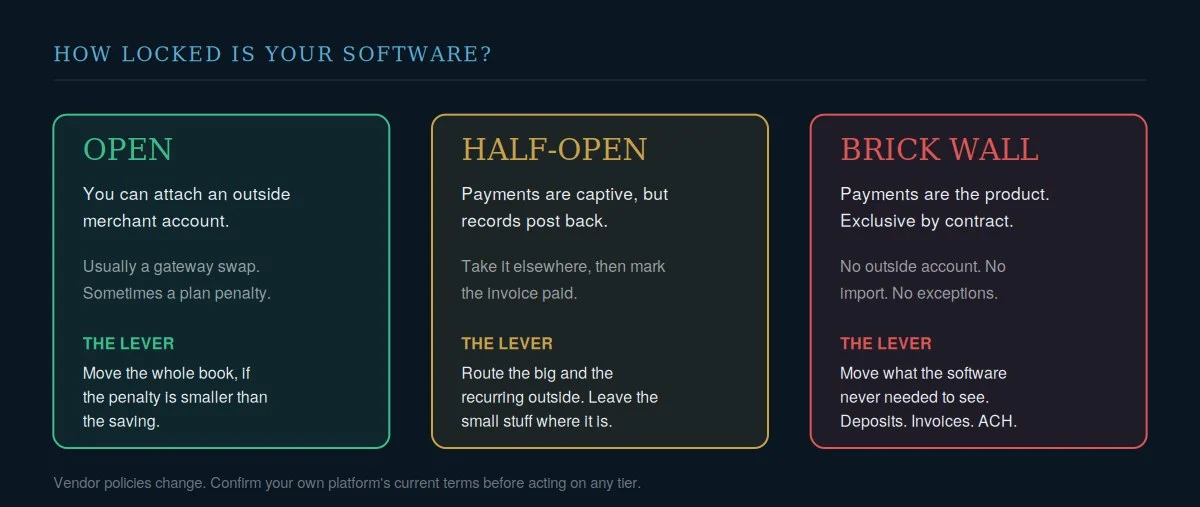
Open. The software will let you bring your own processor and attach an outside merchant account. Practically this means a gateway swap, and sometimes a penalty — a plan fee, a per-transaction charge, or the loss of a feature. The maths is simple: is the penalty smaller than the saving?
Half-open. The software’s own payments product is the only one that settles inside the platform, but the platform will still let you record a payment taken somewhere else against the invoice or the job. Nothing is imported automatically. Somebody taps a button. That is the entire cost, and in exchange the transaction runs on your rate instead of theirs.
Brick wall. Payments are the product. Exclusivity is written into the agreement, there is no third-party option at any plan level, and there is no supported way to post an outside payment back. The only lever left is moving the transactions the software never needed to see in the first place.
Half-open platforms describe themselves as closed, because from a product-marketing standpoint they are — their payments product is the only integrated one. The workaround lives in a support article about invoicing settings, not on the pricing page. So the merchant reads “payments are built in,” concludes there is no choice, and never asks.
Open: Where You Can Bring Your Own Processor and the Only Question Is Arithmetic
Clover is the clearest example of a genuinely open platform. The hardware and the software are one thing; the merchant account behind them is another, and you can pair Clover with a processor of your choosing rather than whoever sold you the device. That is why the same terminal shows up under dozens of different providers at wildly different rates.
The catch with open platforms is rarely permission. It is timing and hardware. A Clover device is boarded to a specific merchant account, so moving means the device is reprogrammed or replaced, and some resellers lock their devices to their own book. The door is open, but it is not a revolving door — which is why the reseller you pick on day one matters more than merchants expect.
Shopify is open with a price on the door. You can run a third-party gateway instead of Shopify Payments, and Shopify charges a transaction fee for the privilege that slides by plan — roughly two percent on the entry plan, down to a fraction of that at the enterprise tier. On a small store that fee usually eats the entire saving. On a large one it stops mattering, which is precisely why the fee is structured the way it is. We ran that specific comparison in Shopify Payments versus a merchant account, and the answer flips at a volume you can calculate rather than guess.
A third-party fee that scales down as you grow is not an accident and it is not really about risk. It is set at the level that makes leaving irrational for small merchants and irrelevant for large ones. Read it as a number to beat, not as a rule.
Half-Open: The Tier Where the Money Actually Is
This is the tier worth understanding properly, because the platforms in it look closed and are not. You cannot bring your own processor as the platform’s own integrated one, but you can still run transactions on it.
Jobber publishes its own payments product on every plan, and also documents third-party payment integrations on select plans — with the plain caveat that the functionality is different from what Jobber Payments offers. That caveat is doing a lot of work. It is not a prohibition. It is a warning that some convenience is lost, which is a trade a contractor running large invoices may take happily and a contractor running fifty small ones may not.
ServiceTitan is the case that taught us to check rather than assume. The platform’s payments product is the integrated one, and it is easy to conclude from that alone that nothing else can be recorded. It can. The office configures a payment type with no attribute attached, and the technician records the payment against the invoice at the point of sale, on the same phone, on the same job. Not an import, not a reconciliation routine — one extra tap. The loop is closed for automatic settlement and open for recording, and those are not the same thing.
The pattern generalises. When a platform will accept a recorded payment, you get to choose which transactions live where. Run the large tickets, the deposits, the recurring plans and the commercial cards on your own merchant account at interchange-plus. Leave the small, fast, high-count payments inside the software where the convenience is worth the premium. Nobody makes you move everything, and on most books you should not.
Flat platform rates overcharge worst on large tickets, because a percentage applied to a $9,000 invoice bears no relationship to what that transaction costs the network. Moving your ten biggest payments a month can recover more than moving the other four hundred, and it changes almost nothing about how your staff works.
Brick Wall: When Exclusivity Is in the Contract
Toast is the clean example of a platform where you cannot bring your own processor at all, and it is worth being precise about why. This is not a soft default or a strong recommendation. Toast’s own payment processing terms state that as a condition of the merchant agreement, the merchant agrees to use Toast as its exclusive provider of payment processing services. Exclusive is a contract word. There is no plan tier that unlocks a third-party processor, and the hardware is Toast’s too.
When you are behind a brick wall, the rate conversation is over and a different one starts: which of your transactions genuinely need to be inside that system? A restaurant’s dine-in and counter volume does — that is what the POS is for. Catering deposits, private-event balances, wholesale accounts and supplier-side billing frequently do not. Those can run on an outside merchant account or on ACH without the POS ever being involved, and on a busy operation they are not a rounding error.
The same logic applies anywhere payments are the product. You are not trying to defeat the platform. You are separating the transactions it earns its fee on from the ones it is simply intercepting.
On brick-wall platforms the expensive terms are usually not the processing rate. They are the multi-year commitment, the auto-renewal, the early-termination exposure and hardware that only works with that vendor. A rate you cannot leave is a different product from a rate you can.
How to Find Out Which Tier You Are In
You can settle this in an afternoon, and the order matters — start with the document, not the sales rep.
Read the payments section of your merchant agreement. If you want to bring your own processor, this is where you find out whether you may. The word to search for is “exclusive.” If the agreement obliges you to use the platform’s payment services, you are behind a brick wall and no support ticket changes that. If it is silent on exclusivity, you are probably not.
Then search the help centre, not the pricing page. Pricing pages sell the integrated product. Support documentation describes what the software will actually accept — look for third-party payment integrations, external payment types, or a payment type that can be configured with no processor attached. That is where the half-open tier hides.
Then work out what bringing your own processor would cost, not just save. A third-party transaction fee, a lost feature, a manual step for your staff, a gateway subscription. Those are real and they belong in the comparison. Payment processor lock-in is only worth breaking when the arithmetic clears the friction, and sometimes it does not.
Then get your actual effective rate. Not the advertised rate — the number you get by dividing total fees by total volume on a real statement. Almost every merchant who does this for the first time finds it is meaningfully higher than the rate they believed they were paying, and the gap is what makes the rest of the exercise worth doing. Our effective rate calculator does the division for you.
Frequently Asked Questions
On open platforms you can bring your own processor outright — that is what makes them open, and it is usually a gateway configuration rather than a migration. On half-open platforms you keep the software and run some or all payments on an outside account, recording them back against the invoice. On brick-wall platforms you cannot, because processing exclusivity is a condition of the software agreement itself.
It depends entirely on volume and average ticket, and the fee is deliberately set so that it is not worth it for smaller merchants. Compare the third-party fee against the difference between your current effective rate and an interchange-plus rate on the same volume. If the gap does not clearly exceed the fee, stay where you are.
Move the transactions the software does not need to handle. Deposits taken before the job is scheduled, commercial and wholesale invoices, recurring plans and anything you could reasonably run on ACH can often live entirely outside the platform without changing how the platform is used day to day. On large tickets that is where most of the excess cost sits anyway.
Send Us One Statement. We’ll Tell You What You Can Actually Change.
If your payment processor came bundled with your software, send Brookside one recent processing statement and the name of the platform. We’ll calculate your real effective rate, tell you which of the three tiers that platform sits in, and show you which specific transactions are worth moving — including the cases where the honest answer is that you should leave it alone. The math takes us about fifteen minutes. Learn more about payment processing consumer protections from the CFPB.
Send Your Statement for a Free ReviewNo obligation • No pressure • Response within one business day
See what a statement review looks like →