Donation Platform Fees: What the Headline Hides
The Fee You Were Quoted Is Rarely the Fee You Pay
Donation platform fees are almost never a single rate. The number on the pricing page is usually one layer of a stack — the tool’s own cut — sitting on top of a payment processing rate, and often a monthly subscription as well. A page that advertises “1.75%” or even “free” can still cost an organization several percent of every gift once all the layers are added up, because the headline was only ever describing one of them.
This is the quiet way nonprofits lose money to fundraising tools: not through one obviously high rate, but through two or three reasonable-looking ones that nobody added together. The fix isn’t dramatic. It’s arithmetic — seeing the whole stack at once and knowing what a gift actually costs by the time it lands in your account.
A fundraising tool and a payment processor are two different services charging two different costs. The tool builds the giving page; the processor moves the money. Most tools bundle the two so smoothly that organizations never realize they’re paying both.
What Actually Comes Out of Each Gift
Walk a single gift through a typical setup and the layers separate cleanly. First, the payment processing fee — commonly around 2.2% for a verified nonprofit on a discounted rate, or 2.9% at standard — plus a fixed amount per transaction. Second, the platform fee, the cut the fundraising tool takes for itself, which ranges from nothing to five percent or more depending on the tool and plan. Third, on many plans, a flat monthly subscription that doesn’t show up in the per-gift percentage at all but is just as real on your bottom line.
Add those together and the “rate” becomes a range. The same $100 gift can net your organization anywhere from about $97 to under $92 depending entirely on which layers are switched on — and the donor, who gave $100 either way, never sees the difference.
A pricing page almost always leads with its most flattering layer. “Low platform fee” can sit next to standard processing; “free” can mean the cost simply moved to your donors. Neither is dishonest — it’s just one layer of several, and the total is the only number that matters.
The Same Gift, Very Different Totals
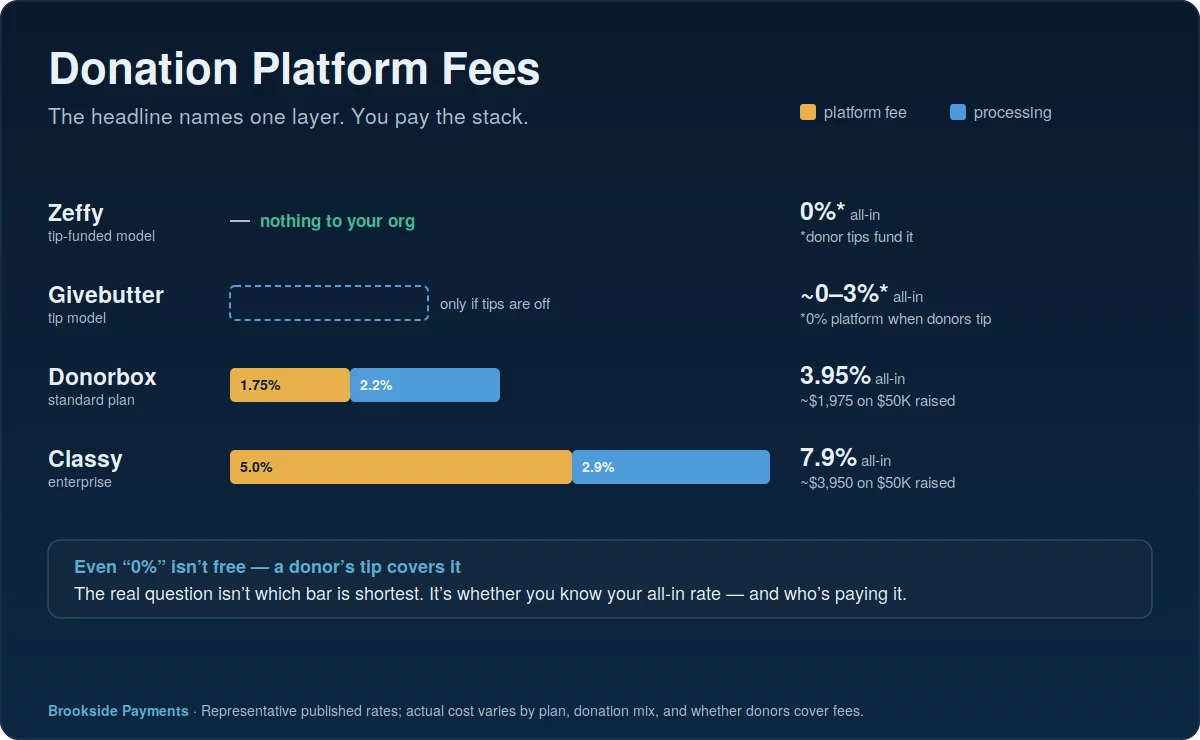
The major tools structure their pricing in genuinely different ways. Donorbox takes a modest cut — around 1.75% on its standard plan — on top of Stripe or PayPal processing, which lands most organizations near 4% all-in. Classy targets larger nonprofits with deeper tooling and a cut of roughly 5% or more, which once processing is added can approach 8% of each gift. Givebutter and Zeffy use a tip model: the tool charges the organization little or nothing and instead asks donors to add an optional tip, which funds the platform.
Those tip-model tools are genuinely inexpensive for the organization — but “free” deserves an asterisk, because the cost didn’t disappear, it moved to the donor. Whether that’s the right trade depends on your donor base and how comfortable you are asking them to cover both the gift and the tool. On $50,000 raised, that spread is the gap between keeping roughly $48,000 and keeping closer to $46,000 — real program money, decided largely by which tool you happened to start with. The headline number alone won’t tell you; the all-in cost, and who absorbs it, will.
Donor-Covered Fees and the Tip Question
The most underused lever here isn’t a discount — it’s letting the donor cover the cost. Most tools can show a “cover the fee” option at checkout, and a large share of donors opt in when asked, which drops your processing cost on those gifts to nearly nothing. The tip-funded tools simply make this the default rather than an option.
It’s a real and legitimate way to keep more of each gift, with one honest caveat: it shifts cost onto the people already giving you money, and not every donor opts in. Used deliberately — alongside the nonprofit processing discount and a cleaner set of tools — it can meaningfully lower what your organization absorbs without cutting a single program.
A zero-cost tool isn’t charity from the provider — it’s a different payer. That can be a perfectly good deal, but treat it as a choice about who covers the cost, not proof that the cost is gone.
Add Up the Layers and Find Your Real Donation Platform Fees
The only number worth acting on is your all-in rate: every charge from every layer — the tool, the processor, and any monthly subscription — divided by total dollars raised over a month. Pull it with the effective rate calculator, using your tool’s payout reports and your processing statement together so nothing hides between the two. It sits inside the bigger picture of nonprofit payment processing — the charity discount, the donation-only rule, and the platform-versus-standalone choice — but it starts here, with one honest total.
Before switching tools or accepting a quote, add the layers on both sides and compare all-in rates. A higher tool charge with cheaper processing can beat a “free” tool once you account for who’s really paying — and only the total tells you which is true for your organization.
Frequently Asked Questions
They’re a stack, not a single number: a platform fee (anywhere from 0% to 5%+), a payment processing fee (around 2.2% to 2.9% plus a fixed amount), and on some plans a monthly subscription. All-in, most organizations land somewhere between roughly 3% and 8% — the headline rate names just one of those layers.
Free to your organization, yes — but donor-funded. Tools like Zeffy and Givebutter run on optional donor tips, so the cost moved to the donor rather than disappearing. That can be a good trade, but it’s a choice about who pays, not proof the fee is gone.
Claim the nonprofit processing discount you qualify for, turn on donor-covered fees, and consolidate tools so you’re not paying overlapping layers. Most importantly, compare all-in totals rather than headline rates before switching — the cheapest-looking tool isn’t always the cheapest once every layer is counted.
Send Us Your Platform Reports. We’ll Add Up Every Layer.
Between the platform charge, the processing rate, and any subscription, almost no nonprofit has seen its fundraising costs totaled in one place. Send Brookside a recent payout report and processing statement and we’ll compute your real all-in rate, tell you whether a cheaper setup actually exists once every layer is counted, and flag any discount you’re leaving unclaimed. The read takes us about fifteen minutes. Learn more about payment processing consumer protections from the CFPB.
Check Our All-In RateNo obligation • No pressure • Response within one business day
See what a statement review looks like →