Nonprofit Payment Processing: The Discount and Its Trap
There’s a Discount Most Nonprofits Never Claim
Nonprofit payment processing has a quirk that costs organizations real money: there is a discounted rate built specifically for charities, and most never apply for it. The ones who do often don’t realize it comes with a line drawn through their revenue — the discount covers donations, and nothing else. Every dollar lost to a fee that didn’t have to be there is a dollar a donor meant for the cause, not for a processor.
The good news is that almost all of it is recoverable once you can see it. Between the unclaimed discount, the fees stacked across the tools you already run, and the option to let donors cover the cost, the typical organization is leaving a meaningful share of its giving on the table — not because the money is gone, but because no one has separated the layers and looked.
What you actually pay to process a gift is the sum of every layer — the donation platform’s fee, the payment processor’s rate, and sometimes a monthly subscription on top. They are separate decisions wearing one number, and each one is adjustable.
Claim the Charity Rate: Then Mind the Line
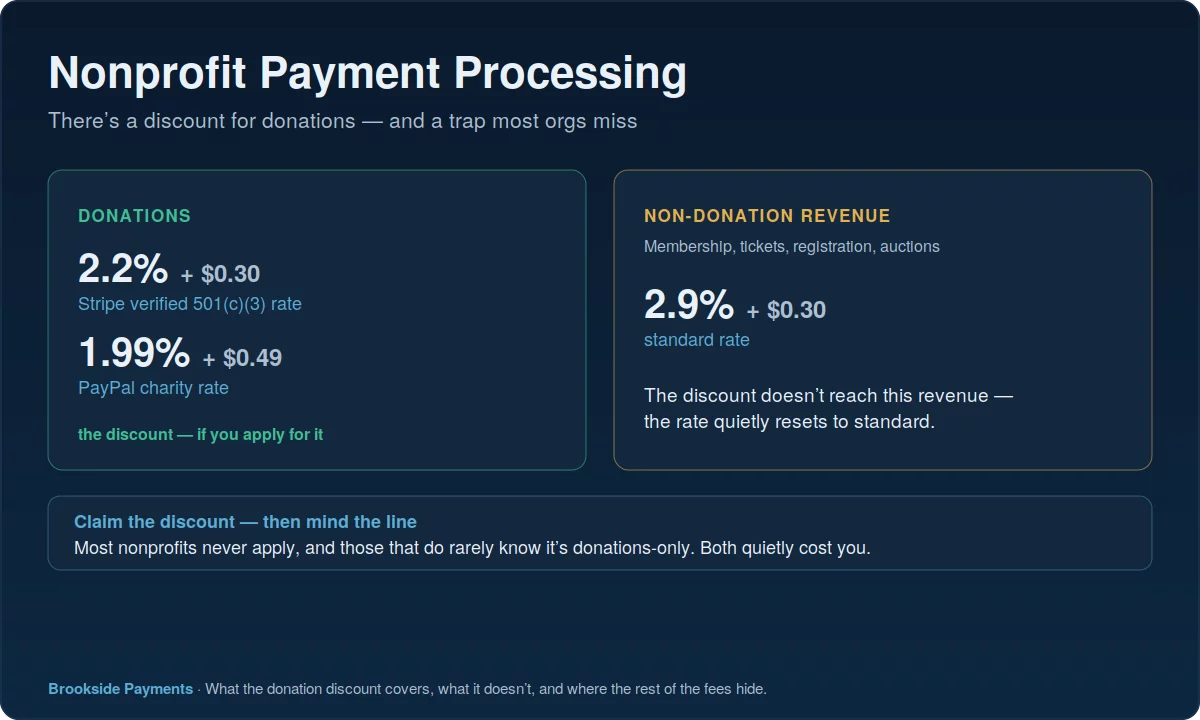
For verified 501(c)(3) organizations, the two largest processors publish discounted rates. Stripe drops its standard 2.9% + $0.30 to a charity rate of about 2.2% + $0.30; PayPal offers roughly 1.99% + $0.49. You apply directly — Stripe at its nonprofit email, PayPal through its Nonprofit Center — with your EIN or IRS determination letter. On meaningful volume, that gap alone is hundreds to thousands of dollars a year.
Here is the part almost no one is told: the discount applies to donations only. Membership dues, event tickets, program registrations, and auction payments bill at the standard rate, and Stripe expects donations to make up the large majority of your volume to keep the discount at all. So the moment your revenue stops being a gift, the rate quietly resets — and an organization that runs galas, classes, or a membership program can be paying full freight on a big slice of its income without realizing the discount never reached it.
If a large share of your income is tickets, dues, or registrations rather than donations, the charity discount is doing less for you than the headline suggests. Knowing your donation-to-everything-else mix is the first step to knowing your real blended rate.
You’re Probably Paying at More Than One Layer
Most organizations don’t take donations through a bare processor — they use a donation platform, and the platform bundles the processing. That convenience hides a stack: you pay the platform’s fee and the processor’s rate, and on many plans a monthly subscription as well. A donation page advertised as “free” or “low-fee” can still cost several percent once every layer is counted, because the headline almost always names just one of them. On $50,000 raised, nonprofit payment processing can quietly run 5% or more once a 3% platform fee stacks on a 2.2% card rate — roughly $2,600 a year, and well past $3,500 for an organization that never claimed the discount, all of it donor money that never reached the work.
This is the single biggest source of quiet overpayment in the sector, and it’s worth seeing in detail — how the major platforms structure those fees, and where the same gift can cost very different amounts. We break the platforms down in our guide to donation platform fees. The point for now is simpler: until you add the layers together, you don’t actually know what a donation costs you.
Let Donors Cover the Fee
One of the most effective ways to cut nonprofit payment processing cost isn’t a rate negotiation at all — it’s a checkbox. Most donation tools can offer donors the option to add a little to cover the processing fee, and a surprisingly large share of donors opt in when asked. On those gifts, your processing cost effectively drops to zero, because the donor absorbed it on top of their intended contribution.
It isn’t a complete answer — not every donor opts in, and it adds a small step to the giving flow — but combined with the charity discount and a cleaner stack, donor-covered fees can move your blended cost down meaningfully without asking the organization to spend a dollar more.
Claim the charity discount, collapse the fee stack where you can, and turn on donor-covered fees. No single move fixes everything; together they decide how much of each gift actually reaches the work.
How to Find Your Real Nonprofit Payment Processing Rate
The number that matters is your effective rate across everything — total fees from every layer (platform, processor, and any subscription) divided by total dollars raised over a month. That figure, not any single advertised rate, is what your organization actually pays; here’s how to pull the pieces off your statement and platform reports. Then ask three things: have we applied for the charity discount? What share of our revenue is non-donation, billing at full rate? And are donors being offered the chance to cover the fee?
The money is in seeing all the layers at once. Most nonprofits overpay for years because the platform fee, the processing rate, and the unclaimed discount were never added up in a single view — and once they are, the fix is usually obvious.
Frequently Asked Questions
Yes. Verified 501(c)(3) organizations can apply for charity rates — roughly 2.2% + $0.30 from Stripe and 1.99% + $0.49 from PayPal, versus the standard 2.9%. You apply directly with your EIN or IRS letter. The catch: the discount covers donations only, so membership, tickets, and registrations still bill at the standard rate.
Usually fee-stacking. Most organizations pay a donation platform fee and a payment processing fee — two separate layers, plus a monthly subscription on some plans. The rate you were quoted is almost never the all-in cost, so the real total stays hidden until you add the layers together.
It’s worth offering. Most donation tools support it, and a large share of donors opt in when asked, which removes the processing cost on those gifts entirely. The trade-offs are minor — not everyone opts in, and it adds a small step to the donation flow — but it’s one of the simplest ways to keep more of each gift.
Send Us One Statement. We’ll Add Up Every Layer.
Between the charity discount, the platform fee, and the processing rate, most nonprofits have never seen their all-in cost in one place. Send Brookside a recent statement and a platform report and we’ll compute your real effective rate across every layer, tell you whether you’re getting the discount you qualify for, and show where the leak is. The read takes us about fifteen minutes. Learn more about payment processing consumer protections from the CFPB.
Check Our Nonprofit’s Real RateNo obligation • No pressure • Response within one business day
See what a statement review looks like →