Foundation Repair Payment Processing: The Trade Where the Card Isn’t the Main Rail
The Trade Where the Card Isn’t the Main Rail
Foundation repair payment processing works differently from almost every other trade, and the reason is simple arithmetic. A pier-and-beam stabilization runs $8,000. A full underpinning job runs $25,000 or more. Nobody hands you a Visa for that. They don’t have the limit, and if they do, they don’t want to use it.
So the question that matters for a foundation company isn’t "what’s my card rate." It’s which rail should this job run on — card, bank transfer, or financing — because on a job this size, that single decision moves more money than any rate you’ll ever negotiate.
The Same $18,000, Three Different Costs
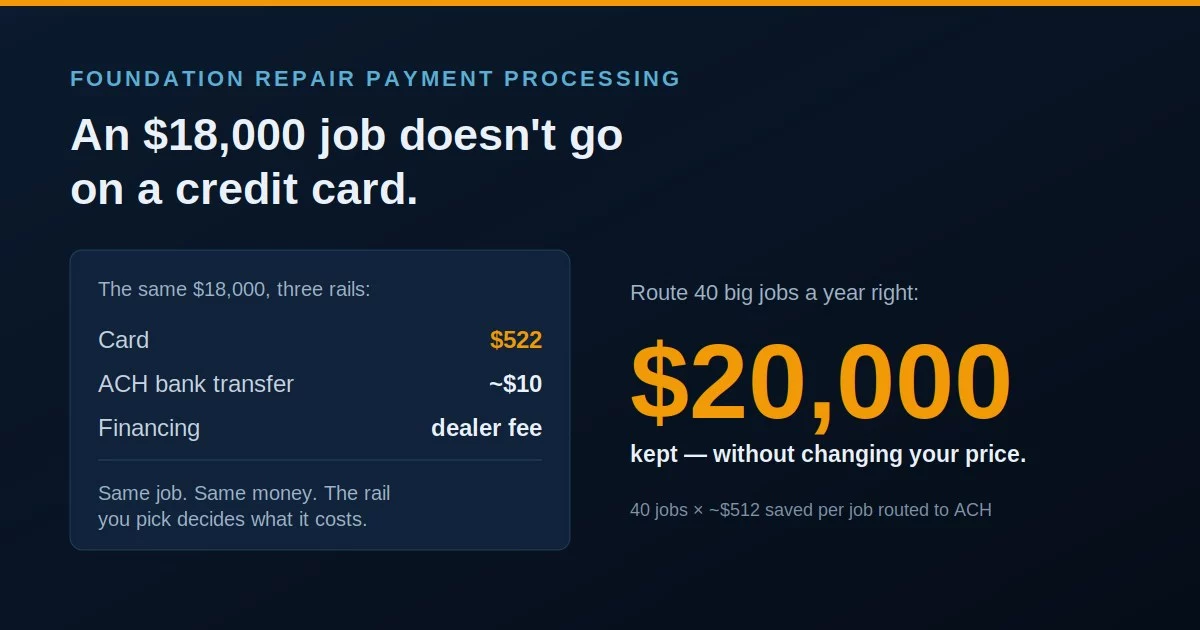
Foundation repair payment processing comes down to this comparison. Run one typical job through each rail and the spread is impossible to ignore.
- Card: 2.9% + 30¢ = about $522 in processing fees
- ACH bank transfer: a flat fee, typically under $15 — often capped regardless of size
- Third-party financing: a dealer fee to the lender, but the homeowner can actually afford the job
- Same job, same money in your account. The rail decided the cost.
That is the whole of foundation repair payment processing in one line: roughly $512 of difference on one job. Route forty big jobs a year to the right rail and you keep about $20,000 — without raising a price, cutting a crew, or renegotiating a thing.
Financing Isn’t a Fee. It’s the Sale.
Here’s where foundation repair payment processing gets decided, and where most contractors get the math backwards. They look at a lender’s dealer fee — a percentage taken off the top when the homeowner finances — and see it as an expensive way to get paid. It isn’t. It’s the price of a sale that otherwise doesn’t happen.
Foundation work is a distress purchase. Nobody wakes up wanting it — there are cracks in the drywall and a door that won’t close, and now there’s an engineer’s report. It’s urgent, it’s unbudgeted, and it’s five figures. A homeowner who can’t write that check doesn’t shop around. They wait. And a job that waits is a job you didn’t book.
Measured against a lost job, a dealer fee is cheap. Measured against a card fee, it looks expensive. Contractors who compare it to the wrong thing talk themselves out of the revenue. This is the same logic as buy now, pay later in retail, scaled up to a number that decides whether the work happens at all.
Don’t Take Cards Off the Table: Aim Them
None of this means foundation repair payment processing should abandon cards, or that a foundation repair merchant account should stop accepting them. It means the card should be pointed at the parts of the job where it earns its fee.
- Deposits. A $1,500 deposit on a card costs about $44 and locks the job in on the spot, at the kitchen table, before the homeowner cools off.
- Small repairs. A $900 crack seal or a pier adjustment isn’t worth routing anywhere else.
- The final draw, when a homeowner wants the points and is happy to pay the convenience.
The mistake isn’t taking cards. The mistake is taking the whole $18,000 on one, by default, because it’s the only rail anyone ever set up for you.
On What You Do Run, Price It Honestly
Foundation repair payment processing still has a rate problem underneath the rail problem, and a foundation repair merchant account has to solve both. Deposits, repairs, and final draws add up to real card volume across a year, and because tickets are large, the percentage is nearly the entire cost — the fixed per-transaction fee is a rounding error.
Most contractors sit on flat-rate or tiered pricing at 3.3% to 3.6% blended. On interchange-plus pricing, that card volume typically lands at 2.9% to 3.2% all-in — real cost plus one visible markup, and the same logic the home services trades run on.
Dual Pricing: Offset the Fee Instead of Shrinking It
There is one more lever in foundation repair payment processing, and it is the one most contractors never hear about. Interchange-plus lowers what the card costs. Dual pricing removes it from your books entirely. You post two prices — one for cash or check, one for card — and the card price carries the processing cost, exactly the way the fuel station down the road has done it for thirty years.
- A $1,500 deposit on a card: the ~$44 fee is built into the card price, not absorbed by you.
- The homeowner still has every option — and the cash or ACH price is genuinely the better deal, which nudges the big payments onto the cheap rail on their own.
- Your effective cost on kept card volume drops toward zero, without you refusing anyone’s card.
The mechanics matter, though, and getting them wrong is the fastest way to break an otherwise sound foundation repair merchant account. A cash discount program and a surcharge program are not the same thing legally, surcharging is capped and restricted in some states, and debit cards can never be surcharged. Set up wrong, it’s a card-brand violation; set up right, it’s the single biggest lever a foundation company has on the card volume it keeps.
How to Set Up Foundation Repair Payment Processing
Good foundation repair payment processing is a merchant account that carries all three rails, so the crew in the field can pick the right one instead of defaulting to the only one that exists.
- Turn on ACH bank transfer for full-job payments and progress draws — this is where the $500-a-job savings lives.
- Add a financing partner so an unaffordable $18,000 becomes an affordable monthly payment, and book the job today.
- Keep cards live for deposits, small repairs, and any homeowner who prefers them.
- Pull one statement, find your true effective rate, and move the card volume to interchange-plus.
- Then decide whether to offset that card cost with dual pricing rather than simply reduce it — done compliantly, it takes the remaining fee off your books.
Done in that order, a foundation company stops paying card rates on jobs that never needed a card, and stops losing jobs that only needed a payment plan.
Frequently Asked Questions
Yes — for deposits, small repairs, and homeowners who prefer them. The error is routing an entire five-figure job to a card by default. ACH is dramatically cheaper on large payments, and financing closes jobs a card can’t.
Compare it to the right thing. Against a card fee it looks expensive; against a job the homeowner can’t afford and therefore postpones, it’s cheap. Foundation work is an unbudgeted distress purchase, so financing frequently is the difference between a booked job and no job.
Yes, with a properly built dual pricing or cash discount program. The card price carries the processing cost while cash, check, and ACH stay cheaper. Surcharging specifically is capped, restricted in some states, and never allowed on debit — so the program has to be set up compliantly.
On the card volume you do run — deposits, repairs, final draws — interchange-plus typically lands around 2.9% to 3.2% all-in. Because tickets are large, the percentage is effectively the whole cost, so judge the effective rate, never the quoted one.
Send One Statement. We’ll Map the Rails.
If five-figure foundation jobs are running across a credit card, that’s roughly $500 a job you didn’t have to spend. Send Brookside one recent statement and we’ll show you your true effective rate, which jobs belong on ACH, and where financing would book work you’re currently losing — about fifteen minutes of math. Learn more about payment processing consumer protections from the CFPB.
Send Your Statement for a Free ReviewNo obligation • No pressure • Response within one business day
See what a statement review looks like →