Pizza Shop Payment Processing: You’re Negotiating the Wrong Fee
You’re Negotiating the Wrong Fee
Every pizza owner has haggled with a processor over a tenth of a point. Almost none have run the same math on the delivery app, and the delivery app is charging them six times more.
That’s the strange thing about pizza shop payment processing. It is the one restaurant category where the card fee — the thing you actually negotiate, shop, and lose sleep over — is not the biggest cost of getting paid. Not by a wide margin.
One $30 Order, Two Very Different Fees
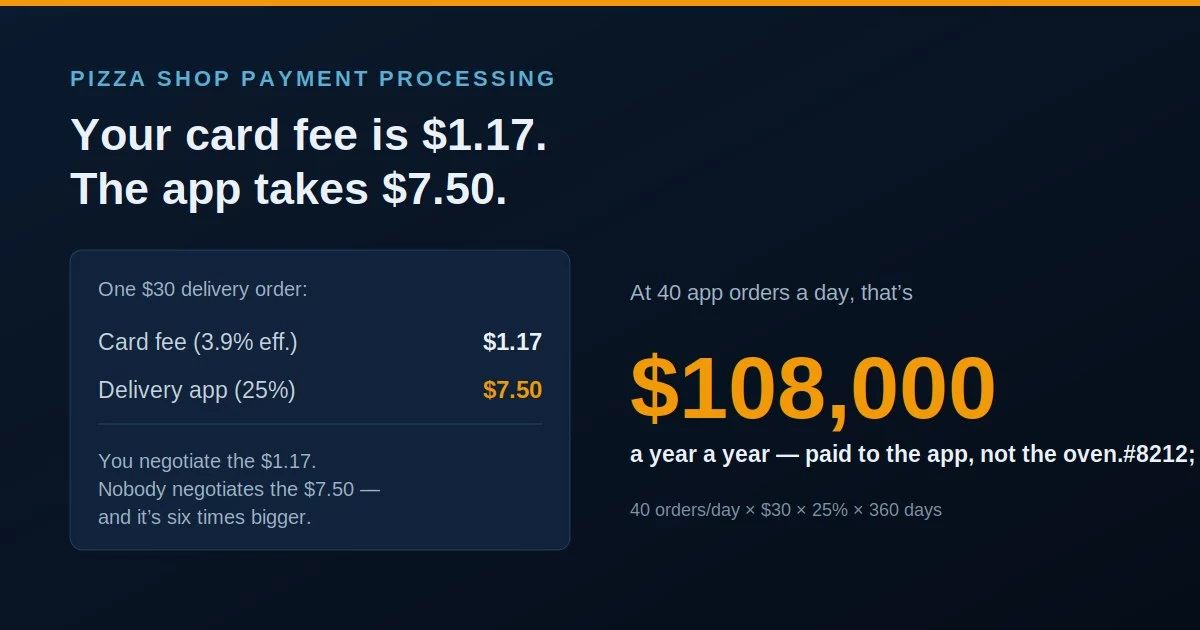
Pizza shop payment processing starts making sense the moment you take a single thirty-dollar delivery order and price it both ways.
- Card fee: 2.9% + 30¢ = $1.17, about a 3.9% effective rate
- Delivery app commission: 15% to 30% — call it 25%, or $7.50
- The app costs roughly six times what your processor does
- At 40 app orders a day, that’s about $108,000 a year in commission
Nobody calls the delivery app to renegotiate. Everybody calls the processor. The fee you can’t easily change is the enormous one, and the fee you fight over is the small one — which is exactly backwards.
The Apps Aren’t a Scam. They’re a Customer-Acquisition Cost.
To be straight about it, and any honest look at pizza shop payment processing has to be: the delivery apps earn their cut on a new customer. Someone who has never heard of your shop opens an app, sees you, and orders. That commission bought you a customer you didn’t have. Twenty-five percent of a sale you’d never have made is a fine trade.
The problem is what happens on order number two, and twelve, and forty. That customer knows you now. They love your pizza. And every time they reorder through the app out of habit, you hand over another 25% for a customer you already own. The commission stops being acquisition and starts being rent.
That’s the real subject of pizza shop payment processing: not escaping the apps, but making sure your regulars aren’t running through them.
Own Your Online Orders
Here is where pizza shop payment processing turns into real money. When a repeat customer orders from your own website instead of the app, the economics invert completely. That $30 order costs you the card fee — a dollar or so — instead of $7.50. Same pizza, same driver, same customer. You just stopped paying rent on a relationship you already had.
This is why first-party online ordering is the single highest-value thing a pizza shop can set up, and it’s a payments problem as much as a website problem. It runs on e-commerce payment processing and a gateway wired into your ordering page — the same payment API integration any online checkout uses. Get that right and every regular you move off the app is worth about six dollars an order to you, forever.
The Phone Order Is Quietly Expensive
There is one more leak in a pizza shop merchant account, and it rings. Pizza is one of the last businesses where people still call. And when a staffer keys that card number into the terminal by hand, it stops being a card-present swipe and becomes a keyed transaction — priced at the higher card-not-present tier, with more fraud exposure and more chargeback risk.
Most shops never notice, because the phone orders are blended into one number on the statement. But a shop taking a third of its orders by phone is paying a card-not-present premium on a third of its volume without knowing it — which is another reason to push regulars toward your own online ordering, where the transaction is properly authenticated instead of read aloud over a phone.
Cash Discount: The Pizza Shop’s Natural Fit
The last lever in pizza shop payment processing is the one that removes the fee instead of shrinking it. Pizza is a low-ticket, price-visible, cash-friendly business — which makes it close to the ideal candidate for a cash discount program or dual pricing. You post two prices, the card price carries the processing cost, and the cash price rewards the customer who pays with cash.
- Tickets are small, so the fixed 30¢ per transaction is brutal — on a $12 slice-and-drink order, that alone is 2.5%.
- Customers are already used to seeing cash and card prices differ in this category.
- Delivery drivers still take cash, so the cheaper rail is one you already run.
Set up compliantly, it takes the card cost off your books entirely. Set up carelessly, it’s a card-brand violation — the rules on surcharging versus discounting are specific, and debit can never be surcharged.
How to Fix Pizza Shop Payment Processing
Fix pizza shop payment processing by working the fees in order of size, which is the opposite of how most shops do it.
- Stand up first-party online ordering and give regulars a reason to use it — a loyalty deal, a free topping, anything. Every order you move off the app saves ~25%.
- Push phone customers to your online page so the transaction stops being keyed by hand.
- Pull one statement and find your true effective rate. On small tickets it will be higher than the rate you were quoted — that’s the fixed fee at work.
- Move the card volume to interchange-plus pricing, then decide whether to offset it entirely with a cash discount program.
Done in that order, pizza shop payment processing goes from a fee you argue about to a cost structure you actually control — and the biggest win doesn’t even come from your processor.
Frequently Asked Questions
No — they’re worth their commission on new customers you’d never have reached. The goal is to stop paying that commission on repeat customers. Move your regulars to your own online ordering and let the apps keep doing what they’re genuinely good at.
Small tickets. The fixed per-transaction fee is a percentage killer on a $12 or $30 order, so a headline 2.9% lands closer to 3.9% effective. That’s why a pizza shop should judge the effective rate, never the quote.
Yes. A card number keyed in by hand is treated as card-not-present, which carries higher interchange and more chargeback risk than a card tapped at the counter. A third of your orders by phone means a card-not-present premium on a third of your volume.
Send One Statement. We’ll Show You What You Actually Pay.
Your processor’s cut is the fee you can fix fastest — and on small tickets it’s almost always worse than you were told. Send Brookside one recent statement and we’ll show you your true effective rate, what the phone orders are costing you, and whether a cash discount program would take the card fee off your books — about fifteen minutes of math. Learn more about payment processing consumer protections from the CFPB.
Send Your Statement for a Free ReviewNo obligation • No pressure • Response within one business day
See what a statement review looks like →