In Garage Door, One Driveway Visit Is a $250 Repair or a $2,500 Door
In Garage Door, One Driveway Visit Is a $250 Repair or a $2,500 Door
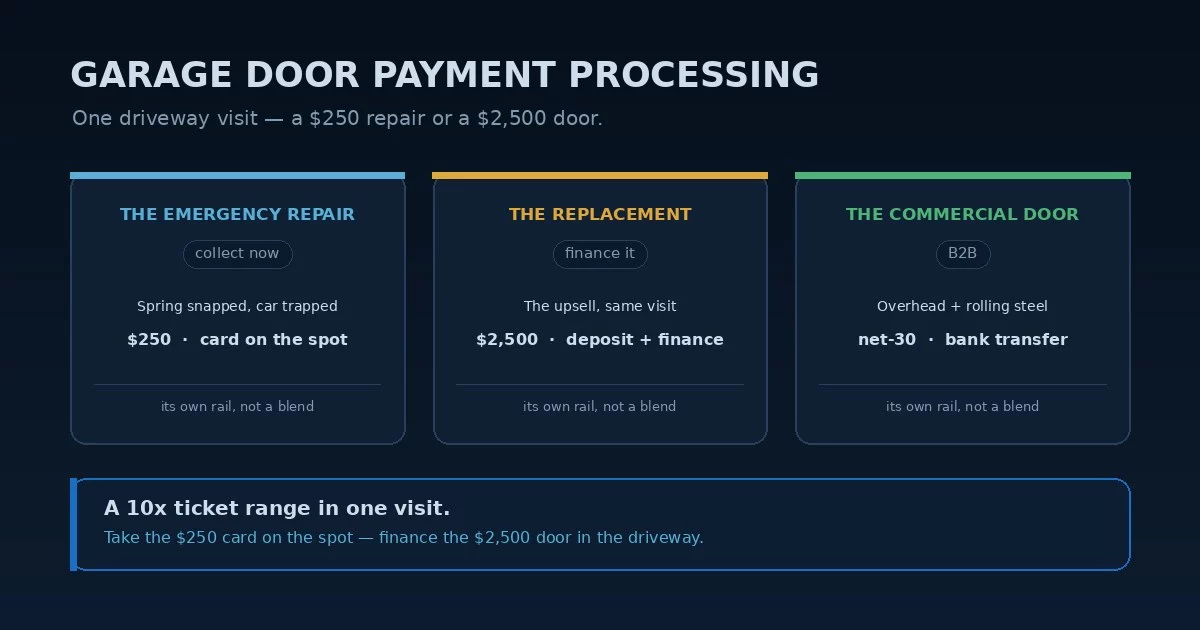
Garage door payment processing has a problem no other trade has quite so sharply: a single visit can be a small emergency repair or a full replacement, and which one it becomes is decided in the driveway. The spring snaps, the car is trapped, the tech rolls out for a $250 fix — and then finds a fifteen-year-old door and quotes a $2,500 replacement on the spot. That’s a ten-to-one swing in ticket size on one appointment, and the payment setup has to handle both ends of it: a fast card-present charge on the repair, and a financed deposit-and-balance on the new door, closed before the tech leaves. A single blended card rate with no financing behind it fits neither end, which is why garage door payment processing usually runs on whatever came bundled with the software.
That swing is the whole story. The repair is a collect-now, card-present transaction. The replacement is a considered purchase that most homeowners would rather finance than pay at once — and whether you can offer that financing in the driveway often decides whether the upsell closes or walks. Get garage door payment processing wrong and you don’t just overpay on the repairs; you lose the replacements that are the real money.
The Bundled Processor Handles the Repair and Misses the Door
Most garage door payment processing decisions get made by accident. The shop runs a field-service platform — ServiceTitan, FieldEdge, Housecall Pro, Jobber — and most ship with an integrated payments product that bundles card processing into the estimate-to-invoice flow. For the repair side that’s fine: the tech swipes a card for the spring job and moves on. The trouble shows up on the replacement, where a card-only bundled setup has no good answer for a $2,500 door the customer wants to spread out.
So the cost of the bundled default is two-sided. The repair volume sits on a blended rate nobody shopped, and the replacement either gets put on a credit card the customer didn’t want to max or it stalls for lack of a financing option in the field. It means your garage door payment processing setup, and your ability to close the bigger ticket, were decided by whoever your software vendor partnered with. As with any home services payment processing arrangement, the bundled default is rarely the best one, and the only way to know is to put it next to an interchange-plus quote — and a real financing option — on your actual mix of repairs and replacements.
A bundled card processor optimized for a $250 spring job leaves the replacement exposed: no way to finance the $2,500 door in the driveway, so the upsell depends on whether the customer happens to have the credit-card room. The setup that wins both has the repair on a clean rate and financing ready in the field. It’s the split that defines garage door payment processing.
The Spring Job: Urgent, First-Time, Collected on the Spot
The repair end of garage door payment processing behaves like any emergency trade. A broken spring or a dead opener is a distress purchase — the car is stuck, the home is exposed, and the customer is usually new with no history with you. That means the money gets collected on the spot, and a card tapped or dipped at the door beats one keyed in over the phone on both rate and fraud exposure. Standard repairs — spring replacement, cable and drum, track realignment, opener swaps — lend themselves to flat-rate pricing, which builds trust and protects margin, and the payment is a single card-present charge in the few hundred-dollar range.
Because these are high-frequency, mid-size tickets, the fixed per-transaction fee and the card-type mix matter as much as the headline rate — the same economics that make flat-rate pricing popular on the service menu make interchange-plus the right call on the processing side. Clean garage door repair payment processing on the spring jobs is mostly about taking the card present and pricing the frequent small ticket honestly, not about chasing a tenth of a percent.
A new customer in a hurry is the easiest job to take by phone and the most expensive way to take it — a keyed card carries a worse rate and higher fraud risk than the same card tapped at the door. On a high-volume repair book, the gap between card-present and keyed adds up fast.
Where Financing in the Driveway Wins the Door
The replacement is where garage door payment processing earns or loses the real money. When the tech converts a repair into a new door — or a homeowner books a planned upgrade — the ticket jumps to a few thousand dollars, and most buyers at that level would rather finance than pay in full. This is the lever the bundled card setup misses: financing offered in the driveway turns “let me think about it” into a signed job, while a card-only shop watches the upsell stall. The repair goes on a card; the $2,500 door wants a financing option or a clean deposit-and-balance structure, decided in the same visit.
The mechanics are worth getting right. A deposit at the order locks the job and covers the door you’re ordering in, with the balance on completion — and a card on file carries it across the two steps. For the customer who finances, you’re paid up front while they spread the cost. The point is that the replacement deserves a deliberate close, not a default swipe of a card the customer didn’t want to use, and a garage door merchant account built for the trade pairs fast repair collection with a financing-and-deposit path for the door. That pairing is the heart of garage door payment processing done well.
One is a fast card-present charge; the other is a financed or deposited four-figure close. Forcing the replacement through the repair’s card-only setup either burns the customer’s credit-card room or loses the job. Handle them as the two different transactions they are. That separation is where garage door payment processing pays off.
The B2B Lane, and the Account Underneath
Beyond the house there’s a commercial side to garage door payment processing — overhead doors, rolling steel, and dock equipment for warehouses, storefronts, and fleets. That work behaves like any commercial trade account: larger tickets, purchase orders, and net-30 terms where a bank transfer beats a card percentage outright and matches how business customers expect to pay. A shop that runs both residential and commercial wants its setup to handle the card-present repair, the financed residential door, and the net-30 commercial invoice without forcing all three onto one rail. Three lanes, three rails is garage door payment processing at full range.
The account underneath is refreshingly ordinary. A garage door company usually codes under MCC 1799, Special Trade Contractors — the same standard-risk family as the building trades, with no high-risk fork and no special account required. Garage door repair isn’t typically covered by a homeowner’s insurance policy either, unless it’s part of a larger covered event like a collision or storm, so there’s no third-party payer in the mix — card, financing, or bank transfer is the whole stream. Confirming the code is a free check, but the savings live in the rails and the rate structure on top of it: disciplined garage door credit card processing across repairs, replacements, and commercial work beats any code tweak.
What Actually Lowers a Garage Door Company’s Card Cost
The levers that move garage door payment processing are structural, not a tenth of a percent on the swipe. Done right, garage door payment processing puts the repair, the replacement, and the commercial invoice each on the rail that fits, and keeps financing ready for the door.
- Move the repair volume to interchange-plus so the high-frequency spring and opener jobs are priced on true cost, where the fixed fee and card mix matter more than the headline rate.
- Have financing ready in the driveway so the tech can close the replacement on the spot instead of losing it to “let me think about it” or burning the customer’s credit-card room.
- Take every emergency card-present — tapped or dipped at the door, not keyed over the phone, for the better rate and lower fraud risk on first-time customers.
- Put commercial work on a bank transfer — net-30 ACH on overhead-door and dock jobs, so the B2B side stops paying a card percentage it doesn’t need to.
Garage door payment processing is a two-tickets-in-one-visit problem before it’s a rate problem. The owner who sets up the repair to collect fast and the replacement to finance cleanly almost always gains more — in closed replacements and honestly-priced repairs — than any rate cut on its own could deliver.
Frequently Asked Questions
Because one visit spans a ten-to-one ticket range. A card terminal handles the $250 spring repair fine, but the $2,500 replacement the tech upsells in the same driveway usually needs financing or a deposit-and-balance structure — and a card-only bundled setup has no answer for it. Garage door payment processing that wins the bigger job pairs fast card-present repair collection with financing ready in the field.
Usually, yes. The emergency repair is a fast, card-present charge collected on the spot — tapped at the door for the best rate. The replacement is a considered four-figure purchase most homeowners would rather finance than pay at once, so financing or a clean deposit-and-balance fits it better than forcing it onto a credit card. Handling them as two different transactions is the core of garage door repair payment processing done right.
No. A garage door company usually codes under MCC 1799 (Special Trade Contractors), the same standard-risk family as the building trades — no high-risk fork. The savings come from pricing the repair volume on interchange-plus, having financing ready for replacements, and putting commercial work on ACH — the way garage door company payment processing actually works — not from a special account.
Send Your Statement. We’ll Price the Repair and Set Up the Door.
If your processor came bundled with ServiceTitan, FieldEdge, or another platform, send Brookside one recent statement. We’ll break the repair volume into an interchange-plus view, show you what card-present capture would save, and walk through financing and deposit options so the tech can close the replacement in the driveway instead of losing it. The review takes about fifteen minutes. Learn more about payment processing consumer protections from the CFPB.
Send Your Statement for a Free ReviewNo obligation • No pressure • Response within one business day
See what a statement review looks like →