Instant Payments vs ACH: FedNow, RTP, and When Each Wins
Start With What You’re Actually Choosing
If you are weighing instant payments vs ACH for your business, the first thing to understand is that you are really choosing among three bank rails, not two. ACH is the slow, cheap workhorse that has moved payroll, vendor payments, and recurring bills for decades. Alongside it now sit two instant rails: RTP, the Real-Time Payments network run by The Clearing House, and FedNow, the Federal Reserve’s instant rail launched in 2023.
Here is the part most comparisons miss: for a business, RTP and FedNow are nearly identical. They settle in seconds, run around the clock, and now move up to ten million dollars per transfer. So the question is rarely FedNow vs RTP — it is when an instant rail beats ACH, and when ACH (or a card) is still the right tool. This guide walks each rail on the axes that actually drive the decision.
A payment rail is the network that moves the money between banks. Cards, ACH, RTP, and FedNow are four different rails, each with its own speed, cost, limits, and rules. The same dollar can travel any of them — the choice is what it costs you and how fast it clears.
RTP and FedNow: Fast, Final, and Almost the Same
Both real-time payments rails do the same core thing. A payment settles in seconds, with the money in the receiver’s account and available immediately. Both run 24/7/365, including nights, weekends, and holidays. Both raised their ceilings to ten million dollars in 2025 — the RTP network in February, FedNow in November — which opened them up to real estate closings, payroll funding, and large supplier payments that used to require a wire.
Both are also credit-push only: you can send funds, but you cannot reach into someone else’s account and pull them. And both are irreversible — once an instant payment lands, there is no built-in return or chargeback. Network cost is a flat few cents per transfer, with no percentage taken out, which is the whole reason businesses look at them in the first place.
So if RTP and FedNow are this similar, how do you pick? Usually you do not — your bank does. An instant payment only completes if both your bank and the other party’s bank are reachable on the same rail. Plenty of banks support one network, some support both, and coverage keeps expanding. Practically, FedNow vs RTP comes down to which rail connects you and your counterparty, not which has the better feature list.
Push-only and irreversible cut both ways. There are no chargebacks to manage, which is great when you are getting paid. But if you send to the wrong account, there is no automatic clawback — recovery depends on the receiving bank’s cooperation. Treat instant payments like cash: confirm the account before you hit send.
ACH Is Slower — But It Does Two Things Instant Rails Can’t
Standard ACH payment processing takes one to three business days to settle, and it only moves on banking days. Same-day ACH compresses that into a few same-day windows but still skips weekends and holidays. Its cost is pennies per transaction, often cheaper than the instant rails, which is why it remains the default for high-volume, non-urgent money movement.
What keeps ACH essential is two abilities the instant rails simply do not have. First, ACH can pull: with authorization, you can debit a customer’s account, which is what makes autopay, subscriptions, and recurring billing work. RTP and FedNow can only push, so a customer has to initiate every instant payment. Second, ACH is reversible — returns, disputes, and unauthorized-debit reversals exist — which is a form of protection an irreversible rail cannot offer. Add near-universal reach (almost every U.S. bank account is ACH-reachable), and the slow rail still wins a lot of jobs.
If you bill the same customers every month, ACH’s ability to pull on a schedule is decisive — you are not waiting on each person to push a payment. For the cost difference between rails, see what you actually pay in ACH processing fees and the rules behind it from Nacha.
Instant Payments vs ACH vs Cards, in One Table
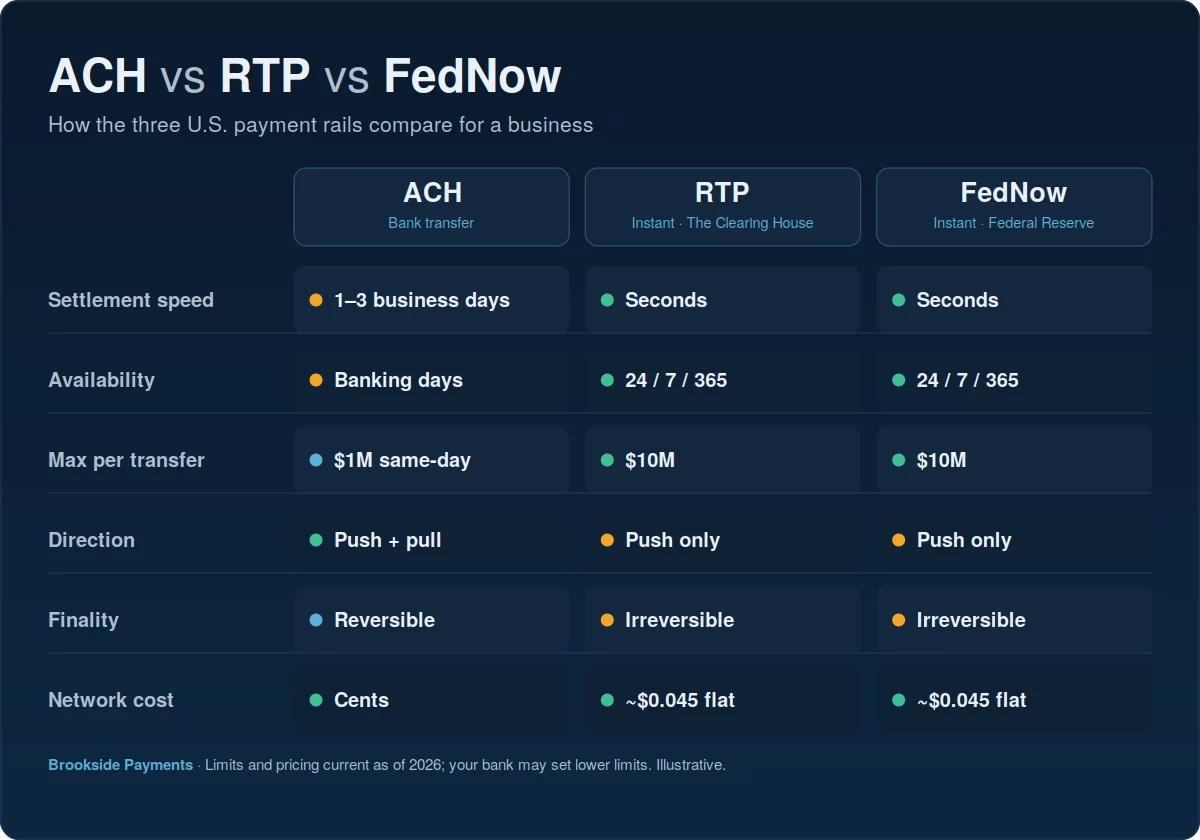
The same comparison from the chart above, in text — the axes a business actually decides on:
| ACH | RTP | FedNow | |
|---|---|---|---|
| Settlement speed | 1–3 business days | Seconds | Seconds |
| Availability | Banking days | 24 / 7 / 365 | 24 / 7 / 365 |
| Max per transfer | $1M same-day | $10M | $10M |
| Direction | Push and pull | Push only | Push only |
| Finality | Reversible | Irreversible | Irreversible |
| Network cost | Cents | ~$0.045 flat | ~$0.045 flat |
Read it by column-strength: the instant rails win on speed, availability, and limit; ACH wins on direction and reversibility; and all three beat a card on cost, since card acceptance runs roughly two to three percent rather than a few flat cents. If most of your revenue currently moves over cards, that gap is where the money is — you can estimate your own card processing cost here. Limits and pricing are set at the network level and current as of 2026; your own bank may cap transfers lower.
Which Rail Belongs on Which Payment
The instant payments vs ACH decision is really a routing problem — the goal is not to crown one rail, it is to route each payment to the cheapest one that fits the job. A few clean rules of thumb:
Cards earn their two-to-three percent when you are selling to consumers at checkout and dispute protection matters. That cost buys you reach, familiarity, and a built-in chargeback process — worth it for retail and e-commerce, wasteful for a $40,000 invoice to a repeat business client.
ACH is the answer for anything recurring or pulled: subscriptions, membership dues, autopay, and B2B invoices you bill on terms. It is also the cost floor for high-volume, non-urgent payments where a one-to-three day wait is fine. When you are deciding between bank rails, ACH vs wire transfer covers the higher-value end of that same call.
Instant payment rails (RTP and FedNow) earn their place when speed and finality are worth a flat few cents: supplier payments you want to clear now, high-ticket transfers like real estate or payroll funding, contractor and vendor payouts, and anything that hits after banking hours. If your pain is the gap between a sale and the cash landing, compare it against next-day funding on your card deposits and against consumer-initiated pay by bank.
Most businesses overpay simply because every dollar runs over the one rail they set up first — usually cards. Matching each receivable to the right rail is where real cost comes out, without changing a thing your customers see.
Frequently Asked Questions
No. They are separate networks — FedNow is run by the Federal Reserve, RTP by The Clearing House — but for a business they behave almost identically: instant, 24/7, push-only, irreversible, with a flat per-transfer fee. Which one you can actually use depends on whether your bank and the other party’s bank are connected to it.
Only if both banks are reachable on the same rail. Real-time payments coverage is large and growing, but it is not yet universal, so an instant transfer can fail simply because one side’s bank is not connected. ACH and cards still have the widest reach, which is why most businesses use instant rails alongside them, not instead of them.
No — they are additive. Cards stay best for consumer checkout where dispute protection matters, ACH stays best for recurring billing you pull and for low-cost reach, and instant rails win where speed and finality justify a flat fee. The savings come from putting each payment on the right one.
Tell Us How You Get Paid. We’ll Show You What Belongs Off Cards.
If most of your revenue runs over cards out of habit, you are likely paying two to three percent on payments that could move for cents. Send Brookside your payment mix or a recent statement and we’ll map each receivable to the cheapest rail that fits — ACH, an instant rail, or cards where they earn their keep. The review takes us about fifteen minutes. Learn more about payment processing consumer protections from the CFPB.
Map My Payments to the Right RailNo obligation • No pressure • Response within one business day
See what a statement review looks like →