Marina Payment Processing: Several Businesses, One Dock
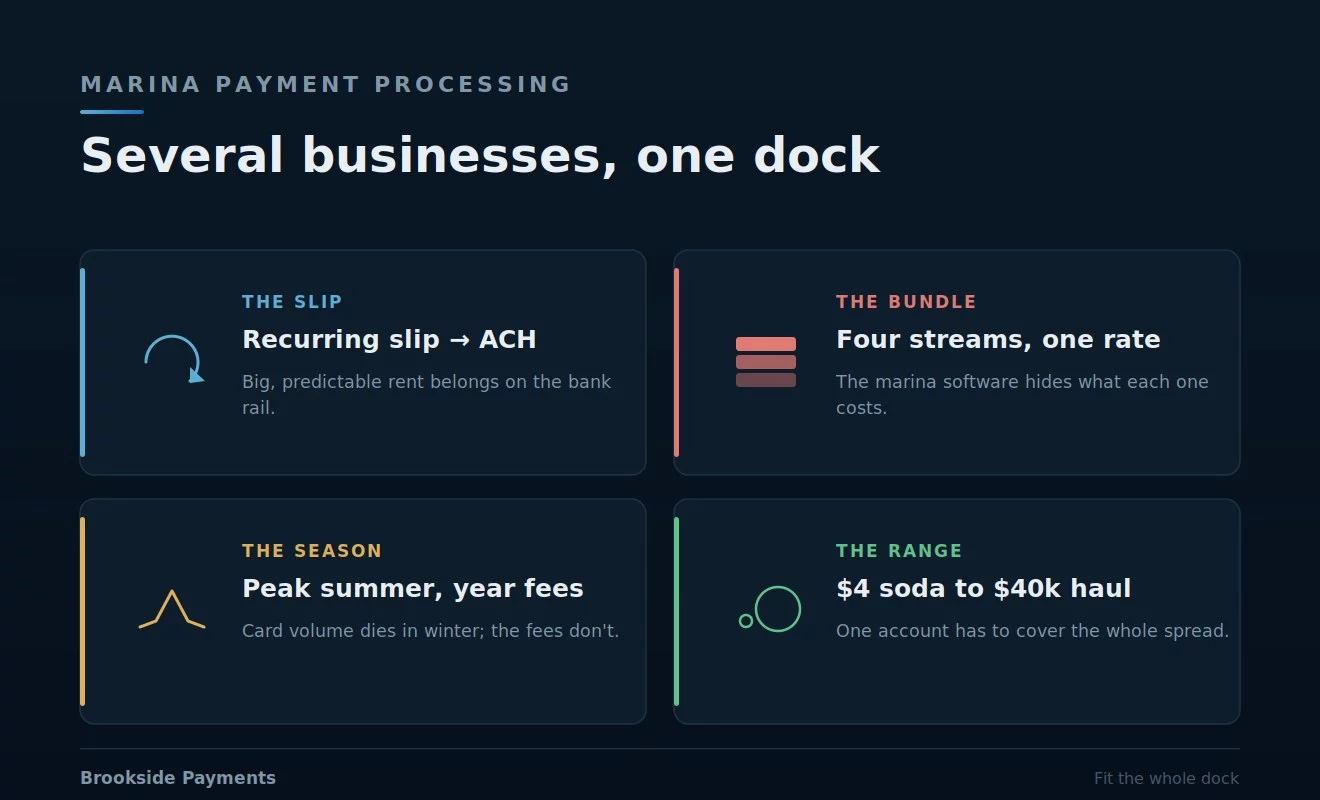
A Marina Is Several Businesses Sharing One Dock
Most merchants run one kind of business. A marina runs four at once: it rents slips on a season-long recurring contract, sells fuel at the dock, writes service and repair tickets in the yard, and rings up snacks and gear in the ship’s store — often storing boats over the winter on top of it. Each of those is a different payment pattern, and they all flow through the same register. That mix is what makes marina payment processing its own problem: it isn’t retail, it isn’t a service shop, and it isn’t a subscription business — it’s all three plus a fuel pump, and the setup has to fit the whole dock, not one slice of it.
The catch is that the marina-management software running your operation — DockMaster, MARINAGO, The Marina Program, and the rest — usually comes with the processing baked in, at a rate the software vendor sets and bundles across every one of those revenue streams. So the question in marina payment processing isn’t just “what’s my rate,” it’s “what am I paying on slip fees versus fuel versus the shop, and can I even see it?” Most marina operators can’t — and that’s where the money quietly leaks.
Seasonal Slip Rent Is Recurring Money: Stop Paying Card Rates on It
A seasonal slip can run a few thousand dollars, billed monthly or as a season-long contract, and at many marinas the front desk still keys those cards by hand on the first of the month — a full day of work just to collect rent. On a $3,000 seasonal slip, paying card interchange instead of moving it to ACH is the difference between roughly ninety dollars in fees and a few dollars. Across a dock full of slips, that’s real money handed over for no reason other than habit. The single biggest lever in marina payment processing is treating recurring slip rent like the rent it is: put it on ACH or e-check with a card-on-file backup, not full card rates.
This is the same logic property managers use on rent and childcare centers use on tuition — when the ticket is big and the payment repeats, the method matters more than the rate. A clean marina merchant account sets up automated recurring billing for slip contracts on the low-cost bank rail, keeps a card on file for the boaters who insist on it, and stops the monthly hand-keying marathon entirely. The slip fee is your most predictable revenue; it should be your cheapest to collect, not your most labor-intensive.
In marina payment processing, a $3,000 seasonal slip on card interchange costs ~$90 where the same payment by ACH costs a few dollars. Slip rent is large, predictable, and repeating — the textbook case for ACH/e-check with a card-on-file backup. Automate the recurring billing on the bank rail and you cut both the fees and the first-of-the-month hand-keying that eats a front-desk day.
One Software Rate Hides What You Pay on Four Different Businesses
The marina-management platform that runs your slips, fuel, service, and store is genuinely useful — and it almost always bundles the card processing in at a single rate the vendor sets. That convenience is also a blindfold: a marina’s revenue streams have very different cost profiles (a $40,000 boat-storage charge, a $4 soda, a $200 fuel fill, a $1,200 repair), and a bundled flat rate charges them all the same way, hiding where you’re overpaying. This is the core of marina credit card processing done poorly — the rate is buried inside the software bill, impossible to compare, and built to stay that way.
Pulling the processing apart from the software is usually the biggest single saving available, and it rarely means giving up the platform you like. Many marina systems integrate with outside processors, which means you can keep DockMaster or MARINAGO for operations and route the actual card processing to an interchange-plus account where every stream’s true cost is visible. Good marina payment processing separates the software you run on from the rate you pay, so a $40,000 storage charge isn’t quietly priced like a candy bar.
Marina platforms bundle card processing at one vendor-set rate across slips, fuel, service, and retail — wildly different ticket sizes charged identically, with the real cost hidden in the software bill. Most systems integrate with outside processors, so you can keep the platform and route processing to a transparent interchange-plus account. Separating the two is usually the largest single saving in marina payment processing.
Peak Summer, Dead Winter: But the Fees Run All Twelve Months
A marina’s card volume looks like a mountain: huge through the summer season, a trickle once the boats are hauled. The processing setup, though, often charges like it’s August all year — monthly minimums, statement fees, gateway fees, and software costs that keep billing through a winter when almost nothing is moving. That mismatch between seasonal revenue and year-round fixed fees is a quiet drain, and it’s a defining feature of marina payment processing that generic retail accounts simply aren’t built for.
The fix is a setup that breathes with the season: an account without punishing off-season minimums, the ability to scale down dormant-month costs, and interchange-plus pricing so the busy months aren’t padded with markup on top of the volume. A boatyard payment processing arrangement that ignores the seasonal shape leaves you paying peak-season overhead in February for a dock full of shrink-wrapped boats. Match the cost structure to the calendar your business actually runs on.
Card volume peaks in summer and collapses in winter, but minimums, statement fees, gateway fees, and software costs often bill all twelve months. Push for no off-season minimums, the ability to wind down dormant-month costs, and interchange-plus so peak months aren’t padded with markup. In marina payment processing, a setup that charges like August in February is paying for boats shrink-wrapped on the hard.
One Account Has to Cover a $4 Soda and a $40,000 Haul-Out
Few businesses span the ticket range a marina does in a single day: a card-not-present fuel pre-pay, a swipe at the dockside terminal, a four-dollar drink in the store, a phone-ordered winter haul-out and storage contract worth tens of thousands. Each end of that range carries different risk and different economics — the micro-ticket where the per-transaction fee bites, the high-dollar charge where the rate and a possible chargeback bite, and the card-not-present pieces (fuel pre-pays, phone bookings) where you carry the fraud exposure. Marina payment processing has to be underwritten and equipped for the whole spread, not the average.
Practically, that means dockside mobile readers that work away from the office, a virtual terminal for phoned-in bookings and fuel pre-pays, and an account whose risk profile expects the occasional five-figure transaction so a big storage charge doesn’t trip a hold. The marinas that get marina management software payments right size the account for the extremes — the smallest ticket and the largest — because both happen at the same dock on the same day.
A marina rings up four-dollar drinks and five-figure haul-outs from the same register, plus card-not-present fuel pre-pays and phone bookings. Spec for the spread: dockside mobile readers, a virtual terminal for phoned-in payments, and an account whose underwriting expects an occasional large charge so a $40,000 storage bill doesn’t trigger a funds hold. Average-ticket assumptions break marina payment processing — a business built on extremes.
Fit the Whole Dock, Not One Slice
A marina loses money in the gaps between its businesses — slip rent paid at card rates instead of bank rates, four revenue streams hidden behind one bundled software rate, peak-season fees billing through a dead winter, and an account sized for the average instead of the extremes. Marina payment processing done well closes all four: recurring slip fees on ACH, the processing unbundled from the marina software so every stream’s cost is visible, a seasonal cost structure that winds down in the off-months, and underwriting that handles a $4 sale and a $40,000 haul-out alike. Fit the whole dock and the busiest season stops quietly funding the processor instead of the marina.
Frequently Asked Questions
Because a marina is several businesses at once — seasonal slip rentals, a fuel dock, service tickets, and a retail shop, often plus winter storage — each with a different ticket size and payment pattern, all flowing through one register. Marina payment processing has to fit all of them; a standard retail account is built for one of those, not the spread, and it ignores both the recurring slip-rent side (which belongs on ACH) and the seasonal swing in volume.
Usually not. Most marina-management platforms integrate with outside processors, so you can keep the software that runs your slips and service and route the actual card processing to a transparent interchange-plus account. In marina payment processing, the bundled rate inside the software is typically the most expensive and least visible part, and unbundling it is usually the biggest single saving, without changing the system your staff already knows.
Put them on the bank rail. Slip rent is large, predictable, and recurring, so ACH or e-check costs a few dollars where card interchange on a $3,000 seasonal slip runs around ninety. Set up automated recurring billing for slip contracts with a card on file as a backup, and you cut both the fees and the first-of-the-month hand-keying that otherwise eats a front-desk day.
Get Your Whole Dock Priced, Not Just the Average
Send Brookside one recent statement and we’ll break out your true effective rate across slips, fuel, service, and the store, show what moving recurring slip fees to ACH would save, and flag whether your processing is marked up inside your marina software. It’s marina payment processing sized to the seasonal swing and the full ticket range. No switch required to find out. You can also review card payment protections from the CFPB.
Get Your Marina ReviewedNo obligation • No pressure • Response within one business day
See what a statement review looks like →