Liquor Store Payment Processing: Higher Tickets, Hotter Targets
A Liquor Store Is Not the Corner Store
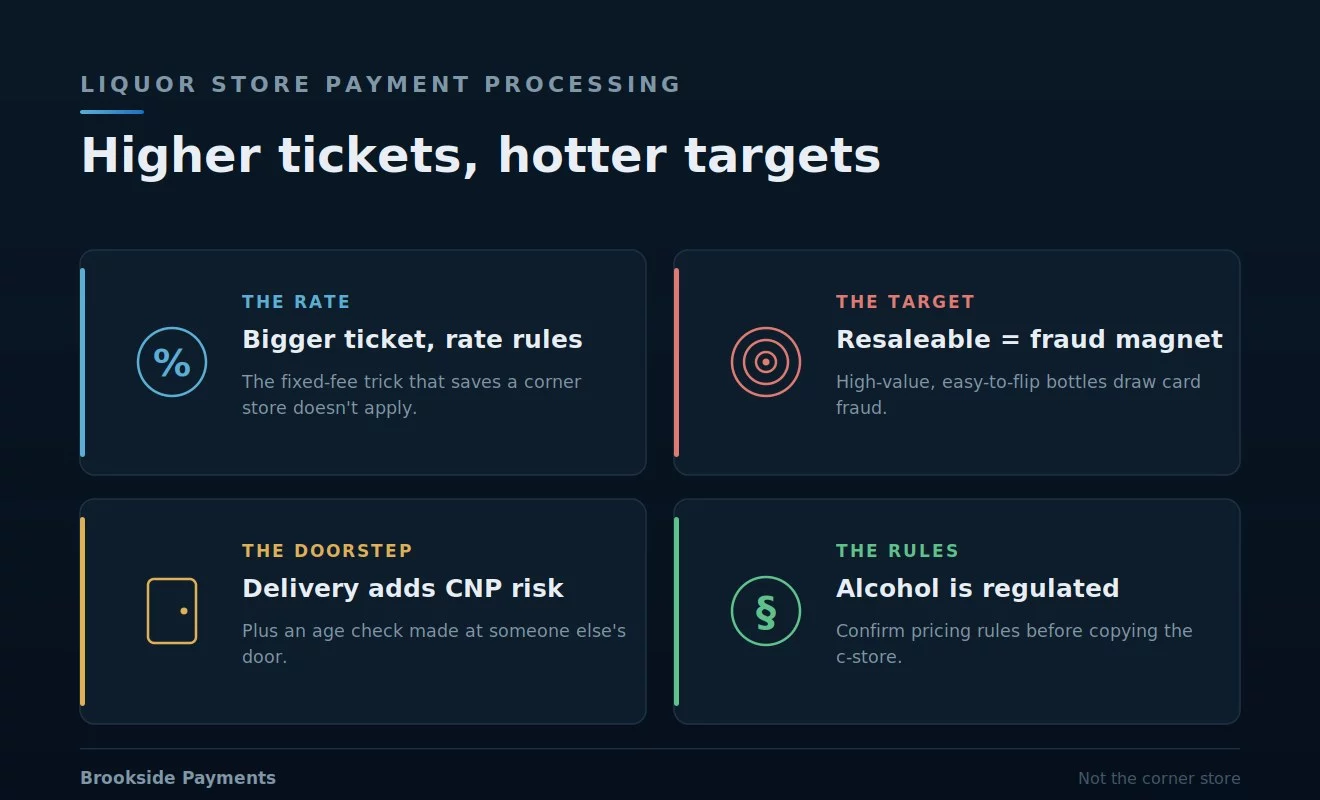
It’s easy to assume a liquor store processes cards like the convenience store next door, but the economics are almost the opposite. The corner store lives on micro-tickets where a flat per-transaction fee is the enemy; a package store rings up a $40 bottle of bourbon, a $60 case of wine, a $120 run before a party. Those bigger tickets change the math entirely — and they bring a different set of risks. Liquor store payment processing is its own problem: the rate matters again, the inventory is a fraud magnet, and the moment you add delivery you’ve taken on card-not-present exposure the corner store never sees.
On top of that, every single sale is age-restricted, and alcohol is one of the most regulated things you can sell. So while a liquor store and a c-store look like cousins on the shelf, the payment realities diverge fast. Treat liquor store payment processing like generic retail — or worse, like the corner store’s cash-discount-only playbook — and you’ll either overpay on the rate, get burned on fraud, or trip over a rule that doesn’t apply two doors down. The bottle is bigger, and so is everything attached to it.
Bigger Tickets Put the Percentage Rate Back in Charge
At a convenience store, the fixed per-transaction fee dominates because the tickets are tiny. Flip that for a package store. On a $45 sale, the flat fee is a rounding error and the percentage rate is firmly back in the driver’s seat — which means the lever that barely mattered next door is suddenly the main one. This is the first thing liquor store payment processing gets wrong when it’s copied from the corner-store template: the cash-discount-only mindset that saves a c-store can leave a liquor store overpaying on the rate it should have been negotiating.
That doesn’t mean cash discount is off the table — plenty of package stores run it — but at these ticket sizes the percentage rate and the pricing structure underneath it (interchange-plus versus a bundled flat rate) drive far more of your real cost. A liquor store merchant account should be evaluated on the rate and the structure first, because that’s where the money is at a $40 average ticket. The bigger the bottle, the more the rate matters — the reverse of the counter down the street.
In liquor store payment processing, the fixed-fee problem that defines the corner store fades when your average sale is ten or twenty times bigger. Here the percentage rate and the pricing structure — interchange-plus versus a bundled flat rate — are where the cost lives. Don’t import the c-store’s fee-first playbook; price the rate first, because at these ticket sizes it’s the number that actually moves your bill.
High-Value, Resaleable Inventory Makes You a Fraud Magnet
Premium spirits and wine are exactly what card thieves love: high-value, easy to resell, and walk-out-the-door anonymous. A stolen card run for $300 of top-shelf liquor is a clean flip for a fraudster — and a chargeback for you. This is a risk the corner store mostly doesn’t carry, and it sits at the center of liquor store payment processing: the more valuable and resaleable your shelf, the more attractive your register is to fraud, and the more chargebacks become a line item you have to actively manage rather than ignore.
In the store, card-present chip and tap protect you — the liability sits with the issuer when the card is dipped. The exposure opens up the moment the card isn’t present: phone orders, “hold it for pickup, I’ll give you my number,” and online sales all shift you into card-not-present territory, where you eat the fraud and the chargeback if it goes bad. Smart liquor store credit card processing treats card-present and card-not-present as two different risk worlds and puts real friendly-fraud and dispute defenses around the not-present side instead of hoping.
Dipped chip and tap push fraud liability to the card issuer. Phone orders, held pickups taken by card number, and online sales flip you into card-not-present, where a stolen-card chargeback is your loss. Resaleable, high-value liquor makes you a target, so liquor store payment processing has to treat the not-present channel as the risk it is — verify, document, and defend disputes rather than absorbing them.
Delivery Adds Card-Not-Present Volume and an Age Check at Someone Else’s Door
Liquor delivery went from novelty to normal, and it quietly rewired the payment picture. Whether you run your own online ordering or list on a delivery marketplace, those sales are card-not-present, they carry the fraud exposure from the last section, and they add a wrinkle nothing else in retail has: the age verification happens at the doorstep, by a driver who may not be your employee. That gap — between who took the payment and who checked the ID — is the part of liquor store payment processing that the delivery pitch tends to gloss over.
On a marketplace, you’re also paying the platform’s cut and, depending on the setup, you may not even be the merchant of record on the card transaction — which changes who owns the funding, the data, and the dispute. Running your own ordering keeps you the merchant of record and keeps the processing economics yours, but puts the age-verification and fraud controls on you to build. Either way, good package store payment processing decides the delivery and online channel deliberately rather than bolting it on and discovering the costs and the liabilities afterward.
Online and delivery orders are card-not-present and carry an age check made at the door by someone who may not be your staff. On a marketplace you pay a cut and may not be the merchant of record — losing control of funding, data, and disputes. Your own ordering keeps the economics and the merchant-of-record status yours, but the fraud and age controls become your build. In liquor store payment processing, choose the channel — don’t drift into it.
Alcohol Is Regulated Differently Two Doors Down
Alcohol is one of the most state-regulated things you can sell, and that reaches into payments. A handful of states are “control states” where the government runs spirits sales outright; many regulate how alcohol can be priced and discounted, and licensing through a state alcohol board sits on top of everything. The practical upshot for liquor store payment processing is that a pricing or discounting structure that’s perfectly fine for the convenience store may bump into alcohol-specific rules — the cash-discount program you copied from the c-store isn’t guaranteed to transfer cleanly to a shelf of regulated bottles.
This isn’t a reason to avoid cash discount or any structure — it’s a reason to confirm it against your own state’s rules before you roll it out, rather than assuming the corner-store playbook applies. The age-restricted, license-gated nature of the business is exactly why wine and spirits payment processing deserves to be set up by someone who has accounted for the regulatory layer, not just the rate sheet.
Alcohol pricing and discounting are regulated at the state level, and control states run spirits sales themselves. A cash-discount or dual-pricing structure that’s fine for a c-store isn’t automatically fine on regulated bottles. Confirm any pricing program against your state’s alcohol rules before rollout — it’s the one place liquor store payment processing can’t just copy the corner store.
Price the Rate, Guard the Shelf, Own the Channel
A liquor store earns and loses money in completely different places than the corner store it resembles. Liquor store payment processing done well starts by inverting the c-store playbook: negotiate the percentage rate and pricing structure first, because the tickets are big enough that the rate rules; build real fraud and chargeback defenses, because your resaleable, high-value shelf is a target; decide your delivery and online channel deliberately, because card-not-present sales and doorstep age checks are now part of the business; and confirm any pricing program against your state’s alcohol rules before you copy it from anyone. Get those right and the bigger ticket works for you instead of against you.
This article is general information, not legal or compliance advice. Alcohol pricing, discounting, and licensing rules vary by state and locality, including control-state restrictions — confirm the rules in your jurisdiction, and with your state alcohol authority, before applying a cash-discount, dual-pricing, or delivery program to alcohol sales.
Frequently Asked Questions
Yes — liquor store payment processing is almost the opposite. A convenience store’s pain is the fixed per-transaction fee on tiny tickets, so cash discount rules. A liquor store’s tickets are far bigger, which puts the percentage rate back in charge, and its high-value resaleable inventory makes fraud and chargebacks a real concern — especially once delivery and online orders add card-not-present volume. The corner-store playbook doesn’t transfer cleanly.
Because premium spirits and wine are high-value, easy to resell, and anonymous to walk out with — an ideal purchase for a stolen card. In-store, chip and tap shift the liability to the card issuer, so the real exposure is in card-not-present sales: phone orders, held pickups taken by card number, and online or delivery orders, where a fraudulent charge becomes your chargeback. Those channels are where liquor store payment processing has to put active fraud and dispute defenses.
Often yes, but liquor store payment processing should confirm it first. Cash discount and dual pricing are widely used, but alcohol pricing is regulated at the state level and a few states control spirits sales directly, so a structure that’s fine for a convenience store isn’t automatically fine on regulated bottles. Confirm it against your state’s alcohol rules before rolling it out rather than copying the corner-store version wholesale.
See What Your Shelf Is Really Costing You
Send Brookside one recent statement and we’ll show you your true effective rate at your ticket sizes, whether your pricing structure is leaving money on a $40 sale, and where your card-not-present and delivery volume is exposing you to fraud and chargebacks. It’s liquor store payment processing reviewed against the regulatory layer, not just the rate sheet. No switch required to find out. You can also review card payment protections from the CFPB.
Get Your Store ReviewedNo obligation • No pressure • Response within one business day
See what a statement review looks like →