Oklahoma Legalized Surcharging, Then Capped It Below What Your Cards Actually Cost
The Oklahoma Credit Card Surcharge Is Legal Now: And Capped Below What Acceptance Costs
On November 1, 2025, the Oklahoma credit card surcharge became legal. Senate Bill 677 repealed the statute that had prohibited them since 1977, and it became law without the governor’s signature. For a merchant who had spent years being told surcharging was illegal in Oklahoma, that is the headline.
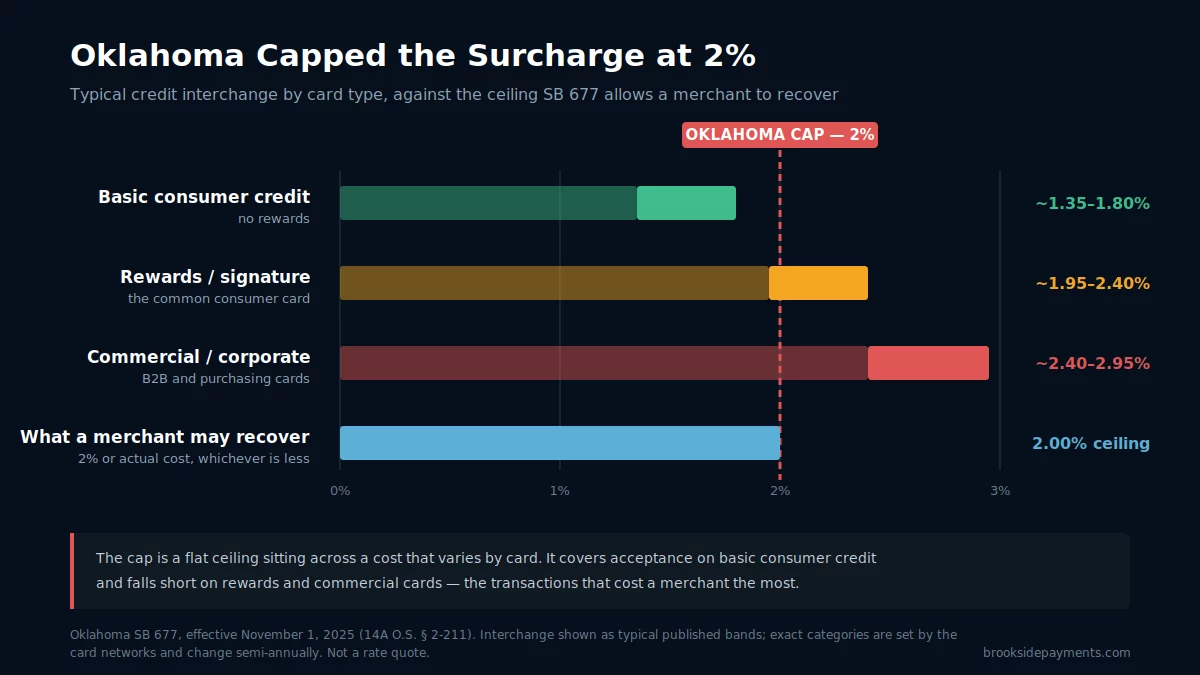
The part nobody put in the headline is the number. The same act that legalized surcharging limited it to 2% of the transaction, or the actual cost of processing, whichever is less. Visa and Mastercard permit up to 3%. Interchange alone on a premium rewards card runs above 2% before a processor adds a cent of markup. So Oklahoma legalized the tool and set the ceiling underneath the cost it was meant to offset — on exactly the cards a merchant is most likely to be handed.
The Oklahoma legislature appears to have noticed. In the 2026 session, four separate bills were filed to raise that limit.
What SB 677 Says About the Oklahoma Credit Card Surcharge
The act did two things at once. It repealed 14A O.S. § 2-417 — the surcharge prohibition — and it rewrote § 2-211, the cash-discount statute, to set the terms surcharging now runs under.
| Provision | What it means for a merchant |
|---|---|
| Surcharge capped at 2% or actual cost, whichever is less | You cannot recover more than 2% even when acceptance costs you more |
| Credit cards only | Debit and prepaid cannot be surcharged — federal law governs those separately |
| Notice required at the point of sale and online | Disclosure before the customer commits, not on the receipt after |
| Cash discounts: no limit on the discount amount | The uncapped path is the one Oklahoma left open |
| Municipalities and public trusts may charge a service fee | Limited to bank and transaction fees, secure-transaction cost, portal fees, bandwidth |
Worth knowing how Oklahoma got here, because it explains why the repeal reads as housekeeping rather than reform. The 1977 ban had been legally shaky since Expressions Hair Design v. Schneiderman in 2017, and Oklahoma’s own Attorney General issued an opinion in December 2019 concluding the statute would likely be struck down if anyone challenged it. Surcharging in Oklahoma was already prohibited-but-probably-unenforceable. SB 677 closed the gap between the statute and reality — and attached a number on the way through.
Why a 2% Cap Does Not Cover a 2%-Plus Cost
An Oklahoma credit card surcharge exists to offset the cost of accepting the card. Whether 2% does that depends entirely on which card is presented, and the merchant does not choose.
A basic consumer credit card sits comfortably under 2% in interchange, and a 2% surcharge covers it with room to spare. A premium rewards card does not — interchange on those runs above 2% on its own, before assessments and before whatever your processor adds. A commercial or corporate card is higher still. Oklahoma’s cap is a flat ceiling sitting across a cost that varies by card, so it works on the cheap transactions and fails on the expensive ones.
That is the structural problem with capping a surcharge at a single number: the thing being offset is not a single number. A merchant whose customers pay with basic consumer cards is fully covered. A B2B supplier taking corporate cards, or a jeweler whose customers reach for the travel-rewards card, is not — and those are precisely the merchants for whom acceptance costs the most.
There is also a second limb most summaries skip. The cap is 2% or the actual cost of processing, whichever is less. A merchant who does not know their real cost of acceptance cannot comply with that provision except by accident. On a flat-rate plan the number is not on the statement at all — which is a compliance problem before it is a pricing one. Ours is a thirty-second calculation and most merchants have never run it.
Four Bills to Raise a Cap Set One Year Earlier
If the 2% limit were working, nobody would be trying to change it. Four bills filed in Oklahoma’s 2026 session address exactly that number. Each is listed below with its bill number and its last recorded action.
Introduction is not passage, and most bills die in committee. The actions above are the last recorded for each measure and none of them is enactment. Oklahoma’s 2026 session concluded in May; anything still sitting in committee at that point did not become law this cycle. Verify current status against the legislature’s own record before relying on any of it.
Oklahoma Is Pushing From Both Ends at Once
What makes Oklahoma unusual is not the surcharge activity by itself. It is that the same session ran bills aimed at the networks.
SB 1940 would exclude certain amounts from interchange fee charges and require rebates from payment card networks. SB 2102 would prohibit issuers from charging certain fees, bar them from penalizing merchants, and require issuer disclosure. Both were placed on General Order on March 10, 2026.
Most states legislating in this area pick a side of the transaction. Illinois went after interchange on tax and gratuity — the IFPA, still the flagship, and still enjoined. New Jersey has run multiple surcharge-prohibition bills. Oklahoma is doing the opposite of prohibition on the merchant side while simultaneously attempting to constrain the network side. Expanding what a merchant may pass on, and reducing what the networks may charge, are two routes to the same destination, and Oklahoma tried both in one session.
Where each state currently stands on surcharging is tracked on our credit card surcharge legality map, and the pending interchange legislation across all states sits on the state interchange fee laws tracker.
The Cap Is the Constraint on Every Oklahoma Credit Card Surcharge
The Oklahoma credit card surcharge is legal today and the 2% ceiling is the law today. Three practical consequences follow.
The statute caps you at the lesser of 2% or your real processing cost, so the compliant surcharge is a number you have to calculate rather than pick. If you are on flat-rate pricing, that number is not visible on your statement — the single blended rate hides the split between interchange and markup entirely.
The same act that limits surcharges to 2% places no limit on the size of a cash discount. Mechanically the two programs land in a similar place for the customer; legally they are different instruments, and in Oklahoma only one of them carries a ceiling. Dual pricing sits in the same family. That is worth knowing before defaulting to a surcharge because it is the option everyone is talking about.
Commercial and corporate cards carry the highest interchange, so a 2% ceiling recovers the smallest share of cost on exactly the transactions that cost the most. If most of your volume is business customers paying by card, the surcharge is not the lever — and it can cost you the account anyway.
One more group is directly addressed by the statute and rarely mentioned in coverage of it: municipalities and public trusts, which SB 677 permits to charge a service fee covering bank and transaction fees, secure transaction costs, portal fees and bandwidth. That is a narrower and more specific authority than the merchant surcharge, and it sits alongside what other states are doing for government payment acceptance — Florida took a different route to the same question with HB 967.
This page describes Oklahoma law as enacted by SB 677, effective November 1, 2025, and legislation filed in the 2026 session with last-recorded actions as noted. Bill status changes; introduction is not passage. Primary source: the enrolled text of SB 677 at the Oklahoma Legislature. This is not legal advice — confirm current requirements with counsel and with your processor before implementing any surcharge or cash discount program.
Frequently Asked Questions
Yes. The Oklahoma credit card surcharge has been legal since November 1, 2025, when Senate Bill 677 repealed the statute that had prohibited surcharges since 1977. The surcharge is limited to 2% of the transaction or your actual cost of processing, whichever is less, applies to credit cards only, and must be disclosed at the point of sale.
Visa and Mastercard permit surcharges up to 3%, but a state may set a stricter limit and Oklahoma did. Where the two conflict, the lower applies. The practical effect is that a 2% surcharge covers acceptance cost on basic consumer cards and falls short on premium rewards and commercial cards, where interchange alone exceeds 2%.
No. SB 677 applies to credit card transactions. Debit and prepaid card surcharging is separately constrained at the federal level, and the card networks prohibit it outright regardless of state law.
Four bills were filed to change the limit — SB 2132, SB 2077, HB 2971 and HB 3041 — and none of them is recorded as enacted. SB 2132 advanced furthest, receiving a Do Pass recommendation from the Banking, Financial Services and Pensions committee on April 8, 2026. The 2% cap set by SB 677 remains the operative limit.
You Cannot Comply With “Actual Cost” If You Do Not Know It
Oklahoma caps your surcharge at the lesser of 2% or what acceptance actually costs you. Send us one recent statement and we will tell you what that second number is — interchange, markup, and your real effective rate, separated out. It takes about fifteen minutes and it is the figure the statute makes you responsible for knowing.
Get Your Free Statement ReviewNo obligation • No pressure • Response within one business day
See what a statement review looks like →