Pet Grooming Payment Processing: Your Software Owns Your Rate
Your Grooming Software Probably Owns Your Payments
Run a grooming salon, boarding kennel, or doggy daycare and you almost certainly run it on software — MoeGo, Gingr, DaySmart, Pawfinity — that schedules the appointments, stores the pet records, and, increasingly, processes the cards. And because grooming is a tipped service, how that tip prompt is set up matters — see tip screen best practices. That last part is where the money quietly leaks. Most pet-care platforms either bundle their own payment processing or steer you hard toward it at a flat rate the software sets, and some even discount the software itself if you use their processor — which is just another way of charging you more to bring your own. That’s the heart of pet grooming payment processing: the rate is buried inside the software you depend on, and it’s built to stay there.
A pet-care business is also more than one kind of transaction — appointment services with real no-show risk, recurring memberships and package plans, a retail shelf, and tips on top of all of it. A flat bundled rate charges every one of those the same way and hides where you’re overpaying. Good pet grooming payment processing separates two decisions most owners treat as one: the software you run on, and the rate you pay to move money through it.
The Software Discount Is a Processing Markup in Disguise
Here’s the tell. Several pet-care platforms price the software lower if you use their built-in payments and higher if you don’t — one popular boarding plan runs about $155 a month on the platform’s own processing versus $180 if you bring an outside merchant account. That $25 “discount” isn’t a discount; it’s the platform betting it will make far more than $25 back on your card volume at the flat rate it sets. Built-in processors are pitched as convenience — one login, one bill — but the convenience is also a blindfold over your real rate. It’s the most overlooked line in pet grooming payment processing, because it never arrives as a processing bill at all; it’s folded into the software.
The flat rate itself is the second problem. A flat percentage charges a $30 nail trim and a $900 week-long boarding stay exactly the same way, with no benefit from the lower interchange that larger, well-qualified transactions should earn. Pulling the rate apart from the software is usually the biggest single saving in pet grooming payment processing — and it doesn’t always mean leaving the platform. Where a system allows an outside processor, you keep the scheduling and pet records and route the cards to a transparent pet grooming merchant account where the true cost is visible. Where it locks payments to its own rate, that lock-in is a real number worth weighing at renewal.
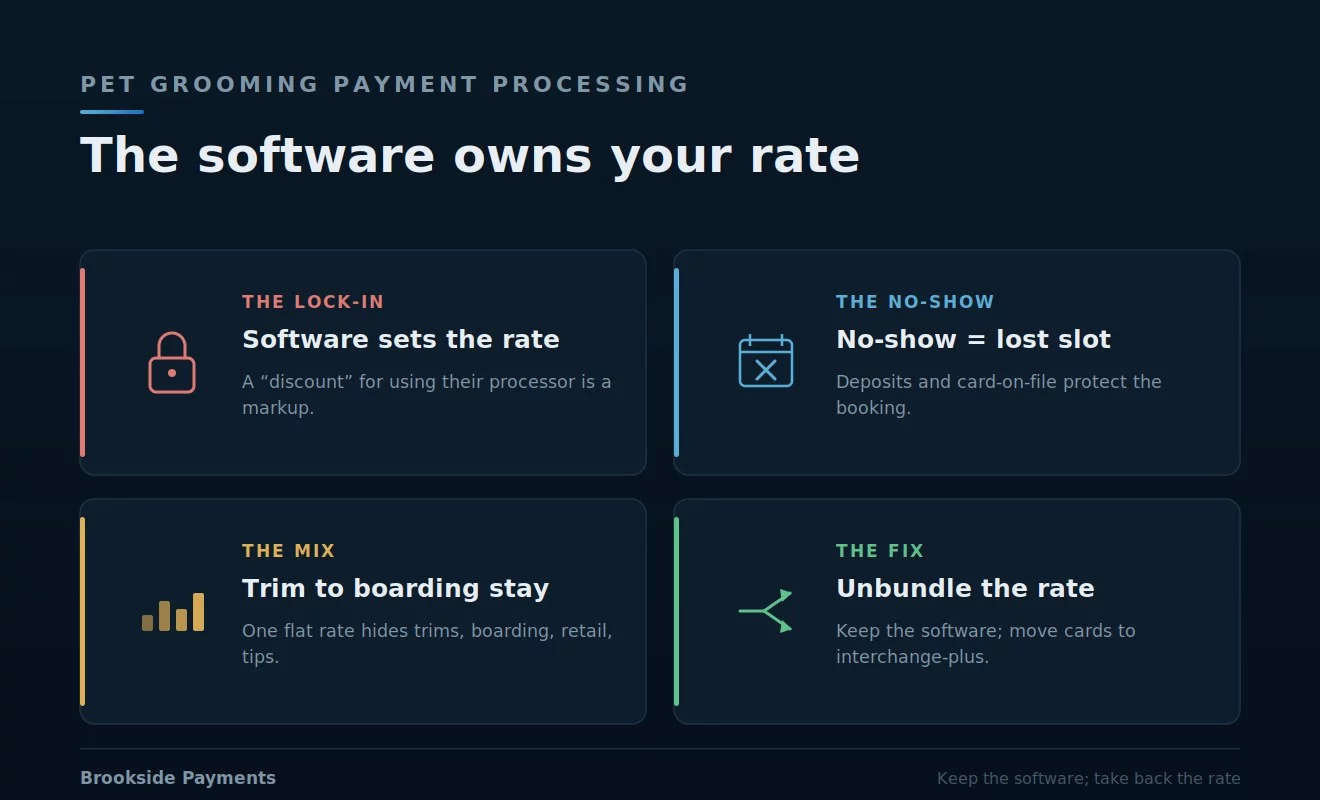
In pet grooming payment processing, pet-care platforms often price the software lower if you use their built-in payments (e.g. ~$155/mo vs ~$180/mo) — that gap is a bet on your card volume, not a favor. And the flat rate charges a $30 nail trim like a $900 boarding stay. Where the platform allows it, keep the software and route processing to a transparent account; where it locks you in, price that lock-in at renewal.
A Missed Appointment Is a Lost Slot: Deposits Protect It
Grooming and training run on appointments, and an empty chair from a no-show is revenue you can’t recover — the slot is simply gone. The defense the better pet platforms push is the right one: take a deposit at booking and keep a card on file, so a last-minute cancellation isn’t a total loss and rebooking is friction-free. But how you collect those deposits and store those cards matters for pet boarding payment processing — card-on-file and deposit handling should be standard, securely tokenized, and not priced at a premium just because they ride through the software.
This is the same playbook a salon or a personal trainer uses, and it depends on a processing setup that supports it cleanly: stored, tokenized cards your staff can charge against a clear no-show policy, deposits that apply to the final bill, and no punitive surcharge for the card-not-present transaction when you run a deposit days before the visit. Done right, deposits and card-on-file are the part of pet grooming payment processing that turns no-shows from a weekly bleed into a rare, managed event. Done through a marked-up bundled rate, you protect the slot but overpay to do it.
No-shows cost you a booked slot you can’t resell. Take a deposit at booking and keep a securely tokenized card on file so cancellations aren’t total losses. Just make sure card-on-file and deposit handling aren’t priced at a premium or hit with punitive card-not-present rates — they should be standard, not an upsell buried in the software’s flat fee.
Grooming, Boarding, Daycare, Retail: And Tips on All of It
A full pet-care business rings up a wide range from one counter: a quick nail trim, a full groom, a multi-night boarding stay, daycare packages, and a retail shelf of food and toys — with tipping prompted at checkout on top. Each piece has a different ticket size and economics, and tips add a wrinkle most generic accounts handle poorly: gratuity gets added after the service, which means tip adjustments and, handled badly, extra downgrades or holds. Sound pet care payment processing has to fit the whole mix, not just the average appointment.
Recurring revenue complicates it further — grooming memberships, daycare packages, and automated renewals are increasingly how these businesses smooth cash flow, and large recurring charges belong on ACH rather than card rates wherever a client will allow it. A setup built for the mix handles tips cleanly, prices the retail and the boarding stay on their real costs, and routes recurring memberships to the cheapest rail. In pet grooming payment processing, one flat rate across all of it leaves money on every kind of ticket. The recurring-membership side has its own mechanics worth a closer look at how membership billing is priced.
One counter rings up nail trims, full grooms, multi-night boarding, daycare packages, retail, and tips. Different tickets, different economics — and gratuity added after service can cause tip-adjustment downgrades if handled poorly. Price retail and boarding on real cost, handle tips cleanly, and route recurring memberships to ACH where you can rather than paying card rates on big repeating charges.
Keep the Software You Like, Fix the Rate Underneath It
None of this means ripping out the platform your staff and clients already know. The whole of pet grooming payment processing comes down to refusing to let the software’s convenience decide your rate. Where the system supports an outside processor, move to interchange-plus so every transaction — the $30 trim, the $900 stay, the retail sale — is priced on its true cost, with deposits, card-on-file, and tips handled cleanly. Where the platform locks payments in, at least know your real effective rate so the “convenience” is a choice you priced, not a default you inherited. That’s what separates dog grooming credit card processing that quietly funds the software vendor from a setup that funds your business.
In pet grooming payment processing, keep the scheduling and pet-record software; move the card processing to a transparent interchange-plus account so each ticket is priced on real cost, with deposits, card-on-file, and tips handled cleanly. Where the platform locks payments to its own rate, at least know your true effective rate so the convenience is a priced choice, not an inherited default.
Don’t Let the Software Set Your Rate by Default
A pet-care business loses money in the gap between the software it loves and the rate that software quietly sets — a flat bundled percentage that prices a nail trim like a boarding stay, hides behind a “discount” for using the built-in processor, and charges a premium for the deposits and card-on-file you need to survive no-shows. Pet grooming payment processing done well closes that gap: unbundle to interchange-plus where the platform allows, handle deposits, tips, and recurring memberships on the right rails, and price the convenience instead of inheriting it. Keep the software; take back the rate.
Frequently Asked Questions
Because the software usually owns the payments. Most groomers, boarders, and daycares run on a pet-care platform (MoeGo, Gingr, DaySmart) that bundles or steers you into its own processor at a flat rate — sometimes even discounting the software if you use their payments. On top of that it’s a mixed business: appointment services with no-show risk, recurring memberships, retail, and tips, each needing different handling. A generic flat rate fits none of it well.
Usually not. In pet grooming payment processing, many pet-care platforms allow an outside processor, so you can keep the scheduling, pet records, and report cards your staff and clients know, and route the actual card processing to a transparent interchange-plus account where the true cost is visible. Where a platform locks payments to its own bundled rate, that lock-in is itself a cost — worth knowing your real effective rate and weighing at renewal.
Take a deposit at booking and keep a securely tokenized card on file, so a last-minute cancellation isn’t a total loss of the slot. The key is that card-on-file and deposit handling should be standard and cheap — not priced at a premium or hit with punitive card-not-present rates because they run through the software. These deposit mechanics are central to pet grooming payment processing: apply deposits to the final bill, and a clear no-show policy turns missed appointments from a weekly bleed into a rare, managed event.
Find Out Your True Rate Behind the Software
Send Brookside one recent statement — or your pet-care software’s payments summary — and we’ll show your real effective rate and what pet grooming payment processing is actually costing you under a built-in bundled processor across trims, boarding, retail, and tips, and whether moving recurring memberships to ACH would save. Keep the software; we’ll fix the rate underneath. You can also review card payment protections from the CFPB.
Get Your Rate ReviewedNo obligation • No pressure • Response within one business day
See what a statement review looks like →