Personal Trainer Payment Processing: The Package Is Unearned Money
The Package You Sold Is a Loan Your Client Made You
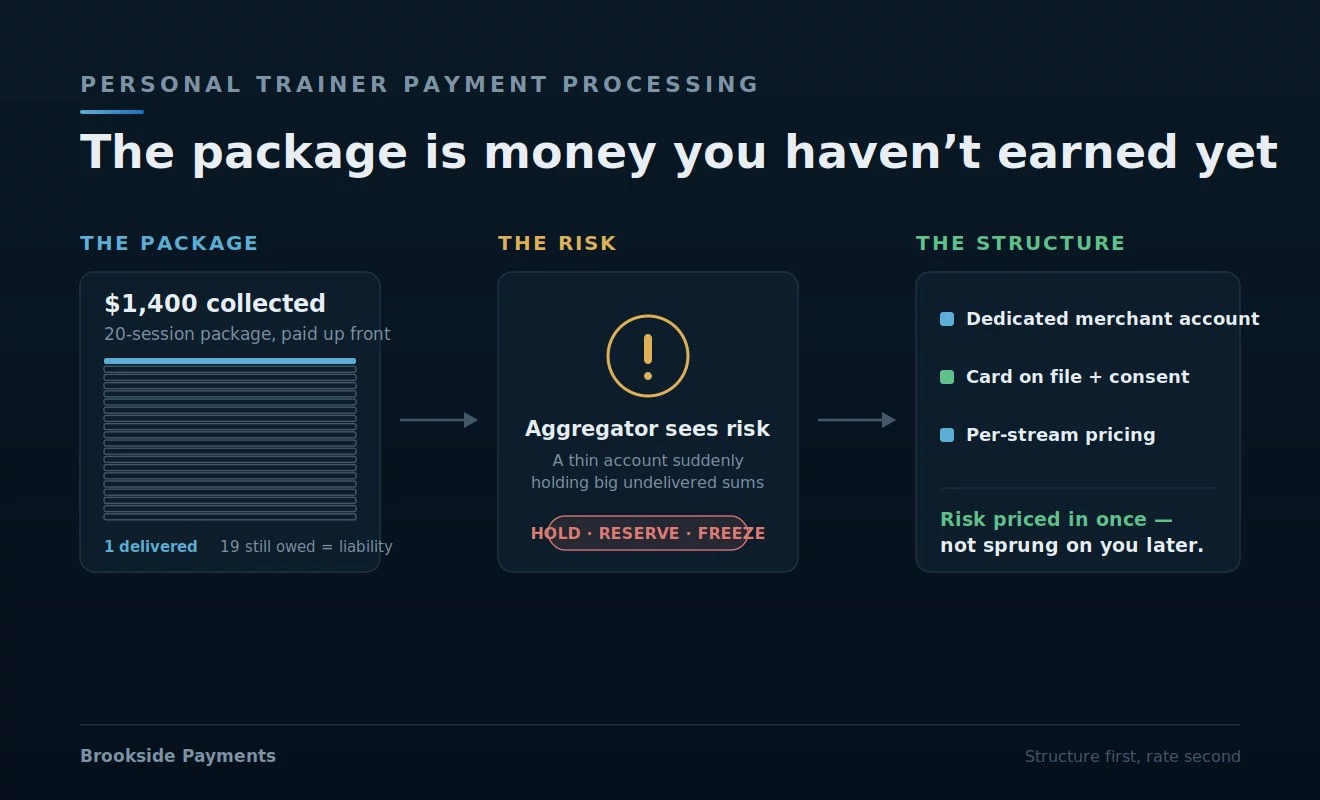
A personal trainer’s biggest sale is usually the one that creates the most risk: the prepaid package. Sell someone twenty sessions for $1,400 and you’ve just collected money you haven’t earned yet — every unused session is a workout you still owe. That’s the quiet fault line under personal trainer payment processing: how you collect for packages, no-shows, and online coaching decides whether your processor treats you like a stable business or a liability waiting to happen.
Most trainers start on whatever’s frictionless — Square, Stripe, Venmo, PayPal — because it takes five minutes and you’d rather be coaching clients than running a payments operation. That works right up until the day a big package charge, a chargeback, or a burst of online sales trips a risk model and the money you already spent gets frozen. Good personal trainer payment processing isn’t about the lowest rate. It’s about not getting blindsided by a hold on revenue you’d already counted on.
Prepaid Sessions Are Unearned Money, and Processors Know It
When a client pays $1,400 up front for twenty sessions, only the first one is earned the moment they swipe. The other nineteen are a promise — future delivery you’re on the hook for. Card networks have a name for that: unearned, or future-delivery, liability, and it’s the single biggest thing that makes a small, otherwise-clean account look risky — the first place personal trainer payment processing either holds up or quietly falls apart. If you get injured, take time off, or the client quits at session three, there’s over a thousand dollars of someone else’s money sitting on a card statement with nothing delivered behind it.
This is why personal trainer payment processing underwriting cares less about your rate and more about your package model. A processor’s worst case isn’t a $90 single session that goes sideways; it’s a stack of large prepaid packages it might have to refund if you can’t deliver. On an aggregator like Square or Stripe, that math runs automatically and invisibly — and the tool it reaches for is a hold or a rolling reserve on your deposits. A proper personal trainer merchant account prices that risk in once, up front, instead of springing it on you later.
Money collected for sessions you haven’t run yet isn’t profit — it’s a refund you might owe. Sell a few big packages in a week and a risk model sees a thin account suddenly holding a pile of undelivered obligations. That’s the exact shape that triggers a reserve. Understanding it is what separates personal trainer payment processing that holds up from the kind that gets reserved against.
Square Is Easy Until It Decides You’re a Risk
When it comes to personal trainer payment processing, aggregators win on day one. You sign up in minutes, there’s no real underwriting, and you’re taking cards before lunch. The trade is that they underwrite you after the fact, continuously, by watching your transactions — and they can hold funds, cap volume, or freeze the account on their own read of risk, with a support queue instead of a phone number. For a trainer whose cash flow is a few big packages a month, one freeze at the wrong moment is the whole month.
A dedicated personal trainer merchant account flips that. You’re underwritten once, up front, as a known business — the processor already understands your package model and builds the risk into the relationship instead of ambushing you with it later. You get a human, predictable funding, and reserves that are agreed to rather than imposed overnight. For a trainer selling real package volume, personal training payment processing on a dedicated account is usually the difference between steady cash flow and a constant low-grade fear of a hold.
The same thing that makes an aggregator easy to join — no real underwriting at signup — is what lets it freeze you with no warning later. Dedicated personal trainer payment processing does the diligence once, so the surprises happen up front, not on a Friday when you need the deposit. The question isn’t which is cheaper per swipe; it’s which one holds your money when you can least afford it.
A No-Show Fee Is a Chargeback Waiting to Happen: Unless You Set It Up Right
Every trainer eventually writes a cancellation policy: miss without 24 hours’ notice and you’re billed for the session. Enforcing it is where personal trainer credit card processing gets technical. To charge a no-show you need a card on file and clear, agreed-to authorization to bill it — otherwise the client disputes the charge, the bank sides with them, and you’ve turned a $90 no-show into a chargeback plus a fee on an account you’d rather keep clean.
The fix is mechanical, not aggressive: store the card properly, get explicit written consent to the cancellation policy and to charging the card on file, and keep the signed policy and the booking record so a dispute has an obvious answer. Done right, the no-show fee is enforceable and rarely contested. Done casually — charging a card the client forgot you kept — it’s a friendly-fraud chargeback nearly every time, which is why no-show handling belongs at the center of personal trainer payment processing, not bolted on after the fact.
You can’t reliably bill a missed session unless the client agreed in advance, in writing, to the policy and to keeping a card on file for it. In personal trainer payment processing, that paper trail is the entire defense if they dispute. Charge a stored card without it and the bank refunds them and dings your account — the opposite of what the policy was for.
In-Person Sessions and Online Coaching Don’t Cost the Same
A trainer’s revenue usually splits across two very different transaction types, and they’re priced in two different worlds. In-person sessions tapped on a phone reader are card-present — the cheapest, lowest-risk way to take a card. Package sales over a payment link, online coaching subscriptions, and remote clients are card-not-present — keyed or online, higher rate, higher fraud exposure. A single flat aggregator rate smears those together and hides which one is quietly costing you.
That blend matters because the mix is rarely even. A trainer who sells most packages online and coaches half their roster remotely is running mostly card-not-present volume at card-not-present rates — and paying for it without seeing it. Transparent fitness trainer payment processing prices the two streams separately, so you can read your effective rate on each instead of trusting that one headline number covers both. It’s the same per-stream discipline that good personal trainer payment processing applies everywhere: see the cost where it actually lives.
Tapped in-person sessions are cheap; online package sales and remote coaching are not. If most of your revenue runs through a link or a subscription, you’re a card-not-present business paying flat-rate prices — and a transparent setup will show you exactly that. It’s the first split a transparent personal trainer payment processing setup will show you, before you decide whether you’re overpaying.
Structure First, Rate Second
The trainers who get burned aren’t the ones paying a slightly high rate — they’re the ones whose package money got frozen mid-month, whose no-show fees turned into chargebacks, or who never noticed their online coaching ran at premium card-not-present rates. Personal trainer payment processing done well starts with structure: an account that understands prepaid packages so it doesn’t reserve against them, a clean card-on-file setup so no-shows are enforceable, and per-stream pricing so you can see card-present and card-not-present separately. Get those right and the rate takes care of itself.
Frequently Asked Questions
For most personal trainer payment processing, Square is fine to start and for low, steady volume. The moment you’re selling real prepaid package volume, the aggregator’s habit of holding funds against undelivered sessions becomes a cash-flow risk — and that’s when a dedicated personal trainer merchant account, underwritten up front for your package model, usually pays for itself in predictability alone.
Yes — if you set it up correctly. You need a card on file plus written, agreed-to authorization for the cancellation policy and for billing that card. With that paper trail the fee is enforceable and rarely disputed successfully. Without it, charging a stored card invites a chargeback the bank will likely grant the client.
Almost always because of undelivered-package risk — the exact failure mode good personal trainer payment processing is built to avoid. A burst of large prepaid charges on a thin account looks, to a risk model, like obligations the processor might have to refund. Aggregators respond with holds or reserves automatically. A merchant account that underwrote your package model up front is far less likely to be surprised into freezing you.
Find Out If You’re a Hold Risk Before Your Processor Does
Send Brookside one recent statement and we’ll show you your true effective rate on in-person versus online sessions, flag whether your package volume is exposing you to a reserve or freeze, and tell you whether a dedicated merchant account would actually pay off for how you sell. No switch required to find out, and it’s the fastest way to see whether your personal trainer payment processing is quietly working against you. You can also review card payment protections from the CFPB.
Get Your Trainer Rate ReviewedNo obligation • No pressure • Response within one business day
See what a statement review looks like →