Official Payments Complaints Land on the County’s Desk
When Taxpayers Hit a Problem, They Call the County
A resident sits down to pay a property tax bill online, picks the card option on the county’s site, and at the last screen a service charge appears on top of what they owe. The charge does not go to the county — it goes to ACI Payments, the vendor behind the page, known for two decades as Official Payments. When the resident is annoyed, confused, or double-charged, they don’t call ACI. They call you. That is the quiet problem under most Official Payments complaints: the county’s name is on the bill, but the county controls neither the fee nor the experience.
ACI is not a fringe operator. It runs the card and e-check pages behind property-tax, utility, and court collections for thousands of counties, cities, and special districts. That reach is exactly why the friction lands on local offices at scale — and why a treasurer or tax collector who has fielded the calls starts asking what the alternatives are.
What the Convenience Fee Actually Costs
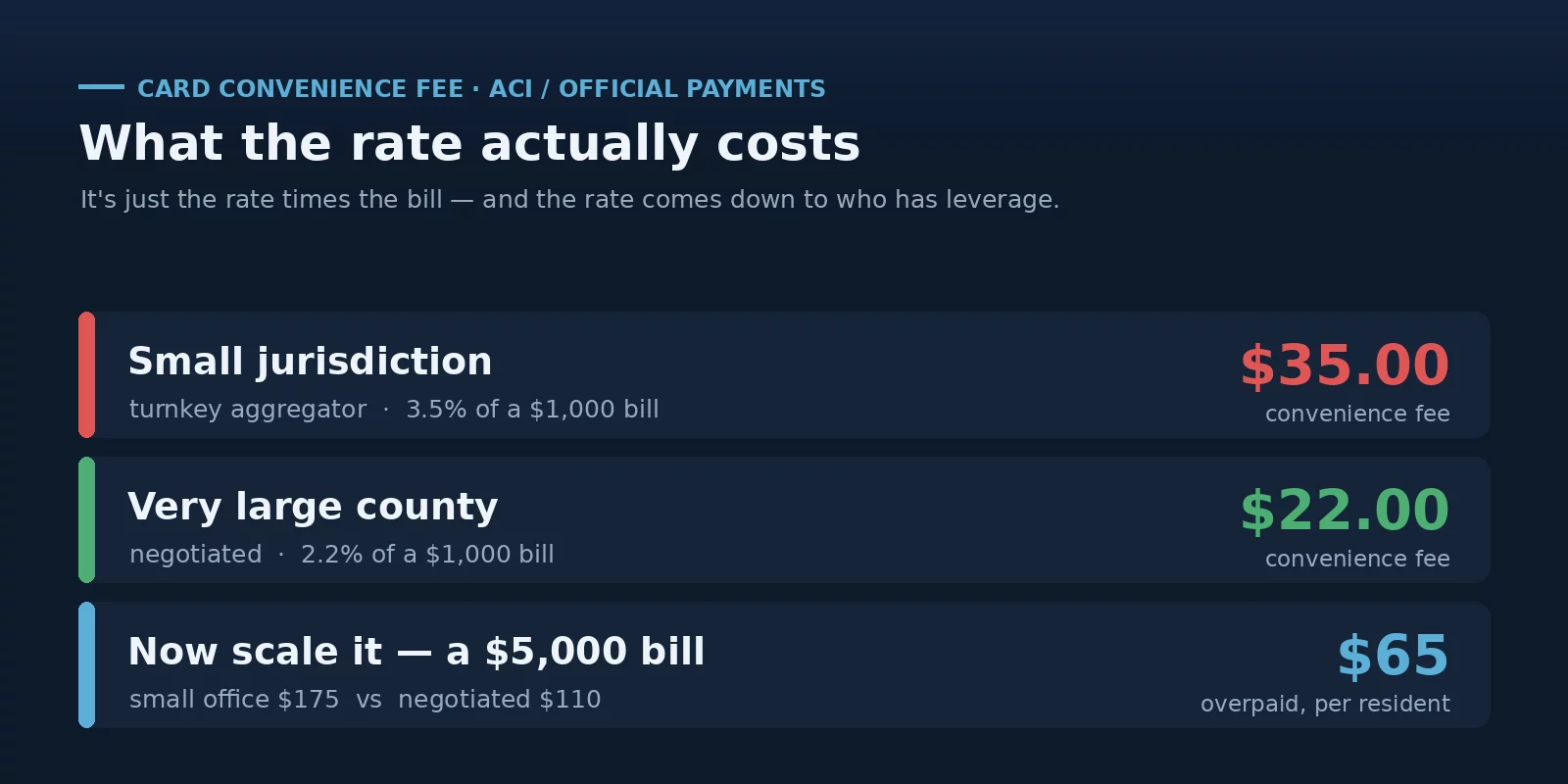
The headline number is the convenience fee, and it falls hardest on the smaller jurisdictions with the least leverage. A township, borough, or small county on a turnkey aggregator commonly pays 3% to 3.5% on cards — Jackson County, Mississippi sits at 3.30%, and the platforms smaller offices run on default to 3% with headroom far higher. Many also add a flat fee on e-check, so the vendor earns margin on every rail. The very large counties that negotiated their own programs sit at 2.4% or better — San Diego at 2.19%, Los Angeles at 2.22%, Orange at 2.25% — which is the tell: the rate tracks leverage, not the true cost of acceptance. Put plainly, the rate is the whole story: 3.5% is $35 on every $1,000 of tax, or $175 on a $5,000 bill, while a negotiated 2.2% is $22 per $1,000 — about $110 on that same bill. Same payment, same resident; the only variable is who had the leverage to negotiate the rate.
Two things make this land as a grievance rather than a line item. First, it is a percentage, so it scales with the obligation — the residents paying the largest tax bills pay the most to a third party for the privilege. Second, it is unavoidable for anyone who wants to pay by card, and the charge shows up on the statement as a “Tax Payment Convenience Fee” or “Service Fee” with the county’s transaction, blurring who actually charged it. To the payer, it reads like the county added a surcharge to its own tax bill.
The percentage is only the advertised cost. On small bills the flat minimum dominates, so a resident paying a modest amount can end up paying an effective rate far above the quoted figure — and they read that as the county nickel-and-diming them.
Paid, But Not Paid: The Failure That Generates the Call
The fee is the predictable one. The one that burns staff time is the failed-but-charged transaction. Public grievance records describe the pattern plainly: a resident submits a tax bill, the screen returns an error saying it could not be processed, and the money leaves their account anyway — over a thousand dollars, in one filed example. The vendor’s phone support tells them nothing was received and points them back to their own bank, where a dispute can take days or weeks to resolve.
From the county’s side, none of that is visible until the resident shows up angry, certain the county took their money and lost it. The office did nothing wrong and cannot see the transaction, but it owns the relationship and the reputation. Multiply that by a busy tax season and the support burden of an outside vendor’s glitch becomes the county’s payroll cost. That is the second half of most ACI grievances — not just the price, but the powerlessness when something goes wrong.
What’s Behind the Official Payments Complaints
Step back and the Official Payments complaints share one root: the county outsourced the collection experience to a third party whose incentives are not the county’s. The vendor’s revenue is the fee, so the fee has no downward pressure. The vendor owns the support line, so the service quality is the vendor’s to set. And the vendor owns the data and the page, so the county can’t fix what it doesn’t control. None of that requires anyone at ACI to behave badly — it is just what an aggregator arrangement produces.
The model has also started drawing legal scrutiny. In a 2026 settlement, the auto lender Westlake agreed to pay $1.2 million to resolve allegations that convenience fees charged when borrowers paid through ACI violated California’s debt-collection law. The defendant there was the lender, not ACI, so it is an indirect signal rather than a ruling against the processor — but it shows that “pay-to-pay” convenience fees collected through these portals are now a live legal question, not a settled cost of doing business.
Residents experience the fee, the failure, and the support as the county’s. The contract gives the county the liability for the relationship and almost none of the levers to fix it. That gap is the whole problem.
How a County Gets Out From Under It
The fix is not a better aggregator — it is changing who holds the rail. With its own merchant account behind a page the county controls, the office sets the terms instead of inheriting a vendor’s. It can hold any card charge to the true cost of acceptance instead of a marked-up percentage, route residents to a low- or no-fee bank-debit lane, and own the support relationship so a failed transaction is something the county can actually see and resolve. The deeper background sits with government payment processing run in-house and the government payment portal the agency owns outright.
This is also where a county’s options differ from a private business. As a government biller, the office may qualify for programs that let it offer free e-check while charging only for cards, and absorb or cap the card cost rather than pass a full percentage to residents. The point is not that accepting cards should be free — it has a real cost — but that the county, not a third party, should decide how that cost is structured and who carries it.
When the merchant account is in the county’s name, the rate, the data, and the support line all become the county’s to set. The fee stops being a number a vendor hands you and becomes a budget decision you make.
Questions to Ask Before the Contract Renews
Whether the incumbent is ACI, a competitor, or an in-house setup, the same short list separates a fair arrangement from a re-skinned toll. What is the all-in cost to a resident paying by card versus e-check, including every minimum and add-on? Who owns the transaction data and the support line when a transaction fails? Is acceptance exclusive, and what are the term and the exit penalty? Can the page post to your tax and utility systems without locking the pricing to the platform? And is there a genuine low- or no-fee path for residents who can’t absorb a percentage on a tax bill?
Run those questions against your current agreement first — the gaps are usually exactly where the complaints you’ve been hearing actually live. The sibling reads on this cover the same pattern in adjacent verticals: AllPaid complaints on the court-payment side, PayGov complaints on utilities, and Xpress Bill Pay complaints on municipal utility billing.
Frequently Asked Questions
Yes. ACI Payments, Inc. is the rebranded Official Payments — the long-running tax-and-bill service now operated under ACI Worldwide. Counties and residents often still call it that, and older portals and statements may use either name.
Because the county’s name is on the tax bill and the page itself. The fee actually goes to the third-party processor, not the county, but the resident sees one transaction with the county’s name attached and reads the charge as the county’s. The county takes the call regardless.
Not while a third party sets it. With its own merchant account the county can absorb the card cost, hold it to the true cost of acceptance, or offer a free bank-debit lane — turning the fee from a vendor’s number into a budget decision the county makes.
Convenience fees on card tax bills are generally permitted, but how they’re disclosed and collected is drawing scrutiny — a 2026 class-action settlement targeted fees charged through ACI on a lender’s account under California debt-collection law. It’s an evolving area; confirm your own program against current state rules.
See What Your Residents Are Really Paying — and What You’d Control Instead.
If your office collects tax or utility bills through ACI, Official Payments, or a similar vendor, send Brookside the current agreement and a recent statement. We’ll show your residents’ all-in card cost next to what the same volume would cost under a county-owned account — with a low- or no-fee e-check lane — and flag the renewal date and any exit penalty before it auto-renews. The review takes about fifteen minutes and commits you to nothing. For background on surprise-fee protections, see the CFPB’s consumer guidance.
Get Your Free Cost ReviewNo obligation • No pressure • Response within one business day
See what a statement review looks like →