Summer Camp Payment Processing: You’re Paid Before Camp Starts
A Summer Camp Gets Paid Months Before a Single Camper Arrives
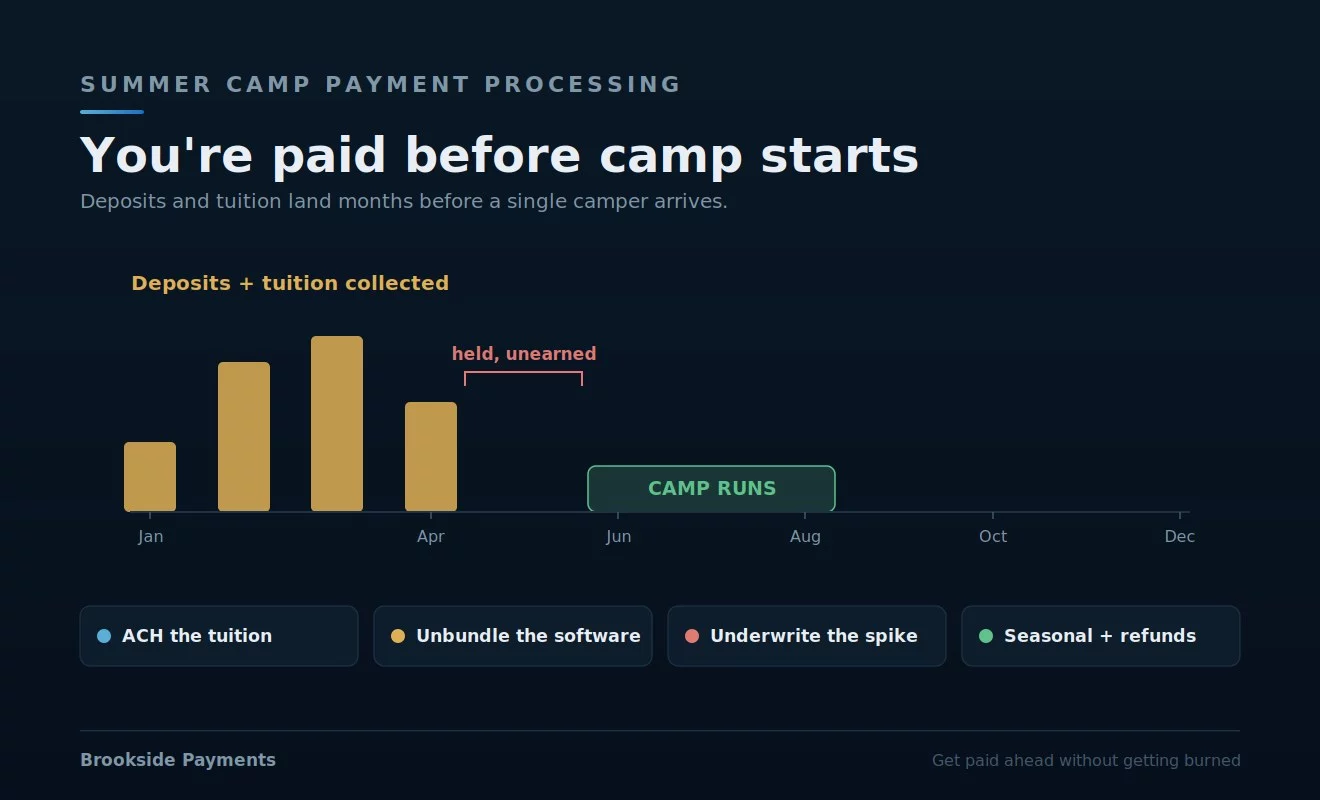
Most businesses deliver, then get paid. A summer camp does it backwards: families register and put down deposits in the winter, settle tuition in the spring, and the camp itself doesn’t run until June. For a few compressed weeks of registration season, a camp collects most of a year’s revenue for a service it won’t deliver for months — and that pay-ahead spike shapes everything about summer camp payment processing. It isn’t childcare’s steady year-round tuition or a school’s enrollment cycle; it’s a seasonal business that takes a mountain of money up front for a promise.
That structure creates a specific set of payment problems generic advice misses: a sudden spike of “unearned” money draws holds, the tickets are large enough to belong on a cheaper rail than cards, and the registration software almost everyone runs — UltraCamp, CampDoc, Regpack, ACTIVE, and the rest — bundles the card processing in at a rate you can’t easily see. Get summer camp payment processing right and the pay-ahead model funds your season cleanly; get it wrong and it invites a held deposit, an oversized fee, or a refund fight at exactly the wrong moment.
Tuition Is Too Big to Leave on Card Rates
Overnight-camp tuition can run well over a thousand dollars a session, and even day camps stack multi-week fees into sizable tickets. On a $1,500 tuition, paying card interchange is roughly forty-five dollars; the same payment by ACH or e-check is a few dollars. Multiply that across a full roster of campers and the method you collect on — not the rate you negotiated — becomes the biggest number in summer camp payment processing. The card networks are an expensive way to move large, scheduled payments, and tuition is exactly that.
This is why the better camp platforms offer e-check, and why a smart setup leans on it: put tuition and payment-plan installments on ACH with a card on file as backup, and reserve cards for the small add-ons — the camp store, a late-pickup fee — where the convenience is worth it. A clean summer camp merchant account is built around the bank rail for the big recurring tickets, the same way childcare centers handle tuition and property managers handle rent — sound camp tuition payment processing starts there. The deposit gets a family to commit; ACH gets you the balance without handing a slice to the card networks.
A $1,500 tuition on card costs ~$45; by ACH it’s a few dollars — and a camp runs that across an entire roster. Tuition and scheduled payment-plan installments are large and predictable, the textbook case for the bank rail. Keep a card on file as a backup and use cards for small add-ons; collect the big balances by ACH/e-check.
Your Registration Software Sets a Rate You Can’t See
Almost every camp runs on a registration and management platform — UltraCamp, CampDoc, Regpack, ACTIVE’s Camp & Class Manager, iCampPro — and the payment processing is baked in, at a rate the platform sets and folds into its overall bill. The software is genuinely useful for forms, waivers, health records, and rosters; the bundled processing is where the cost hides. Because it’s wrapped inside the platform fee, most directors never see their true card rate or compare it to anything — which is precisely what makes it the most overlooked line in summer camp payment processing.
Pulling the processing apart from the platform is often the biggest available saving, and it doesn’t always mean leaving the software. Some camp platforms let you connect an outside processor; where they do, you keep the system your staff and families know and route the card processing to a transparent interchange-plus account where the true cost is visible. Where a platform locks processing to its own bundled rate, that lock-in is itself a cost worth weighing at renewal. Good camp registration payment processing treats the software and the rate as two separate decisions.
Camp platforms (UltraCamp, CampDoc, Regpack, ACTIVE, iCampPro) bundle card processing at a rate folded into the software bill, so most directors never see their true rate. Where the platform allows an outside processor, keep the software and route processing to a transparent account. In summer camp payment processing, where it locks you to its bundled rate, count that lock-in as a real cost at renewal.
A Spike of Pay-Ahead Deposits Is Exactly What Triggers Holds
Here’s the risk unique to the pay-ahead model. When a camp collects a compressed flood of deposits and tuition for a season months away, the processor sees a sudden spike of payments for a service that hasn’t been delivered — and that is the textbook profile that triggers a reserve, a hold, or a frozen payout. It’s worse when the camp’s processing runs through a payment facilitator (the bundled PayFac model some registration platforms use, where you’re a sub-account rather than a true merchant), because a PayFac can hold or freeze far faster and with less warning than a dedicated account. Nothing derails summer camp payment processing like your deposits being held the week before camp opens.
The defenses are structural: a real, underwritten summer camp merchant account whose risk profile expects the seasonal spike rather than an aggregator that flags it as anomalous, clear records tying each payment to a future session, and a funding setup that won’t strand your cash when you need it for staff and supplies. The pay-ahead money is your camp’s working capital for the season — the one thing you cannot afford to have frozen is the deposit pile you’re counting on to actually run the camp.
A compressed flood of deposits for a service months away is exactly the profile that triggers reserves and frozen payouts — and a bundled PayFac (where you’re a sub-account, not a true merchant) can freeze faster and with less warning. Get a real merchant account whose underwriting expects the seasonal spike, document each payment against a future session, and don’t let an aggregator strand the cash you need to run camp — the one risk summer camp payment processing can’t afford to ignore.
Year-Round Fees and Refund Risk on a Few Months of Camp
A camp’s payment activity is a tall spike and a long flat line: heavy through registration and the season, near-silent the rest of the year. Processing setups built for steady businesses charge through that silence — monthly minimums, gateway fees, and platform costs that bill in October for a camp that runs in July. That seasonal mismatch is a quiet drain, and it pairs with the other end of the pay-ahead model: refunds and cancellations. When a family cancels, you may be returning money already spent on staff deposits and supplies, and a disputed deposit can come back as a chargeback. Both belong in any honest look at summer camp payment processing.
The setup that fits is one that breathes with the calendar — no punishing off-season minimums, costs that scale down when nothing’s moving — paired with a clear, well-disclosed deposit and refund policy that’s actually enforceable through your processor, so a cancellation is a known process rather than a chargeback surprise. A youth camp payment processing arrangement that ignores the season pays summer overhead in winter; one that ignores refunds learns its exposure through disputes. Plan for both before registration opens.
Card volume spikes for the season and goes quiet for months, but minimums and platform fees often bill all year — push for no off-season minimums and costs that scale down. And because cancellations return money you may have already spent, set a clear, disclosed deposit/refund policy your processor can actually support, so in summer camp payment processing a cancellation is a process, not a chargeback.
Get Paid Ahead Without Getting Burned
The pay-ahead model is a summer camp’s biggest advantage and its biggest payment risk at the same time. Summer camp payment processing done well turns the advantage into clean working capital: collect tuition and payment plans on ACH instead of card rates, separate the processing from the registration software so the rate is visible, get a real merchant account that underwrites the seasonal deposit spike instead of an aggregator that freezes it, and run a seasonal cost structure with a refund policy your processor can enforce. Do that, and summer camp payment processing turns the mountain of money you collect before camp opens into cash that’s there when you need it — to actually run the camp.
Frequently Asked Questions
Timing. A daycare bills steady tuition year-round and a school runs an enrollment cycle, but a summer camp collects a compressed spike of deposits and tuition months before it delivers anything. That pay-ahead model gives summer camp payment processing risks the others don’t have — a sudden flood of “unearned” payments that can trigger processor holds, plus the seasonal swing and refund exposure of a business that only runs a few months.
Yes, and the pay-ahead spike is exactly why. When a processor sees a sudden surge of payments for a service that hasn’t been delivered, it may place a reserve or hold — and that risk is higher if your processing runs through a bundled payment facilitator (where you’re a sub-account) rather than a true merchant account. The defense is a real account underwritten for the seasonal spike, with clear records tying each payment to a future session.
ACH for the big payments, cards for the small ones. On a $1,500 tuition, card interchange is around forty-five dollars versus a few dollars by ACH or e-check — across a full roster that’s the largest number in summer camp payment processing. Put tuition and payment-plan installments on the bank rail with a card on file as backup, and reserve cards for add-ons like the camp store where the convenience is worth the fee.
See What Your Camp Is Really Paying: And Risking
Send Brookside one recent statement and we’ll show your true effective rate inside your registration software, what moving tuition and payment plans to ACH would save across your roster, and whether your processing runs through a PayFac that could hold your deposit spike. It’s summer camp payment processing built around a real merchant account for the seasonal surge. No switch required to find out. You can also review card payment protections from the CFPB.
Get Your Camp ReviewedNo obligation • No pressure • Response within one business day
See what a statement review looks like →