Dance Studio Payment Processing: Why Your Software Sets the Rate
Why Studios Hand Their Processing Rate to Their Software
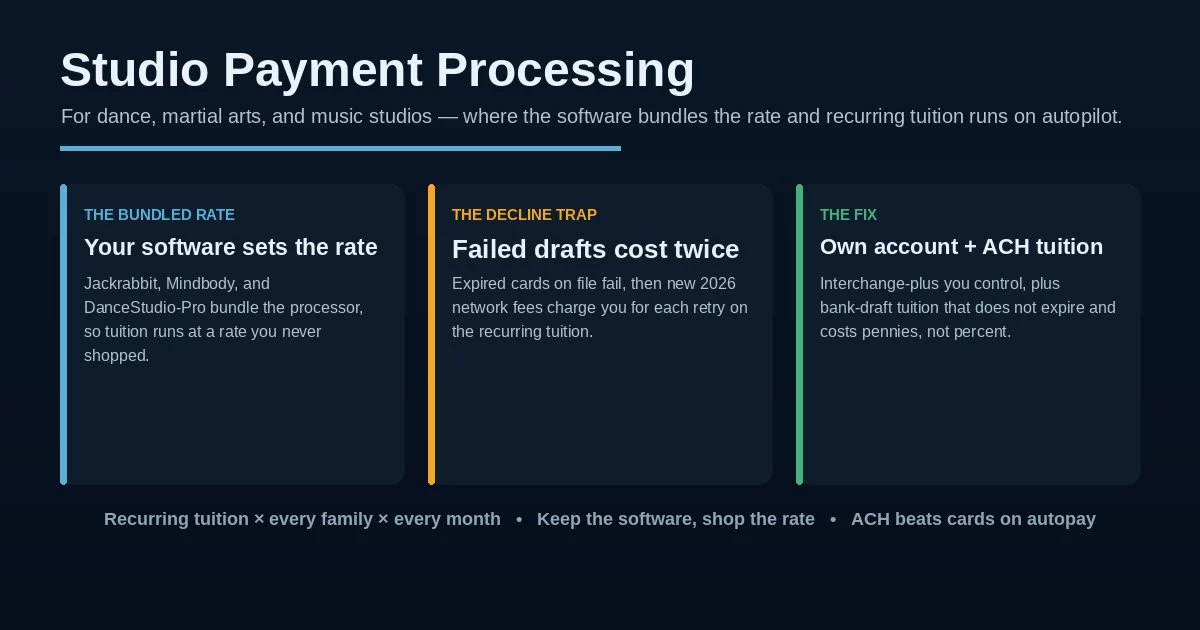
Dance studio payment processing almost always arrives bundled with the software. You sign up for Jackrabbit, Mindbody, DanceStudio-Pro, or iClassPro to handle registration, scheduling, and tuition, and the card processing comes baked in — Jackrabbit Pay, Mindbody Payments, or a narrow set of built-in gateways. It works on day one, so you never look closely. The rate you’re paying on every tuition draft is one the platform set, not one you ever shopped — and the same is true whether you run a dance studio, a martial arts school, or a music studio.
That bundling is convenient, and convenience is exactly the point. The platform has no incentive to hand a single-location studio a competitive rate when switching feels like switching your entire operating system. The studio software you love for class management and the merchant account that processes your tuition do not have to be the same vendor — and once you separate those two decisions, the savings start. A studio tuition payment processing setup you actually control is a different choice from the app you schedule with. Sound dance studio payment processing starts by treating the merchant account as its own decision, separate from the software.
When the processor is built into your studio platform, the markup is set for you and folded into a flat rate or a per-student fee. There is no pressure to price a small studio fairly, because the platform is betting you’ll never move your processing somewhere cheaper. A dance studio merchant account you own takes that bet off the table.
Tuition Runs on Autopilot: And So Do the Fees
The whole appeal of studio software is that tuition runs itself: a card or bank account goes on file at registration, and the platform auto-drafts on the 1st every month. That steady, predictable revenue is exactly what a studio needs — but every one of those drafts is a card transaction at the platform’s bundled rate, repeating month after month, family after family. The cost is invisible precisely because it’s automatic. You never hand anyone a card, so you never feel the percentage coming off the top.
Run the math and it adds up fast. A studio billing 150 families an average of $150 a month is processing roughly $270,000 a year in tuition, and even a half-point of unnecessary markup on that dance studio payment processing is real money walking out the door annually — money that could cover a new instructor, recital costs, or a studio expansion. Because the charges recur, the difference between a bundled rate and transparent interchange-plus pricing compounds every single month. Martial arts school payment processing and music studio payment processing carry the exact same recurring-revenue math.
A retail shop pays the markup once per sale. A studio pays it on the same families every month, forever. That makes the rate the single most important number in your whole payment setup — a small percentage difference, multiplied by every family and every month, is the difference between a comfortable margin and a thin one.
Expired Cards, Failed Drafts, and the New Fees That Punish Retries
Here’s the wrinkle most studio owners haven’t caught yet. Cards on file expire, hit limits, or get replaced, so a share of your monthly drafts fail — and when they do, the platform automatically retries them. That used to be merely an annoyance and a cash-flow gap. As of 2026, it’s also a fee. Mastercard now assesses a Credential Continuity fee on recurring payments attempted with outdated credentials, and an escalating Excessive Authorization fee once a card racks up repeated declined attempts. In other words, your failed tuition drafts can now cost you twice: the missing tuition and a per-retry penalty on top.
The fix is two-part and entirely within your control. First, keep cards current — a processor with an automatic card-updater service refreshes expired card numbers behind the scenes so drafts don’t fail in the first place. Second, and bigger: move recurring tuition onto bank drafts wherever families will allow it. ACH payment processing pulls tuition straight from a checking account for pennies per transaction instead of a percentage, and bank accounts don’t expire the way cards do — which means fewer failed drafts and fewer of the new retry fees. For a recurring-billing business, ACH is the single most overlooked lever in dance studio payment processing — and it works identically for martial arts school payment processing and music studio payment processing.
A failed tuition draft used to just delay your money. In 2026 it can also trigger Mastercard’s Credential Continuity and Excessive Authorization fees on the retries. Keeping cards updated and shifting autopay to ACH attacks both problems at once — fewer failures, lower cost per draft, no retry penalties.
What the Right Studio Payment Setup Looks Like
The durable answer is a dedicated studio merchant account that’s separate from your class-management software — your own merchant ID on interchange-plus pricing, so the markup is a line you can see and audit instead of a blended rate the platform chose. You keep Jackrabbit, Mindbody, or DanceStudio-Pro for everything you love — registration, scheduling, attendance, recital and costume billing — and route the actual card and ACH processing through an account you control. This is what well-run dance studio payment processing looks like. Most platforms support connecting an outside gateway or processor; the two don’t have to be the same company. Run any quote through an effective rate calculator to see your true all-in cost.
From there, the structure does the work: ACH bank-draft as the default for recurring tuition (cards as the backup), an automatic card-updater to cut failed drafts, and — for the families who do pay by card — the option of a compliant cash discount or dual-pricing program to offset the card cost rather than absorbing it. The studio platforms even market surcharging as a feature, which tells you how much the card percentage matters at studio volume. The point isn’t to fight your software; it’s to stop letting your software quietly set your most important recurring cost. That is what a dance studio merchant account on interchange-plus is built to do.
Your own merchant ID on interchange-plus you can audit, ACH tuition that costs pennies and rarely fails, a card-updater that prevents declined drafts, and a surcharge or cash-discount option for card payers — all while keeping the studio software you already run. You stop renting your tuition revenue to a bundled rate.
Staying Set Up Right: And What to Ask Before You Sign
Once the account is right, the maintenance is light but it matters. Keep cards on file current with an updater service, default new families to ACH at registration, and watch your seasonal pattern: registration season and recital or competition season can spike your volume sharply, and a sudden jump on a thin processing history is a classic trigger for a processor to hold funds. A studio-aware setup anticipates the surge instead of freezing on it. Keep in mind that a failed draft is not a chargeback — but if a parent disputes a legitimate tuition charge, the chargeback process still rewards the studio that has a signed enrollment agreement and clear tuition policy on file.
Whether you’re leaving a bundled platform rate or setting up a new studio, the questions are concrete. Will you get your own merchant ID on interchange-plus, with the markup itemized — or a flat rate the software set? Can you keep your class-management platform and still move the processing? Does the account support ACH bank-draft for tuition and an automatic card-updater? What’s the reserve structure, and how does it treat a registration-season spike? And read the merchant agreement closely — term length, early-termination fee, and reserve language matter most for a business whose revenue recurs every month. Handled this way, dance studio payment processing stops skimming your tuition and starts behaving like the quiet, reliable backbone it should be. Studios that also run a class-pass or membership model can compare notes with our gym payment processing and personal trainer payment processing guides.
Frequently Asked Questions
Because the processor is bundled into the software and the rate is set for you, not shopped. Platforms like Jackrabbit, Mindbody, and DanceStudio-Pro package card processing with scheduling and tuition billing at a convenient flat or per-student rate, and there’s no pressure to price a single-location studio competitively, so dance studio payment processing tends to run higher than it should. You can keep the platform for class management and route the actual processing through your own account on interchange-plus pricing, which itemizes the markup so you can see and audit it.
ACH bank-draft is usually the better default for recurring tuition. It pulls straight from a checking account for pennies per transaction instead of a percentage, and bank accounts don’t expire the way cards do — so you get fewer failed drafts and avoid the new 2026 Mastercard retry fees that hit declined recurring card payments. Keep cards on file as a backup and for families who prefer them, ideally with an automatic card-updater to prevent failures.
Usually, yes. The registration, scheduling, and tuition tools you rely on are separate from who actually processes the payment. Many studios keep the class-management software they like and connect their own merchant account or gateway on interchange-plus pricing, which can meaningfully lower the effective rate without changing how you run the day. Compare your true all-in cost with an effective rate calculator before deciding.
Get a studio setup that stops skimming your tuition.
Send us your studio software’s rate or a recent statement and we’ll show you what you’re really paying on every tuition draft, whether you can keep your platform and move the processing, how much ACH tuition would save versus cards, and how to head off the new 2026 retry fees on failed drafts — no obligation, no sales pressure. Learn more about payment processing consumer protections from the CFPB.
Review My Studio ProcessingNo obligation • No pressure • Response within one business day
See what a statement review looks like →