Specialty Merchant Registration: Mastercard’s 2026 High-Risk Fee Overhaul
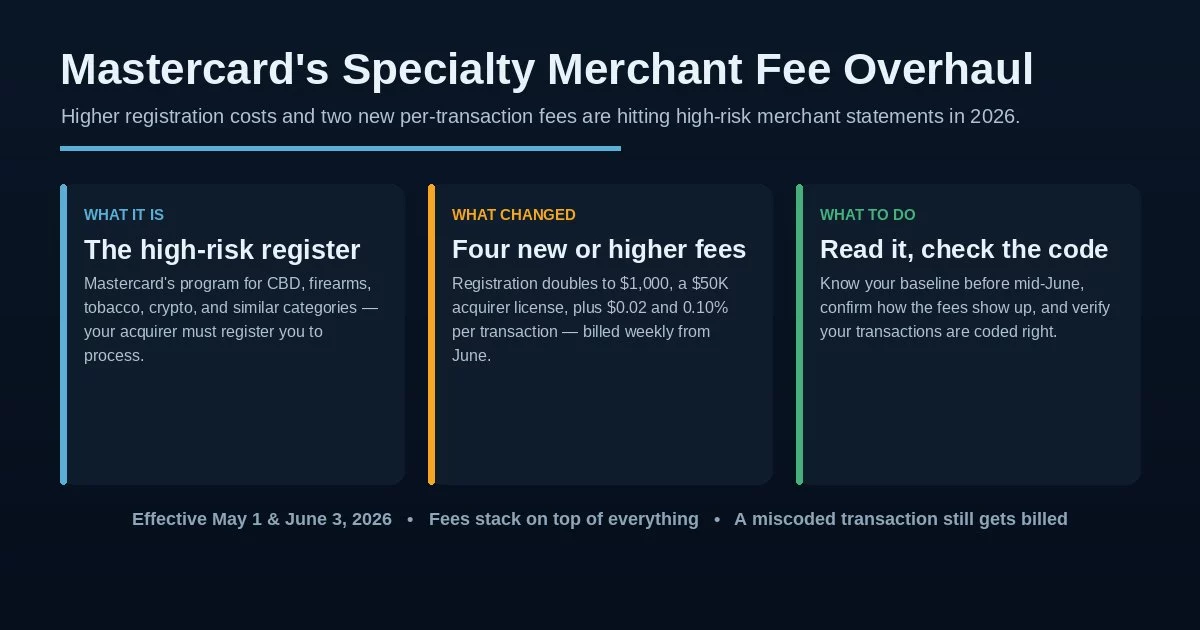
A Major Change to How High-Risk Merchants Get Billed
If you process in a category Mastercard treats as high-risk, the cost of staying registered is rising sharply in 2026 — and a couple of brand-new fees are about to appear on your statement. The change runs through the specialty merchant registration program, the specialty merchant registration system Mastercard uses to monitor and register merchants in categories it classifies as elevated-risk: CBD, firearms, tobacco and vape, nutraceuticals, online gambling, cryptocurrency, high-risk securities, adult content, and similar verticals. If your business operates in one of these spaces, Mastercard requires your acquirer to register you with the network before you can accept card payments at all.
On October 28, 2025, Mastercard published a bulletin overhauling that program — raising the existing registration fee, adding a new license fee on acquirers, and introducing two entirely new per-transaction charges that attach to every high-risk sale. The first wave took effect May 1, 2026; the second lands June 3, 2026, with the first billing on June 14. There’s no phase-in and no opt-out short of leaving the program. This is the largest change to the specialty merchant registration program in years, and the high-risk registration fee increase is only part of it. For the high-risk merchant, the practical takeaway is simple: new line items are coming to your statement this summer, and it pays to understand them before they show up.
Mastercard’s specialty merchant registration program is how the network identifies and monitors merchants in higher-risk categories. Registration is handled by your acquiring bank, not by you directly — but the fees attached to it flow downhill to the merchant. Visa runs a parallel program, the Visa Integrity Risk Program, with its own separate fees.
The Four New or Higher Fees: And When They Hit
Mastercard split the rollout into two dates, and there are four distinct charges to know. As of May 1, 2026, the annual Specialty Merchant Registration Fee doubled from $500 to $1,000 per registered merchant, per year, and Mastercard introduced a new High-Risk Acquirer License Fee of $50,000 per year that every acquirer onboarding high-risk merchants must pay — auto-granted to existing acquirers, but billed whether they asked for it or not. Then, effective June 3, 2026, two new per-transaction fees attach to every high-risk sale: a Specialty Merchant Transaction Fee of $0.02 per transaction, and a Specialty Merchant Volume Fee of 0.10% (ten basis points) of each transaction. Both are billed weekly, with the first billing on June 14.
The important structural detail is that these are not a repackaging of existing costs — they stack on top of interchange, assessments, scheme fees, and whatever premium you already pay for being coded high-risk. The per-transaction fees follow the transaction itself through Mastercard’s clearing systems, applying to standard purchases, cash-back purchases, credits, and unique transactions, with only funding transactions exempt. This is the kind of change that’s easy to miss in the noise of a high-risk statement, which is exactly why it’s worth flagging before mid-June rather than discovering it on an invoice.
From May 1, 2026: registration $500 → $1,000 per merchant per year; a new $50,000 annual acquirer license. From June 3, 2026 (first billed June 14): a $0.02 per-transaction fee and a 0.10% volume fee, both billed weekly. All of it sits on top of your existing processing costs, which is what makes this high-risk merchant registration change bite harder than the headline numbers suggest.
Why an Acquirer Fee Still Lands on Your Statement
It’s reasonable to ask why a $50,000 acquirer license or an acquirer-paid registration fee is your problem. The answer is pass-through. Acquirers don’t absorb costs of this size — they recover them, and the recovery shows up as new or higher line items on the merchants who triggered them. The per-transaction and volume fees are even more direct: they’re tied to your sales specifically, so they pass straight through to your account. Expect to see new fee lines appear on high-risk statements starting in mid-June 2026, and expect pass-through language to start appearing in merchant agreements to authorize them.
The numbers are not trivial at volume. Consider a high-risk merchant running $500,000 a month in card sales at a $25 average ticket — roughly 20,000 transactions a month. The 0.10% volume fee alone runs about $500 a month, the $0.02 transaction fee adds another $400, and the $1,000 annual registration sits on top — close to $12,000 a year in brand-new direct fees, before the acquirer recovers any share of its license cost. Whether your processor passes these through transparently, buries them in a blended rate, or pads them with a markup is exactly the kind of thing an interchange-plus pricing setup makes visible and a tiered plan hides.
The registration, license, transaction, and volume fees all sit on top of the interchange, assessments, and high-risk premium you already pay. For a merchant already paying more to be coded high-risk, this is additional cost layered onto an already-expensive account — which makes knowing your true effective rate, line by line, more important than ever.
A Miscoded Transaction Still Triggers the Fee: What to Do Now
Here’s the trap most high-risk merchants won’t see coming. These fees attach at the transaction level, based on how your sales are tagged in Mastercard’s system. If a transaction is coded as specialty-merchant volume, the fee follows it — and there is no re-coding strategy or workaround that removes it. But the reverse is the real danger: a transaction that’s misclassified can still trigger the fee without delivering the program protections that are supposed to come with it. You can end up paying for the high-risk designation while not actually getting the monitoring and acceptance benefits it’s meant to provide. Correct coding isn’t a billing nicety here; it’s the difference between paying for something and paying for nothing.
So there are concrete steps worth taking before the June billing cycles begin. Pull a current statement and know exactly what you pay today, line by line, so the new fees are recognizable when they appear — our guide to reading your merchant processing statement shows where they’ll land. Ask your processor directly how the four new charges will be displayed and at what frequency, since weekly billing means they won’t look like your usual monthly lines. And confirm your transactions are coded correctly for your actual business category, so you’re not paying the specialty fee on volume that shouldn’t carry it. A processor that knows high-risk well should be able to answer all three without hesitation.
Pull a recent statement and baseline your current costs. Ask your processor how and how often the four new fees will appear. Verify your transaction coding matches your real business category. Done before mid-June, this turns the new fees from a nasty surprise into a known, planned-for line item.
Staying Compliant: And the Consolidation Risk to Watch
There’s a second-order effect worth understanding. By adding a $50,000 annual license on top of higher per-merchant fees, Mastercard has raised the cost of being a high-risk acquirer at all — and the likely result is consolidation. Smaller or generalist acquirers may decide specialty merchants aren’t worth the licensing and operational burden, which means fewer acquiring options for the businesses that already had the fewest. If you operate in firearms, tobacco, CBD, or another monitored category, the value of working with a processor that specializes in high-risk payment processing — and isn’t going to exit the space — just went up. This is also a reminder of how Mastercard’s monitoring works alongside tools like the MATCH list to keep close watch on high-risk accounts.
Whether you’re already registered or just entering a high-risk category, the questions to ask are concrete. Will your processor show the four new fees transparently, or fold them into a blended rate? Is your high-risk merchant account on interchange-plus so you can actually see them? Does your merchant agreement spell out how pass-through fees like these are handled, and at what markup? And is the processor committed to high-risk acquiring for the long term, not likely to drop the category when the economics tighten? Specialty merchant registration is a fixed cost of operating in a regulated category, and the high-risk registration fee that comes with it is not negotiable — but how much of it you actually pay, and whether you can see it clearly, depends entirely on the processor you choose. Categories most affected include CBD, tobacco and vape, and firearms.
Frequently Asked Questions
It’s the program Mastercard uses to identify, register, and monitor merchants in categories it classifies as high-risk — CBD, firearms, tobacco and vape, nutraceuticals, online gambling, cryptocurrency, high-risk securities, adult content, and similar verticals. If your business falls into one of these categories, your acquiring bank has to register you with Mastercard before you can process its cards, and that registration carries annual fees. Visa runs a parallel program called the Visa Integrity Risk Program with its own separate fees.
It depends on your volume, but the new charges add up. The annual registration fee doubled to $1,000 per merchant as of May 1, 2026, and from June 3 there’s a $0.02 per-transaction fee plus a 0.10% volume fee, both billed weekly. A high-risk merchant doing $500,000 a month at a $25 average ticket would see roughly $12,000 a year in new direct fees from the per-transaction and volume charges plus registration — and acquirers will also be recovering a new $50,000 annual license fee. All of it stacks on top of your existing processing costs.
Not by switching processors — these are Mastercard network requirements that apply industry-wide to merchants in monitored categories, and registration generally can’t be moved from one acquirer to another. What you can control is how clearly you see the fees and whether you’re overpaying on top of them. An interchange-plus account itemizes the charges so you can verify them, a correct transaction coding ensures you’re not paying the fee on volume that shouldn’t carry it, and a true high-risk specialist won’t pad the pass-through or abandon the category.
Make sure the new specialty fees show up clearly: And that you’re not overpaying on top of them.
Send us a recent statement and we’ll baseline what you pay today, show you where the new specialty merchant fees will land and how your processor plans to display them, confirm whether your transactions are coded correctly, and tell you whether you’re on a high-risk account that prices these pass-throughs transparently — no obligation, no sales pressure. Learn more about payment processing consumer protections from the CFPB.
Review My High-Risk StatementNo obligation • No pressure • Response within one business day
See what a statement review looks like →