Tire Shop Payment Processing: Nobody Walks In Planning to Spend $1,100
Nobody Walks In Planning to Spend $1,100
Tire shop payment processing has a problem most auto businesses don’t. A set of four tires is a big ticket, and it is almost always an unplanned one. Your customer didn’t budget for it. They found out this morning, at the curb or in your bay, that the car isn’t safe to drive. They need the tires today.
That combination — large, urgent, unbudgeted — is what makes tire shop payment processing different from every other auto vertical: it is exactly the transaction a card is most likely to refuse. And when it does, you don’t lose a few dollars of margin. You lose the entire sale, standing at your own counter, with the tires already off the rack.
The Fee Is $32. The Decline Is $1,100.
Owners negotiate hard on the rate, and they should. But run the numbers on where the money actually goes in tire shop payment processing and the priority flips.
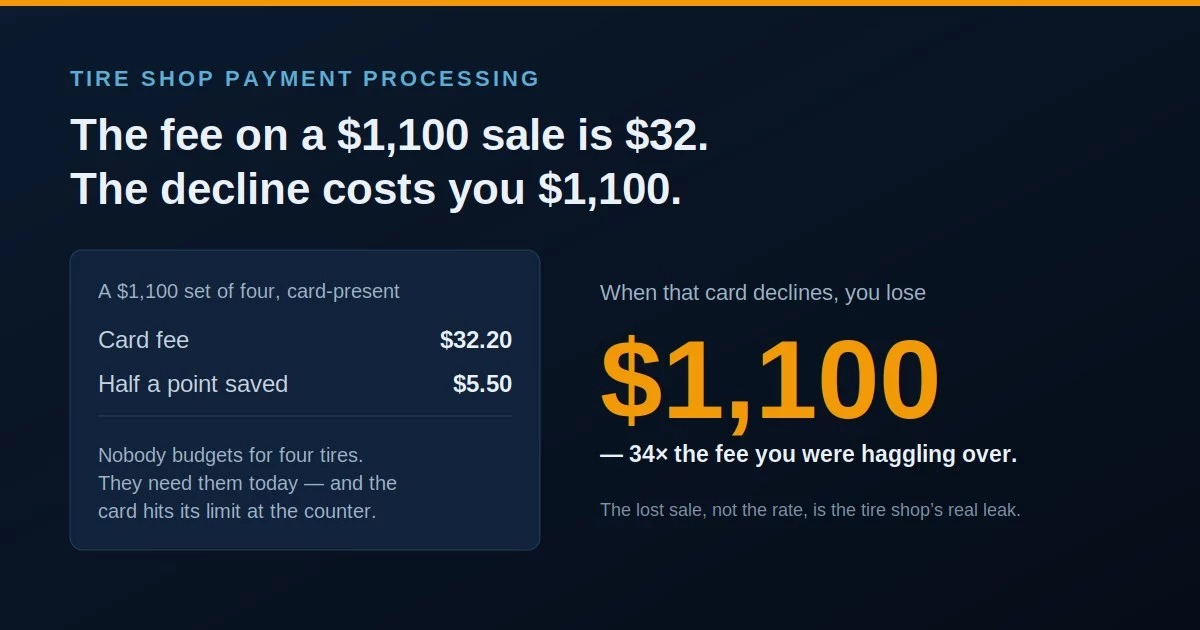
- Card fee at 2.9% + 30¢: $32.20 — the cost of doing business
- Shaving half a point off your rate: saves about $5.50 on that sale
- The card declines and the customer leaves: you lose $1,100
- One recovered decline is worth more than 200 sales’ worth of rate haggling
That’s the whole argument. A better rate is worth real money over a year, and you should have one. But a declined card on a four-tire sale is a hole 34 times bigger, and most shops have never done a single thing about it.
Your Sale Looks Like Fraud to the Issuer
The decline problem in tire shop payment processing is not bad luck. A $1,100 charge at an auto shop the cardholder has never visited, on a day they weren’t planning to spend money, is precisely the pattern an issuing bank’s fraud model is built to stop. Add a customer who is near their credit limit — common, because this expense wasn’t planned — and the decline is close to predictable.
The card can decline because of an issuer fraud hold, because the customer is over their limit, or because of a simple address or CVV mismatch. All three look the same to your service writer: a red screen and an awkward silence. But each has a different fix, and knowing which one you’re looking at is the difference between saving the sale and watching it walk.
The decline code your terminal returns tells you which one it is. Most shops never read it.
What a Tire Shop Should Have Ready
The goal isn’t to force a card through — it’s to give the customer a way to pay that works, before they leave to “think about it.” A tire shop merchant account should be set up so the counter has options the moment the first card fails.
- Split tender: take $600 on one card and $500 on another. Most declines are limit problems, not fraud, and splitting the ticket solves them instantly.
- A second rail: an ACH bank payment or a debit card avoids the credit limit entirely.
- Financing: a buy now, pay later option turns an unaffordable $1,100 into four payments — and closes a sale you were otherwise losing.
- Read the code: a fraud hold usually clears with one phone call from the customer to their bank. A limit decline never will.
None of this is exotic, and all of it belongs in tire shop payment processing. It’s the difference between a counter that can only run a card and a counter that can actually close.
On a Big Ticket, the Percentage Is the Cost
With declines handled, the rate is worth real attention — because on a $1,100 sale, the fixed per-transaction fee is a rounding error and the percentage is the entire cost. That’s the inverse of a quick lube or a coffee counter, where the fixed fee does the damage.
Most tire shops on flat-rate or tiered pricing run somewhere near 3.3% to 3.5% blended. Moved to interchange-plus pricing, tire shop payment processing typically lands in the 2.9% to 3.2% range all-in. On a shop doing $80,000 a month, that gap is a few hundred dollars every month — worth having, but still smaller than the sales you’re losing at the counter.
How to Fix Tire Shop Payment Processing
Tire shop payment processing improves in a specific order: fix the lost sales first, then fix the rate. That order matters, because the first one is worth more.
- Make sure your terminal supports split tender, and that your counter staff know how to use it.
- Add a financing or BNPL option so an unbudgeted $1,100 has a path that isn’t “come back Friday.”
- Teach the counter to read the decline code — fraud hold, limit, or mismatch — and respond to each differently.
- Pull one statement and find your true effective rate, then move to interchange-plus so the percentage on big tickets is real cost plus one visible markup.
Do it in that order and the tire shop merchant account stops being a way to accept money and starts being a way to close sales.
Frequently Asked Questions
Because the sale is large, urgent, and unplanned. That pattern trips issuer fraud models, and customers who didn’t budget for tires are often near their credit limit. Split tender and a financing option recover most of these.
Judge the effective rate, not the quote. A tire shop on interchange-plus typically lands around 2.9% to 3.2% all-in. Because tickets are large, the percentage matters far more than the fixed per-transaction fee.
Yes, if your terminal is set up for split tender. It’s the single most effective decline recovery a tire shop has, because most large-purchase declines are credit limit problems rather than fraud.
Send One Statement. We’ll Find Both Leaks.
If four-tire sales are declining and walking out the door, that’s costing you far more than your rate is. Send Brookside one recent statement and we’ll show you your true effective rate and how to set the counter up to recover declines — split tender, a second rail, and a financing path. The review takes about fifteen minutes. Learn more about payment processing consumer protections from the CFPB.
Send Your Statement for a Free ReviewNo obligation • No pressure • Response within one business day
See what a statement review looks like →