Oil Change Payment Processing: The Cards You Want Most Cost You Most
The Cards You Want Most Cost You Most
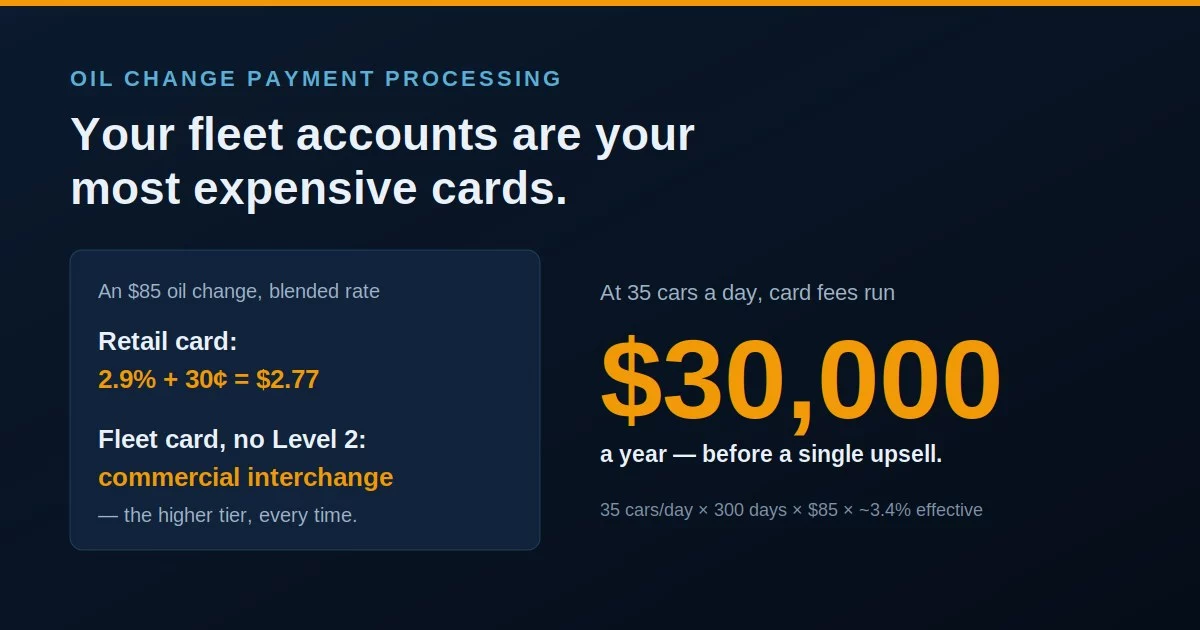
Oil change payment processing looks simple from the bay. Cars come in, the ticket is $70 to $110, the card taps, the car leaves. Do that thirty-five times a day and the fees add up to real money — roughly $30,000 a year before you sell a single air filter.
But the number that actually separates a quick lube from every other auto shop isn’t the retail card. It’s the fleet card. The commercial accounts you work hardest to win — the plumbing company with nine vans, the county’s pickup fleet, the local delivery outfit — hand you a card that costs more to accept than the walk-in customer’s, and most shops have no idea it’s happening.
Commercial Cards Sit in a Higher Interchange Tier
A fleet or commercial card — WEX, Voyager, Fuelman, Comdata, or a business credit card — is not priced like the consumer card in a customer’s wallet. Commercial cards carry their own, higher interchange categories. Accept one the way you accept a retail card and you pay the top of that tier, every single time.
Commercial interchange has a discount built into it — but only if you send extra data with the transaction. Submit Level 2 data (a tax amount and a customer code) and the card qualifies for a reduced commercial rate. Send nothing, and it clears at the highest tier available. Most quick lube terminals send nothing, because nobody set them up to.
That’s the quiet leak in oil change payment processing: your best, most loyal, highest-frequency customers are running on the most expensive cards you accept, at a rate you could be cutting with a setting you don’t know exists.
What Thirty-Five Cars a Day Actually Costs
The retail side of oil change payment processing is straightforward, and it’s where most owners stop looking.
- An $85 ticket at 2.9% + 30¢ = $2.77 → a 3.3% effective rate on retail
- Fleet cards clear higher — commercial interchange, no Level 2 data submitted
- Blended across the day, many shops land at 3.4% to 3.7% all-in
- 35 cars/day × 300 days × $85 ≈ $890,000 a year in card volume
At 3.4%, that’s about $30,000 a year in processing. Trim it to the 2.9% to 3.2% range that oil change payment processing should run at on interchange-plus with fleet cards handled properly, and you keep several thousand dollars — without touching your price board or your bay time.
Speed Is Revenue in a Two-Bay Shop
Speed is the other half of oil change payment processing, because a quick lube sells throughput. The whole promise is that the car is in and out in fifteen minutes, and everything in the shop is built around protecting that clock — including the payment. A terminal that takes eight seconds to authorize instead of two, or that drops its connection at the busiest hour, isn’t a small annoyance. It’s a car still sitting in the bay while the next one waits on the apron.
This is where oil change credit card processing quietly differs from a restaurant or a salon, where a slow card is just a slow card. In a bay, the payment is the last step before the bay reopens. Hardware and connectivity are a throughput decision, not just a cost decision.
The Upsell Changes the Ticket: And the Fee
Your average ticket isn’t really $40. It’s $40 for the oil, plus the cabin air filter, plus wipers, plus the coolant flush the tech spotted. Those upsells are the margin in the business, and they push the ticket into the $85 to $150 range where the percentage rate matters far more than the fixed per-transaction fee.
The drive-up customer wants a fast card-present tap at the lowest retail rate. The fleet account wants a commercial card accepted with Level 2 data, or invoiced monthly on account. A proper oil change merchant account handles both — a flat-rate app blends them into one number and charges you the fleet premium without ever showing it to you.
How to Fix Oil Change Payment Processing
None of this requires new equipment or a slower bay. Oil change payment processing improves by pricing the two flows correctly, and the first step costs you one statement.
- Pull one statement and find your true effective rate — total fees over total volume, not the rate you were quoted.
- Separate the fleet volume from the retail volume. If nobody has ever mentioned Level 2 data to you, you are almost certainly paying the top commercial tier.
- Move to interchange-plus pricing so each card — retail or commercial — clears at its real cost plus one visible markup.
- Turn on Level 2 data for commercial cards so fleet accounts qualify for the reduced rate instead of the highest one.
- Check the terminal’s authorization speed and connection. In a bay, seconds are inventory.
Run in that order, a quick lube blended at 3.4% or worse typically lands near 2.9% to 3.2% all-in — and the fleet accounts stop being the most expensive cards in the shop.
Frequently Asked Questions
Commercial and fleet cards sit in higher interchange categories than consumer cards. They can qualify for a reduced commercial rate, but only if you submit Level 2 data with the transaction. Most shops never have it enabled, so the card clears at the top tier.
Judge the effective rate, not the quote. Blended across retail and fleet volume, a quick lube on interchange-plus with Level 2 enabled typically lands around 2.9% to 3.2% all-in. Much past 3.4% and the commercial cards are the likely reason.
Both work, and the right answer depends on the account. Cards are faster but carry commercial interchange. Monthly invoicing on ACH avoids card fees entirely on your largest recurring accounts, which is usually cheaper once a fleet reaches real volume.
Send One Statement. We’ll Find the Fleet Premium.
If your shop takes fleet cards and nobody has ever mentioned Level 2 data, you’re paying the highest commercial tier on your best accounts. Send Brookside one recent statement and we’ll separate your retail and fleet costs and show you exactly what interchange-plus and Level 2 would save — the math takes us about fifteen minutes. Learn more about payment processing consumer protections from the CFPB.
Send Your Statement for a Free ReviewNo obligation • No pressure • Response within one business day
See what a statement review looks like →