Zero Cost Processing Is Not Zero Cost
Zero Cost Processing Is Not Zero Cost
Somebody has called your business and offered you zero cost processing. Free credit card processing. Zero-fee merchant services. The names change; the pitch doesn’t. Stop paying processing fees, keep 100% of every sale, sign here.
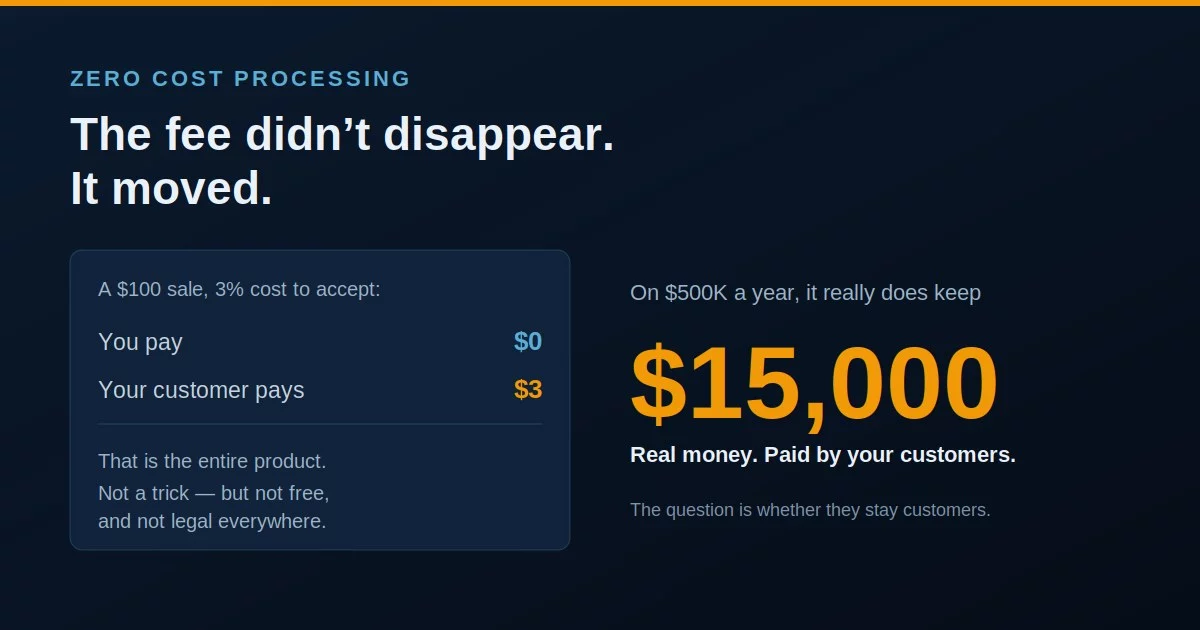
It isn’t a scam, and the savings are real. But the name is doing something sneaky, so let’s say the quiet part out loud: the fee does not disappear. It moves to your customer. That’s the entire product. Everything else — whether it’s legal for you, whether it’s worth it, whether it costs you customers — follows from that one sentence.
Where the Three Dollars Goes
The program is easiest to understand on a single sale.
- Traditional: you absorb $3. You keep $97.
- Zero cost: the customer is charged $103. You keep $100.
- Nobody made $3 vanish. Your customer paid it.
And to be fair to the pitch: on $500,000 a year of card volume, that’s about $15,000 you stop absorbing. That is real money, and for plenty of businesses it’s the right call. The problem isn’t that it doesn’t work. The problem is what the salesperson leaves out.
It’s Not One Program. It’s Three, and They Have Different Rules.
"Zero cost processing" is a marketing label, not a product. Underneath it is one of three real programs, and the legal difference between them is not academic.
- A cash discount program — one posted price, with a discount for paying cash.
- Dual pricing — two prices shown side by side, cash and card.
- A surcharge program — the card fee added at checkout as a separate line.
Surcharging is the one with teeth. It’s capped by the card brands, it can never be applied to debit cards — even when the customer runs a debit card as credit — and it’s restricted or banned in several states. A rep who says "it’s all the same thing" is either uninformed or hoping you are. If you’re weighing the two most common options, the dual pricing versus cash discount comparison is the place to start.
Your Customers Vote on This, Not You
Here’s the question no rep will ask you: how will your customers feel about it? Because they’re the ones now paying the fee, and their reaction determines whether this is brilliant or expensive.
Some businesses can do this all day without a murmur. Nobody blinks at a fee on a government payment, a utility bill, an HOA assessment, or a contractor’s invoice — those payers expect it. B2B invoicing is much the same. But in competitive consumer retail, where the shop across the street isn’t doing it, a card surcharge is a reason to shop across the street. Lose two or three percent of your customers to save three percent on fees and you’ve done a lot of work to break even.
Is your customer captive or comparing? Captive payers — dues, invoices, bills, permits — absorb the fee without leaving. Comparing customers — retail, restaurants, anywhere with a competitor next door — might not. That single question predicts more about whether this works than any rate on the proposal.
The One Nobody Tells You: You Still Have a Rate
This is the part that costs merchants the most, and it’s almost never explained. Under any of these programs, there’s still an underlying processing rate. You just stopped feeling it — because the customer is paying it.
Whether shifting that rate onto customers is worth doing at all comes down to one number: how much of your profit card processing is actually taking. Above a comfortable margin it is not worth the friction; on a thin one, it is survival.
So what happens when that underlying rate is padded? The surcharge or card price your customer sees goes up. A merchant on an honest interchange-plus program might pass along a modest fee. A merchant on a padded tiered rate passes along a bigger one — and never notices, because the money isn’t coming out of their pocket. Their customers eat it, and their competitors look cheaper.
Zero cost processing removes the merchant’s incentive to audit their own rate. The one person who was watching the number stops watching, because it stopped being their money. That’s exactly why you should still know your true effective rate — even, and especially, when you’re not the one paying it.
How to Evaluate Zero Cost Processing Honestly
Zero cost processing is a legitimate tool. Whether it’s the right tool for you depends on four things, in this order.
- Ask which program it actually is — cash discount, dual pricing, or surcharge. If the rep can’t answer cleanly, that’s your answer about the rep.
- Check your state and your card mix. Surcharging is capped, state-restricted, and never permitted on debit. A debit-heavy business gets far less out of this than the pitch implies.
- Ask whether your customers are captive or comparing. This decides it more than any other factor.
- Get your underlying rate on interchange-plus anyway — so the fee your customers see is the real cost of acceptance, not someone’s padded markup.
Done properly, zero cost processing keeps $15,000 a year in a business that can carry it. Done carelessly, it’s a compliance problem, a customer problem, and a very comfortable place for a processor to hide a rate nobody’s checking anymore.
Frequently Asked Questions
It depends which program it is. Cash discount and dual pricing are broadly permitted. Surcharging is capped by the card brands, prohibited on debit cards entirely, and restricted or banned in several states. The label is legal; the specific implementation is what has to be checked.
It depends on whether your customers are captive or comparing. Payers of dues, invoices, bills, and permits rarely object. Consumer retail and restaurants, where a competitor next door isn’t doing it, carry real risk of losing more in sales than you save in fees.
Yes — more than ever. The underlying rate sets what your customers are charged. A padded rate means a bigger fee on their receipt, and because it isn’t your money anymore, nobody in your business is checking it. Know your effective rate even when you don’t pay it.
Send One Statement. We’ll Tell You If It Fits.
We build these programs — and we’ll also tell you when you shouldn’t run one. Send Brookside one recent statement and we’ll show you your true effective rate, what your card mix means for surcharging, and whether your customers are the kind who’d absorb it or the kind who’d leave. About fifteen minutes, and we’ll give you a straight answer either way. Learn more about payment processing consumer protections from the CFPB.
Send Your Statement for a Free ReviewNo obligation • No pressure • Response within one business day
See what a statement review looks like →