The Rule That Keeps Debit Cheap Just Lost in Court
The Debit Interchange Cap Is One Court Ruling From Changing
The debit interchange cap is the reason accepting a debit card costs you a few cents instead of a few percent — and for the first time since 2011, it is genuinely in play. In August 2025 a federal court struck the cap down entirely, ruling that the Federal Reserve overstepped its authority when it set it. The cap survives today only because the same judge froze his own order while the Fed appeals. Where that appeal lands will decide whether the number on your debit line goes down, stays put, or disappears as a regulated figure altogether.
This is the kind of change that never shows up in a state legislature and rarely reaches a small-business owner until it is already on the statement. It is not a bill and not a card-network rule — it is a federal lawsuit and a parallel Federal Reserve rulemaking, both moving at once. Here is exactly where the cap stands in 2026, why the two sides of it cut in opposite directions for merchants, and what is worth doing now while nothing on your statement has changed yet.
What the Debit Interchange Cap Actually Is
Every time a customer pays with a debit card, the merchant pays an interchange fee to the bank that issued the card. For most banks, that fee is limited by federal rule. Under the Durbin Amendment to the 2010 Dodd-Frank Act, the Federal Reserve set a cap through Regulation II: for a bank with $10 billion or more in assets, debit interchange on a regulated transaction cannot exceed 21 cents plus 0.05% of the sale, with an extra penny allowed for issuers that meet fraud-prevention standards.
That cap is why debit is the cheapest card in most merchants’ mix. A $100 debit sale carries roughly 22 cents of interchange under the cap. The same $100 on a rewards credit card can run $1.50 to $2.00 — interchange that no cap touches, because the Durbin cap covers debit only. Small banks and credit unions under $10 billion are exempt from the fee cap as well, which is why some debit transactions already cost more than the headline number suggests.
For a merchant, the practical takeaway is simple: the more of your volume runs on regulated debit, the more the cap is quietly saving you. Which is exactly why a case that could move it matters.
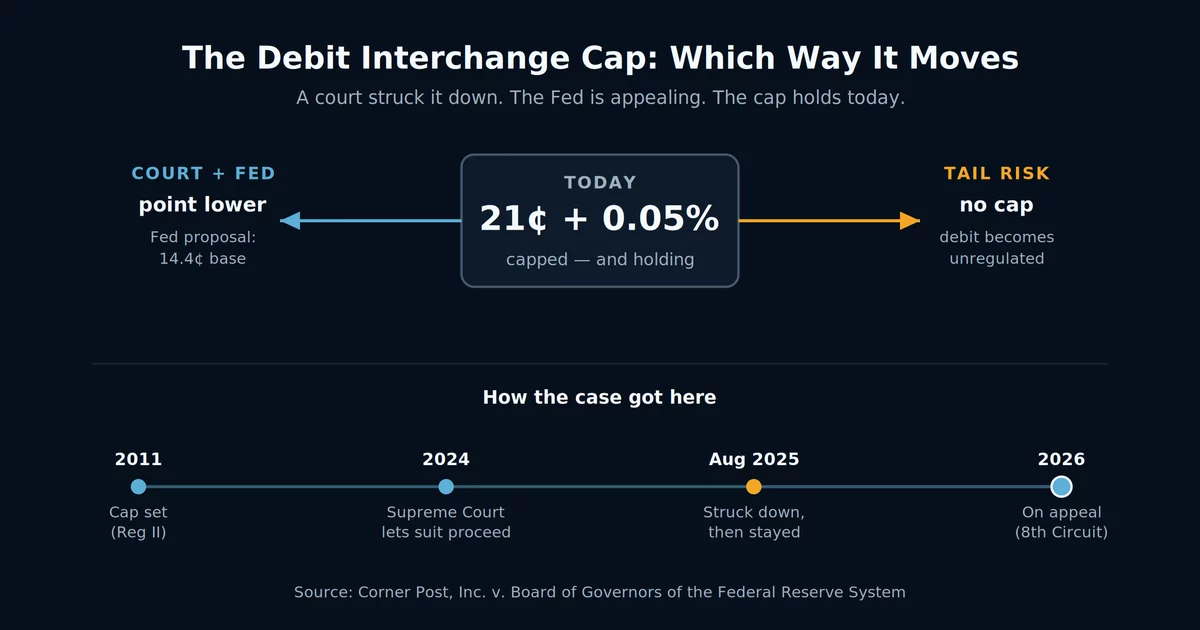
A federal court struck down the entire federal debit interchange cap in August 2025. It still exists today only because the judge who struck it down stayed his own order while the Federal Reserve appeals — so the 21-cent-plus-0.05% cap remains in force right now, but its long-term survival is an open question before the Eighth Circuit.
The Court Case That Could Cut the Debit Interchange Cap
The case is Corner Post, Inc. v. Board of Governors of the Federal Reserve System. Corner Post is a North Dakota truck stop and convenience store that started accepting debit cards in 2018, and it joined a challenge brought by North Dakota retail and petroleum trade associations. Their argument is one merchants will find familiar: the cap is set too high. Specifically, they contend the Federal Reserve padded the number by folding in costs the Durbin Amendment never authorized — fixed network and processing costs, transaction-monitoring costs, and fraud losses — rather than limiting the cap to the incremental cost of authorizing, clearing, and settling a single transaction.
On August 6, 2025, the U.S. District Court for the District of North Dakota agreed. It held that the Federal Reserve exceeded its statutory authority, and it vacated the interchange-fee standard at the heart of the cap. Then it did something that keeps the current number alive: it stayed its own ruling pending appeal, explicitly to keep debit interchange from becoming, in the court’s words, a completely unregulated market in the meantime.
The Federal Reserve appealed to the Eighth Circuit Court of Appeals in October 2025 and finished briefing with its reply in March 2026. Bank and credit-union groups, including the American Bankers Association, filed briefs urging the court to reverse — because for card issuers, a lower cap means less revenue. As of this writing the appeal is fully briefed and awaiting the court. If the Federal Reserve loses, the case could return to the Supreme Court, which already ruled once in 2024 to let the challenge proceed.
This is a merchant-brought case arguing the cap is too high, and the court agreed. If the ruling stands, the Federal Reserve has to reset the cap lower — using only the narrower costs the statute allows. Running on a separate track, the Fed already has its own pending proposal to cut the base from 21 cents to 14.4 cents. Two independent forces are pushing the cap down, and the district court’s order does not block the Fed’s rulemaking.
Why the Ruling Cuts Both Ways
The reason this is worth watching rather than celebrating is that a cap struck down is not the same as a cap lowered. There are two very different endings.
In the ending merchants want, the vacatur stands, the Federal Reserve re-sets the cap using only the costs the Durbin Amendment permits, and regulated debit gets cheaper to accept. The Fed’s own 14.4-cent proposal points the same way. In the other ending, the cap is thrown out without a replacement ready, and debit interchange briefly has no federal ceiling at all — which is the exact outcome the North Dakota judge stayed his ruling to avoid. Issuers would have every incentive to raise fees before a new cap is written. That tail risk is real, even if it is not the likeliest path.
Two more facts keep this in perspective. First, there is a genuine split in the courts: a federal court in Kentucky reviewed the same regulation and ruled the opposite way, that the cap is lawful. A split like that is what pushes a question toward the Supreme Court, and it is why no one can call the outcome yet. Second, and most important for planning: nothing has changed on your statement. The stay means the 21-cent-plus-0.05% cap is fully in force today and will stay in force until the appeal is resolved. This is a watch-and-position story, not an act-today one.
The current cap is live and unchanged — but it is being litigated toward one of two outcomes, and a conflicting ruling in another court means the Supreme Court could have the final word. Treat any change as something to verify against the court’s own record when it happens, not to pre-empt now.
What to Do About the Debit Interchange Cap Right Now
The single most useful thing a merchant can do before the cap moves is know how exposed you are to it — and that comes down to how much of your volume is debit and whether you can even see it. On flat-rate pricing you cannot: a blended 2.6% rate charges the same for a capped debit card and an uncapped rewards card, so a change in the debit cap is invisible to you and stays inside your processor’s margin. On interchange-plus pricing, debit shows up as its own line, at its own low rate — which means if the cap falls, you see it, and if the cap is lifted, you see that too.
It is also worth knowing that the court case is not the only thing moving your debit cost, and the other force runs the opposite way. Capital One’s acquisition of Discover lets it route its debit cards onto a network that is exempt from the Durbin cap entirely, pushing interchange on those specific cards up several-fold. So a merchant today faces two opposing pressures on the same debit line: a court case that could lower the cap across the board, and corporate routing changes lifting it on particular cards. You cannot manage either one if your pricing model hides the debit line in the first place.
Concretely: pull your effective rate and your debit share now, so you have a baseline to measure against when the Eighth Circuit rules. Do not switch processors over the debit interchange cap — whatever happens applies network-wide regardless of who processes your payments. And if a processor ever tells you a debit fee increase is “the new Durbin rule,” check it: the cap is public, the case is public, and the timing rarely matches the claim. You can track the rule itself on the Federal Reserve’s Regulation II page.
Frequently Asked Questions
Not right now. A federal court vacated it in August 2025, but stayed that ruling pending the Federal Reserve’s appeal, so the 21-cent-plus-0.05% cap remains fully in force today. Whether it survives long-term is what the Eighth Circuit will decide, and a conflicting ruling in another court means the Supreme Court could ultimately weigh in.
The likelier direction is down. The case was brought by merchants arguing the cap is set too high, and a separate Federal Reserve proposal would cut the base fee from 21 cents to 14.4 cents. The tail risk is the other way: if the cap is thrown out with no replacement ready, debit interchange could briefly be unregulated and rise. For now nothing has changed on your statement.
Know your debit share and your effective rate now, so you have a baseline. Interchange-plus pricing shows your debit line as its own number; flat-rate pricing hides it. Do not switch processors over this — any change applies network-wide. And if a processor blames a debit fee increase on “the new Durbin rule,” verify it against the public record before accepting it.
Pull Your Debit Share. We’ll Show You What the Cap Is Worth to You.
If the debit interchange cap moves, the merchants who see it first are the ones whose statements show debit as its own line. Send Brookside one recent statement and we’ll calculate your effective rate, break out what share of your volume is regulated debit, and show you exactly where a change in the cap would land — the math takes us about fifteen minutes. Learn more about payment processing consumer protections from the CFPB.
Get Your Debit Share and Effective RateNo obligation • No pressure • Response within one business day
See what a statement review looks like →