Auto Detailing Payment Processing: The Fee Depends on How It’s Booked
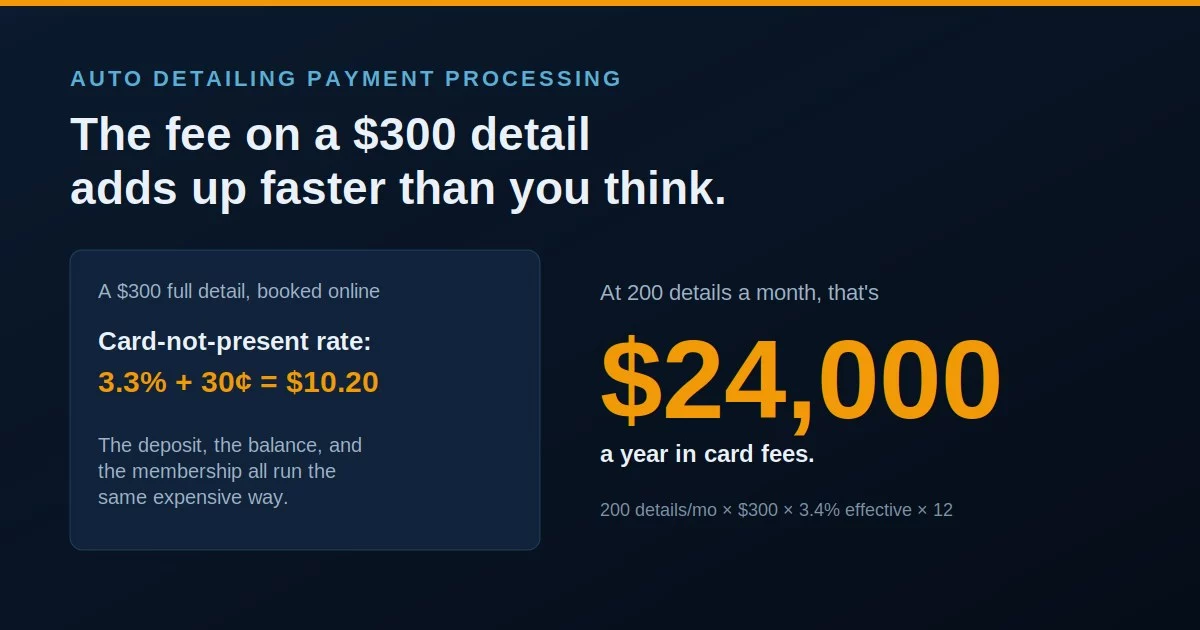
The Ticket Is Big. The Fee Depends on How It’s Booked.
Auto detailing payment processing isn’t a small-ticket problem like a coffee counter. A full detail is a real ticket — $200, $300, sometimes $500 for a ceramic coat — so the flat 30¢ per swipe barely registers. What matters at that ticket size is the percentage, and the way details actually get paid quietly pushes most of that volume into the most expensive lane a card can travel.
Think about how the money comes in. The customer books online and leaves a deposit. You text an invoice for the balance. The monthly maintenance plan bills a card on file. Almost none of that is a card dipped into a terminal in front of you — it’s card-not-present, and card-not-present is where auto detailing payment processing gets expensive.
On a $300 Detail, the Percentage Is the Whole Game
A bakery loses money to the fixed per-transaction fee because its tickets are tiny. Detailing is the opposite. On a $300 job the fixed fee is rounding; the rate is real money, and a card-not-present rate is higher than the one you were probably quoted.
- Booked online, balance invoiced: 3.3% + 30¢ = $10.20 → a 3.4% effective rate
- Walked up, dipped on a terminal at interchange-plus: about $8.70 → near 2.9%
- Same detail. The channel — not the work — set the fee.
Half a point on one detail is nothing. Half a point across two hundred details a month is a car payment. That is the real shape of auto detailing payment processing: a percentage, on a mid-ticket sale, multiplied by a volume most owners never add up.
Your Best Jobs Are the Ones You Never Swipe
This is where auto detailing payment processing quietly turns expensive: mobile detailers feel it hardest. If you drive to the customer, the card is almost never present the way a terminal wants it — the booking, the deposit, and the final invoice all run as card-not-present, at the 3.3% + 30¢ invoice rate or the 3.5% + 15¢ keyed rate. A flat-rate app treats those as its most expensive transactions, and for a mobile operation that is most of the book.
The identical detail costs different amounts depending on whether the card touched a terminal. Detailing’s booking-and-invoice workflow lives on the pricey side of that fork by default. The fix isn’t to stop taking deposits — it’s to run them on a setup that prices card-not-present honestly instead of at a blended flat rate.
Memberships and Packages Bill a Card on File
The best detailing businesses aren’t selling one wash at a time — they’re selling monthly maintenance plans and prepaid packages. That is a genuinely good model, but it means a card on file charged on a schedule, which is card-not-present every single cycle. A car wash runs the same recurring-membership engine at a lower ticket; detailing runs it at $50 to $150 a month per member, so the rate on that recurring volume compounds faster.
On-site work wants a card-present terminal or tap-to-pay at the lowest rate. Deposits, invoiced balances, and recurring memberships want proper card-not-present handling with a stored card and clear billing. A real auto detailing merchant account carries both cleanly — where a single flat-rate app blends them into one high number and calls it simple.
This is also where detailing separates from the rest of the auto services lane: it’s appointment-based, recurring, and card-not-present-heavy, not a walk-in counter.
No-Shows, Deposits, and the Tip on a Detail
A no-show on a two-hour detail is a lost half-day. Storing a card at booking lets you take a deposit and hold the slot, which protects the schedule the way auto detailing credit card processing should — and the deposit-then-balance flow needs to be wired so the customer isn’t double-charged or confused. Get that wrong and you eat chargebacks; get it right and the calendar defends itself.
Tips matter here too. A great detail earns a real tip, and if you present a tip screen at handoff, the prompt design changes what customers actually leave. That’s worth setting up deliberately rather than accepting an app default — see our guide to tip screen best practices.
How to Fix Auto Detailing Payment Processing
You don’t have to change how you book or bill. Auto detailing payment processing improves by changing the cost underneath the workflow, and it starts with a number you already have on a statement.
- Pull one statement and find your true effective rate — total fees over total volume, blended across card-present and card-not-present.
- Move to interchange-plus pricing so the card-not-present premium is the real network cost plus one visible markup, not a padded flat rate.
- Split the flows: a card-present terminal or tap-to-pay on site, proper card-not-present handling for deposits, invoices, and memberships.
- Wire deposits and recurring billing so stored cards are secure and customers are billed once, cleanly.
Run in that order, an auto detailing merchant account that was blended near 3.4% often lands around 2.8% to 3.1% all-in — real margin back on every membership and invoice, without touching your prices.
Frequently Asked Questions
Judge the effective rate, not the quote. A detailing shop on interchange-plus, blended across on-site and card-not-present volume, typically lands around 2.8% to 3.1% all-in. Much past 3.4% and the card-not-present premium is being marked up.
Because they’re card-not-present. Bookings, deposits, and invoiced balances aren’t a card dipped into a terminal, so they price at the higher invoice or keyed rate. A mobile book is mostly card-not-present, which is why the blended rate runs high.
Yes, and you should. Storing a card at booking lets you hold a deposit against no-shows and charge the balance on completion. It needs to be wired so the customer is billed once and clearly, which a proper merchant account handles better than a flat-rate app.
Send One Statement. We’ll Split the Fees Apart.
If your bookings, deposits, and memberships all run card-not-present, that’s where your rate is quietly high. Send Brookside one recent statement and we’ll separate your card-present and card-not-present costs and show you exactly what interchange-plus would save on each — the math takes us about fifteen minutes. Learn more about payment processing consumer protections from the CFPB.
Send Your Statement for a Free ReviewNo obligation • No pressure • Response within one business day
See what a statement review looks like →