HOA Amenity Payments: The Charges Nobody on the Board Priced
The Charges Nobody on the Board Priced
HOA amenity payments are the small, constant charges most boards never think of as a payment problem: the guest pass, the pool fee, the clubhouse deposit, the replacement gate fob, the tennis-court booking. Each one is tiny, most are paid online through a resident portal, and together they run at a rate the annual dues never do.
Dues get all the attention because they’re big and once-a-year. But dues are the easy part — one large payment, easy to price, easy to pass a convenience fee on. HOA amenity payments are the opposite: dozens of small card-not-present charges a month, and that combination is exactly what card pricing punishes hardest.
Why a $25 Guest Pass Costs More Than It Looks
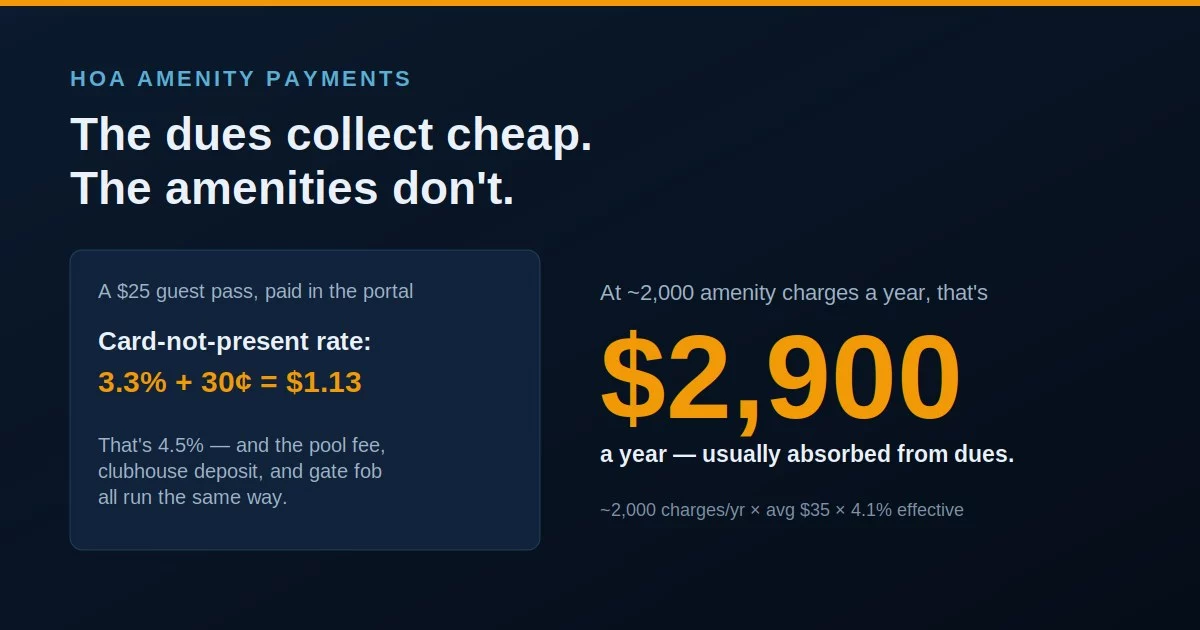
Card pricing has a percentage and a fixed per-transaction fee. On a large annual dues payment the fixed fee vanishes. On a $25 guest pass it dominates — and because amenity charges are paid online, they price at the higher card-not-present rate, not the cheaper in-person one.
- $25 guest pass: 3.3% + 30¢ = $1.13 → a 4.5% effective rate
- $400 annual dues: 3.3% + 30¢ = $13.50 → 3.4%, and passable as a convenience fee
- Same card, same portal. The ticket size set the cost.
Run that across a season — guest passes, pool fees, room rentals, fob replacements — and a community’s HOA amenity payments quietly settle around 4% to 4.5% effective. That’s the rate nobody on the board ever approved, because nobody ever looked at the small charges.
You Can Pass a Fee on Dues. You Can’t on a $10 Pool Guest.
Most associations have already learned to pass the card fee to owners on dues — that’s what a convenience fee on HOA dues is for. It works because the charge is large and expected. Try the same thing on a $10 pool guest or a $25 clubhouse deposit and it lands badly: a dollar-something surcharge on a ten-dollar amenity reads as petty, and half the residents just pay cash at the desk instead.
Because surcharging small amenity charges is awkward, most HOAs quietly absorb the card fees on them — which means amenity processing costs come straight out of the operating budget, funded by dues. The fee didn’t disappear; it just moved onto the association’s books where nobody’s watching it.
Amenities Get Jammed Into the Dues System
The other half of the problem is where amenity charges live. Dues run through a real collection system; amenity payments usually get bolted onto it as an afterthought, or worse, tracked in a spreadsheet and a binder at the clubhouse desk. Residents can’t self-serve, the desk takes cards manually, and reconciliation is a monthly headache.
Dues want a large, scheduled, convenience-fee-passed payment. Amenities want small, self-serve, card-not-present charges with deposits and refunds for rentals. A properly set-up HOA merchant account carries both cleanly instead of forcing the amenity charges through a system built only for dues — which is the leap the HOA fee collection system makes on the collections side.
What Amenity Payments Actually Require
Once you see amenity charges as their own flow, the setup is straightforward. Residents need a portal where they can buy a guest pass or book the clubhouse themselves, on a card, without a desk staffer keying it in. Rentals need a stored card so a deposit can be held and refunded cleanly. Season and pool passes are recurring, so they want card-on-file billing rather than a fresh transaction every time.
Underneath all of it, the amenity flow needs to be priced on its own terms. Because these are small card-not-present charges, the rate matters more than it does on dues — and that’s where interchange-plus pricing on the HOA amenity payments makes the difference between a 4.5% blended cost and something the association isn’t quietly bleeding on.
How to Fix HOA Amenity Payments
You don’t have to change your management software or your dues process. HOA amenity payments improve by pricing and routing the amenity flow correctly, and it starts with a number the board already has.
- Pull one statement and find the true effective rate you pay on the small amenity charges, separate from dues.
- Move the account to interchange-plus pricing so the card-not-present premium is real cost plus one visible markup, not a padded flat rate.
- Give residents a self-serve portal for guest passes, bookings, and passes — so the desk stops keying cards by hand.
- Wire deposits and recurring passes on a stored card, billed once and refunded cleanly.
Done that way, an HOA merchant account that was absorbing 4.5% on every guest pass often lands near 3% all-in on the amenity flow — money that stops coming out of dues, without raising a single fee on residents.
Frequently Asked Questions
On dues, passing a convenience fee works. On small amenity charges it usually doesn’t — a surcharge on a $10 pool guest annoys residents and pushes them to cash. The better move is to price the amenity flow correctly so absorbing it costs far less in the first place.
Because amenity charges are small and card-not-present, they run higher than dues. On interchange-plus with a proper portal setup, the amenity flow typically lands near 3% all-in. If your statement shows the small charges costing 4% or more, the fixed per-transaction fee is the reason.
Yes, and they should. A resident portal lets owners buy guest passes, book the clubhouse, and pay amenity fees themselves on a card, which ends the desk keying transactions by hand and makes month-end reconciliation clean.
Send One Statement. We’ll Separate Dues From Amenities.
If your association absorbs the card fees on guest passes, pool fees, and rentals, that’s where dues money is quietly leaking. Send Brookside one recent statement and we’ll break out what the small amenity charges actually cost you versus dues, and show you what interchange-plus would save on each — the math takes us about fifteen minutes. Learn more about payment processing consumer protections from the CFPB.
Send Your Statement for a Free ReviewNo obligation • No pressure • Response within one business day
See what a statement review looks like →