Car Wash Payment Processing: The Membership Is the Business
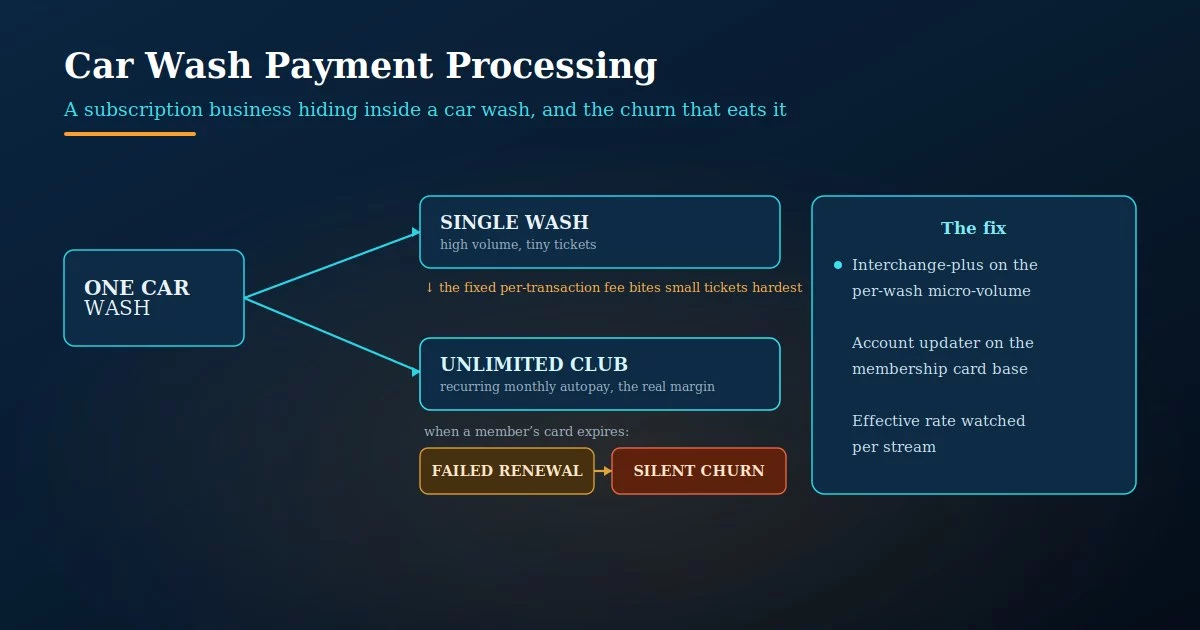
A Car Wash Is a Subscription Business Wearing a Tunnel
The cars going through the tunnel aren’t the business anymore. The membership is. The unlimited-wash club — that flat monthly charge a few thousand members forget they’re paying — is the predictable, high-margin recurring revenue that modern car washes are actually built around, and the single washes are almost a customer-acquisition channel for it. Which means car wash payment processing has to do two very different jobs at once, and most setups are built for neither.
On one side you’ve got a flood of tiny transactions — a $12 wash, a $4 vacuum, a $6 add-on — at enormous volume. On the other you’ve got a recurring subscription book that lives or dies on whether the monthly charge actually goes through. The cost mistakes hide in different places on each side, and a single flat rate papered across both misses both.
On a $4 Vacuum, the Flat Fee Hurts More Than the Rate
Everyone watches the percentage rate. On a car wash, the number that quietly does more damage is the fixed per-transaction fee — the flat ten, fifteen, or thirty cents tacked onto every single swipe regardless of size. On a $400 sale that fee is a rounding error. On a $4 vacuum or a $12 wash, run thousands of times a month, it’s a meaningful slice of the ticket, and because it’s a flat amount rather than a percentage, no amount of “low rate” marketing makes it go away.
This is the part of car wash payment processing that’s genuinely different from almost any other business: ticket sizes are tiny and volume is huge, so the fixed component of your cost matters more than the rate. A processor selling you a headline rate while burying a fat per-transaction fee is selling you the worst possible structure for a high-volume, low-ticket operation. Good car wash credit card processing is priced with the per-transaction fee front and center, not hidden under a rate.
A 15-cent transaction fee is nothing on a big sale and brutal on a small one. At $4, fifteen cents is almost 4% before the rate even applies; at $12 it’s well over 1% on its own. Multiply by thousands of washes a month and the fixed fee, not the percentage, is where a car wash bleeds. Price the per-transaction fee first.
Your Real Revenue Is a Stack of Cards That Quietly Expire
The unlimited club is the asset — predictable monthly recurring revenue from members who signed up once and stopped thinking about it. That “stopped thinking about it” is exactly the vulnerability. When a member’s card expires or gets reissued after a fraud flag, the monthly charge silently fails, and because the member isn’t watching, nobody notices. The renewal doesn’t bounce loudly; it just quietly stops, and a paying member becomes a lapsed one without ever deciding to cancel.
This is involuntary churn, and on a membership-driven wash it’s one of the largest hidden leaks in the whole operation — the same expired-card dynamic that erodes any recurring book, applied to your single most valuable revenue stream. The fix is the same one that matters in self-storage and every other subscription business: an account updater service that automatically refreshes expired and reissued card numbers with the networks before the charge fails, plus a dunning sequence that actually reaches the member when an update isn’t available. A car wash merchant account built for unlimited wash membership billing treats that updater as core infrastructure, not an afterthought.
A member lost to an expired card looks like normal attrition but isn’t — they didn’t choose to leave, and the recurring margin they represented just disappears. Account updater services catch most expired and reissued cards automatically. On a wash where memberships are the business, whether your processor runs one is the difference between a stable book and one that slowly drains every month.
Card on File, Tag, and App: Built for Unattended Volume
The mechanics of how a car wash takes payment shape the cost too. Single washes happen at an unattended kiosk or pay station — card-present, tapped or dipped, fast — which is the cheapest way to run a transaction when the terminal holds its connection. Members, by contrast, are recurring and card-not-present: the club bills a card on file every month, and increasingly members enter via an app, an account, or an RFID tag read at the gate. That card on file is the engine of the whole membership book, which is why keeping it current ties directly back to the churn problem above.
The practical point is that car wash merchant services have to handle both a high-throughput card-present lane and a recurring card-on-file program cleanly, without forcing one onto pricing built for the other. The single-wash lane wants low fixed fees and fast card-present authorization; the membership lane wants reliable recurring billing and an account updater. Different jobs, one account.
A current card on file is what makes the membership renew without a member ever touching it — and pairing it with an account updater means fewer failed renewals, less silent churn, and a recurring book that holds. For a membership-driven wash, that pairing is the single highest-leverage piece of the setup.
What Car Wash Payment Processing Should Actually Look Like
Put the two sides together and good car wash payment processing follows. Price the single-wash volume on interchange-plus with the per-transaction fee negotiated as hard as the rate, because on tiny tickets that fixed fee is the real cost. Run an account updater on the entire membership card-on-file base so reissued cards don’t quietly drain the club. And watch your effective rate per stream — the single-wash lane and the membership lane behave so differently that one blended number hides which side is leaking. The membership book deserves its own line of sight.
None of this changes how a car flows through the wash or how a member taps in at the gate. It changes what you keep — which, on a business where the margin lives in a recurring book of small charges, is the entire game. A wash that prices the micro-tickets right and stops the membership from silently churning keeps money that a flat-rate setup was quietly handing back every month.
One flat rate across the whole operation misses both levers at once: it buries a fat per-transaction fee that punishes every small ticket, and it ignores the membership churn that drains your best revenue. It’s the most common car wash setup and the most expensive — paying too much on every wash while quietly losing members to expired cards. Fix both: transparent per-transaction pricing and an account updater on the club.
Frequently Asked Questions
Interchange-plus pricing with the per-transaction fee negotiated as hard as the rate (because tiny tickets make the fixed fee the real cost), plus an account updater running on your entire membership card-on-file base so reissued cards don’t quietly churn. That combination handles both the high-volume single-wash lane and the recurring club.
Because members set the club to autopay and forget it, so when a card expires or is reissued, the monthly charge fails silently and the member lapses without deciding to cancel. An account updater refreshes those card numbers with Visa and Mastercard automatically, catching most failures before they become lost members.
Car washes run a huge volume of tiny tickets — a few dollars for a vacuum, a dozen for a wash. The fixed per-transaction fee is a flat amount, so on small tickets it’s a large percentage of the sale, and at car wash volume it adds up faster than the rate does. That’s why it has to be priced first, not buried under a headline rate.
See What Your Washes and Your Membership Are Really Costing You
Send Brookside one recent statement and we’ll calculate your true effective rate on both streams, show you what the per-transaction fee is costing on your single-wash volume, and flag whether an account updater is catching your members’ reissued cards before they churn. No switch required to find out. Learn more about payment processing consumer protections from the CFPB.
Get Your Car Wash Rate ReviewedNo obligation • No pressure • Response within one business day
See what a statement review looks like →