Chargeback Prevention: The Chargeback You Prevent Is Free
The Chargeback You Prevent Is Free
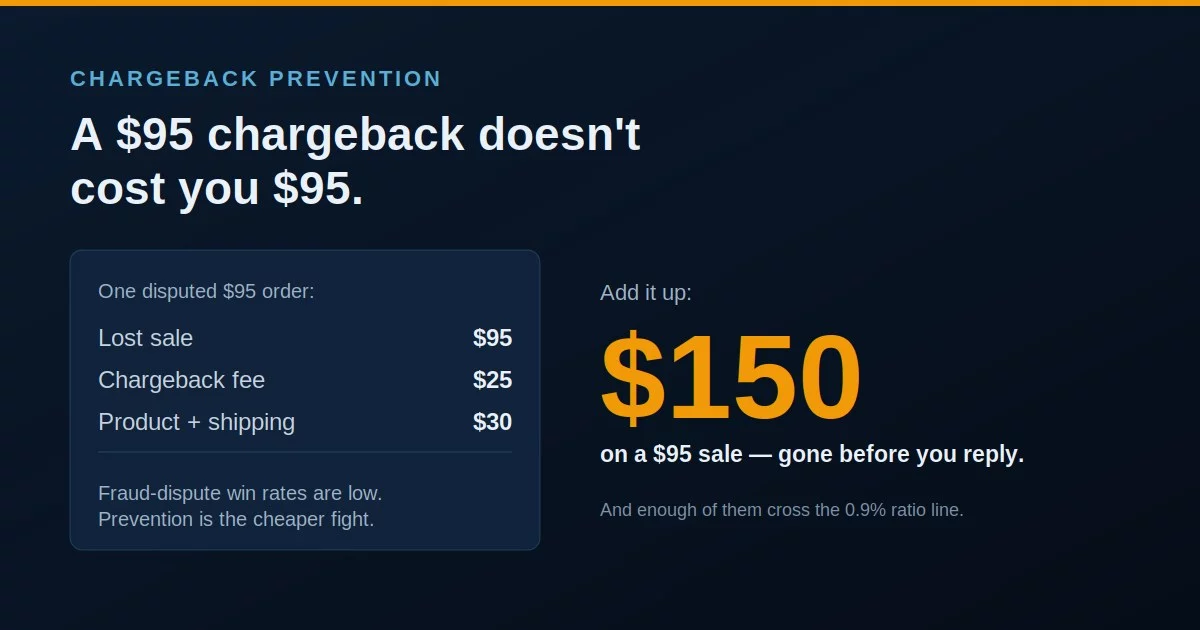
Chargeback prevention is the part of dispute management most merchants skip, because it’s less satisfying than winning a fight. But the math is lopsided: a chargeback you prevent costs nothing, while a chargeback you fight costs you around $150 on a $95 sale whether you win or lose — the sale, the fee, the product, and the hours spent on evidence.
That’s why chargeback prevention beats dispute response as a strategy. Responding is damage control after the money is already gone and the mark is already on your ratio. Prevention stops the dispute before it ever becomes a chargeback — no fee, no lost product, no hit to the ratio the card networks are watching.
Why One Chargeback Costs Almost Double the Sale
The number that makes prevention worth the effort isn’t the sale amount — it’s the true, loaded cost of a single dispute once everything is added up.
- Lost sale: $95 — refunded to the cardholder
- Chargeback fee: $25 — charged by your processor, win or lose
- Product + shipping: $30 — already gone, rarely returned
- Total: ~$150 on a $95 sale, before the time you spend fighting it
And that’s just the direct cost. Every chargeback also counts toward your chargeback ratio, and enough of them push you past the 0.9% line where Visa’s monitoring programs begin — which is where the real damage, higher reserves and account termination, starts. Chargeback prevention is cheaper than any of that.
Most Chargebacks Aren’t Fraud
Effective chargeback prevention starts by aiming at the right target. Merchants picture stolen cards, but the majority of chargebacks are friendly fraud — a real customer who made a real purchase, then disputed it. They didn’t recognize the charge on their statement, forgot about the subscription, or simply found it easier to call the bank than to call you.
Friendly fraud is preventable in ways real fraud isn’t. A clear billing descriptor, an obvious refund path, and responsive customer service quietly stop a huge share of disputes — because the customer who can find your name and get a refund in two minutes never calls their bank at all. Most chargeback prevention is really customer-recognition and customer-service design.
The Operational Basics That Stop Disputes
Before any paid tool, prevention is a set of operational fixes that cost nothing. Make your billing descriptor say your business name the way customers know it, not a cryptic parent-company code. Use AVS and CVV checks so mismatched cards are flagged at authorization. Send delivery and tracking confirmation so “I never got it” has an answer on file. Make refunds easy and fast, because a refund is always cheaper than a chargeback fee.
These sound basic, and that’s the point: the cheapest prevention is the work nobody bothers to do. A customer who recognizes the charge, got what they ordered, and knows they can reach you has no reason to dispute.
Alerts: Refund It Before It Becomes a Chargeback
The second layer of chargeback prevention is deflection alerts, and this is where you actively intercept disputes. When a cardholder disputes a charge, networks like Ethoca (Mastercard) and Verifi (Visa) can send you an alert within hours — before the dispute hardens into a chargeback.
You get a short window to refund the transaction directly. Refund it, and the chargeback never posts: no chargeback fee, no product-recovery loss on a fraud case, and critically, no hit to your ratio. You still lose the sale, but you dodge the $25 fee and the ratio damage — and on a case you’d likely lose anyway, that’s the cheaper outcome every time.
How to Build Chargeback Prevention Into Your Account
Chargeback prevention works best as a stack, cheapest fixes first, paid tools where the volume justifies them.
- Fix the billing descriptor so customers recognize the charge on their statement.
- Turn on AVS and CVV checks and act on the mismatches your processor flags.
- Send delivery confirmation and make your refund path obvious and fast.
- Add deflection alerts (Ethoca, Verifi) once your dispute volume makes them pay for themselves.
- Track your chargeback ratio monthly so you see trouble before the networks do.
Run in that order, most merchants cut disputes enough to stay well under the monitoring thresholds — which keeps reserves low, the account stable, and the $150-per-chargeback math from ever adding up.
Frequently Asked Questions
Start with the free operational fixes: a clear billing descriptor, AVS and CVV checks, delivery confirmation, and an easy refund path. Those stop most friendly-fraud disputes. Add deflection alerts once your volume justifies the cost.
Yes, for the right cases. An alert lets you refund a disputed transaction before it becomes a chargeback, which avoids the fee and the ratio hit. You still lose the sale, so alerts pay off most where you’d likely lose the dispute anyway.
The networks watch your ratio, not your count. Crossing roughly 0.9% of transactions puts you in Visa’s monitoring program, which brings higher reserves and, if it continues, account termination. Prevention keeps you comfortably below that line.
Send One Statement. We’ll Read Your Chargeback Risk.
If chargebacks are climbing, the fee and ratio damage add up fast. Send Brookside one recent statement and we’ll show you where your disputes are coming from, what your current ratio looks like against the thresholds, and which prevention layers would cut it — the review takes us about fifteen minutes. Learn more about payment dispute protections from the CFPB.
Send Your Statement for a Free ReviewNo obligation • No pressure • Response within one business day
See what a statement review looks like →