Day spa payment processing: services, packages, gift cards, and retail all run through one terminal
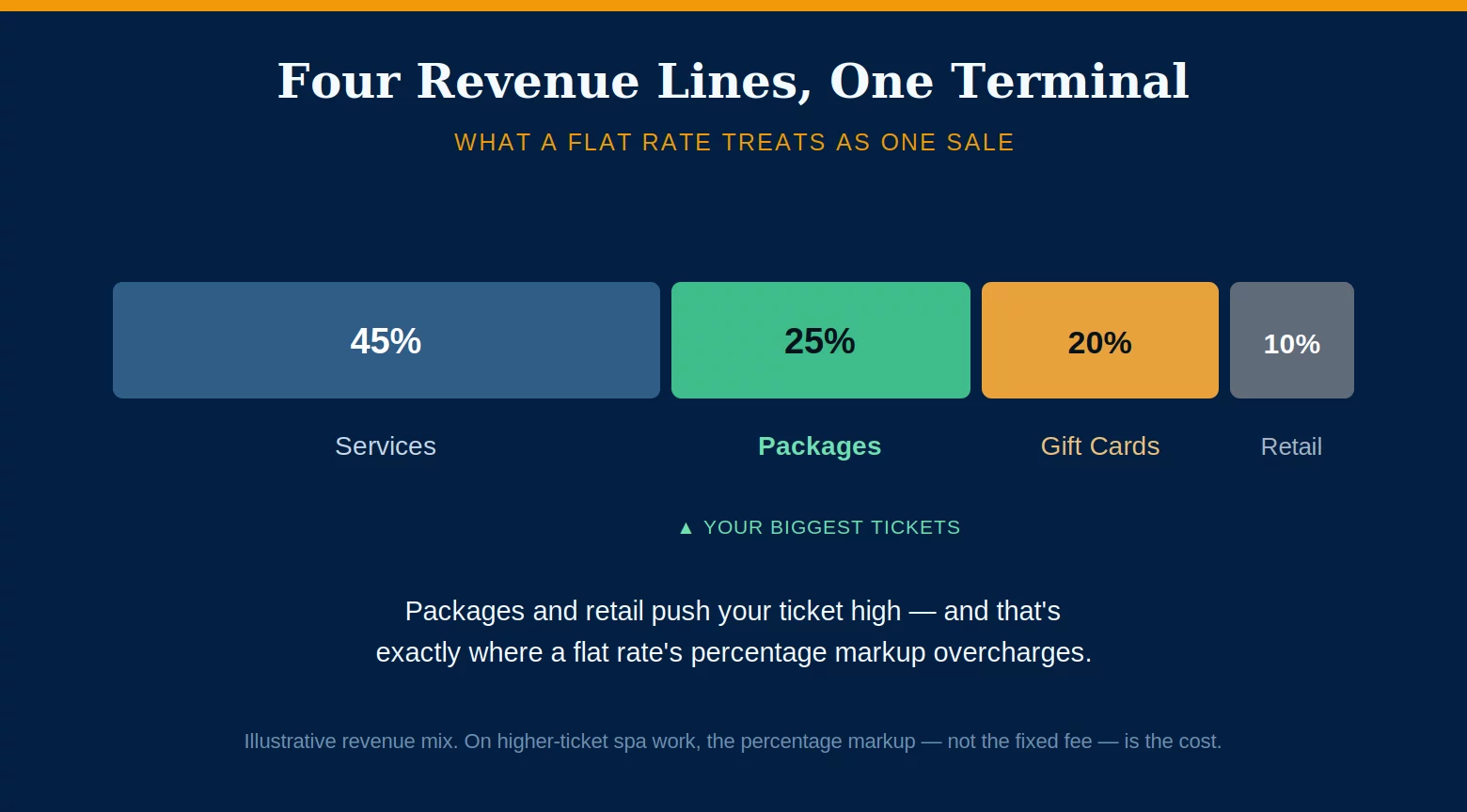
Day spa payment processing is different from the single-service personal-care businesses around it. A hair or nail appointment is one service and one ticket. A day spa runs four revenue lines through the same terminal: individual services, multi-service packages, gift-card sales, and retail product at checkout — plus, increasingly, monthly memberships. That mix, and the higher tickets that come with it, is what a flat-rate aggregator handles badly.
This is a plain look at why your bigger package tickets get overcharged, why gift cards are a payment line of their own, how memberships and retail add-ons fit, and where a spa actually cuts card costs. Getting day spa payment processing right starts with recognizing you are not a single-service business.
Why Bigger Spa Tickets Get Overcharged on Flat-Rate
Unlike a quick counter sale, a day spa ticket adds up fast — a massage plus a facial plus a mani-pedi, or a half-day package, easily runs $200 to $400. At that size, the part of your rate that matters flips: the fixed per-transaction fee becomes trivial, and the percentage markup becomes the whole game.
On a $280 package, a flat 2.6% is about $7.28 — and a flat rate bundles interchange, assessments, and the processor’s markup into that one opaque number, so you never see how much is genuinely cost versus margin. Interchange-plus itemizes it: true cost plus a small fixed markup. On higher-ticket spa work, that transparency is where day spa payment processing savings are largest, because a fraction of a percent on a $280 sale is real money, repeated all day.
Gift Cards Are a Payment Line, Not a Feature
For most day spas, gift cards are not a nice extra — they are a major revenue stream, and a seasonal one, spiking hard around the holidays, Mother’s Day, and wedding season. Every gift card sold is a card transaction you pay processing on, so gift-card volume carries real processing cost on top of its cash-flow benefit. It is a piece of day spa payment processing most owners never separate out.
Your point-of-sale and processor should support stored-value gift cards cleanly — issuing, redeeming, tracking the outstanding balance (a real liability on your books), and reporting on breakage. When a big share of revenue moves through gift cards, the rate you pay to sell them matters, and clean gift-card handling keeps redemption from becoming a reconciliation headache.
Memberships and Product Sales Change the Setup
Two more lines separate a day spa from a single-service shop, and both shape how day spa payment processing should be set up. Many spas now run monthly membership or wellness plans, which means recurring billing — stored card-on-file profiles charged automatically each month. And the retail shelf matters: skincare and product sales ring up alongside services, making a spa a retail-and-service hybrid rather than a pure service business.
That combination — card-on-file for memberships, retail product alongside services, gift cards, and higher-ticket packages — is more than a basic flat-rate reader is built for. Good day spa merchant services should handle recurring billing, stored profiles, and retail plus service on one account without forcing you into separate systems.
Where Day Spa Payment Processing Cuts Costs
The levers for day spa credit card processing follow directly from that mixed, higher-ticket book of business.
Because packages and retail push your average ticket well above a single service, moving off a bundled flat rate and onto interchange-plus lowers the percentage markup where it costs you most. On a book full of $200-plus tickets, that difference compounds quickly.
Beyond pricing, match the account to the operation: card-on-file for membership billing, integrated gift-card support, and retail-plus-service capability on one day spa merchant account. The same applies to a standalone salon or a massage practice — massage payment processing shares the tipped, appointment-based structure, just without the packages-and-retail depth a full day spa carries. If your spa software locks you into a flat processor, that is usually where a dedicated account on transparent pricing wins.
Frequently Asked Questions
Because your tickets are bigger. On a small sale the fixed per-transaction fee dominates, but on a $200–$400 package the percentage markup is what matters — and a flat rate bundles that markup into one opaque number. Moving day spa payment processing to interchange-plus itemizes true cost versus markup, which is where the savings sit on higher tickets.
Yes — a gift-card sale is a card transaction like any other, so you pay your rate on it. Because gift cards are a large, seasonal revenue line for most spas, the rate you pay to sell them adds up. Your setup should also handle issuing, redeeming, and tracking the outstanding balance, which is a liability you carry until it’s spent.
No. A med spa provides medical aesthetic procedures and often has higher-risk underwriting and different compliance considerations. A day spa is a non-medical relaxation and beauty business — its payment profile is about packages, gift cards, memberships, and retail, not medical procedures. The two are underwritten and set up differently.
See What Your Packages and Gift Cards Are Really Costing You.
Your bigger tickets are where a flat rate quietly overcharges. Send us a recent statement and we will show you your true effective rate on your day spa payment processing — and what interchange-plus, clean gift-card handling, and membership billing would keep in your pocket. Learn more about card processing consumer protections from the CFPB.
Get a Free Statement ReviewNo obligation • No pressure • Response within one business day
See what a statement review looks like →