Farmers Market Payment Processing: Built for the Booth, Not the Store
Built for the Booth, Not the Store
A farmers market vendor isn’t running a store. There’s no wired internet, no permanent terminal bolted to a counter, no checkout line that stays in one place — just a folding table, a few months of the year (or a few mornings a week), and a phone doing the work a register would. That gap is the whole story of farmers market payment processing: nearly every default a normal retailer takes for granted is wrong for a booth, and the processor selling you a setup rarely mentions it.
The same reality covers the flea-market stall, and festival vendor payment processing is the same animal — outdoor, intermittent, low-ticket, often parked exactly where the cell signal goes to die. Get the structure right and a card reader is a quiet sales machine that catches the shopper with no cash on them. Get it wrong and you’re paying year-round fees for a few months of selling, eating a fat fixed fee on a $6 jar of jam, or watching an “offline” sale you thought you made never actually land. Good farmers market payment processing starts by admitting a booth is not a store.
Offline Mode Isn’t a Feature: It’s a Risk You’re Absorbing
Outdoor markets are where cell signal goes to die, so every mobile reader sells “offline mode” as the fix: take the card now, upload the transaction when you reconnect. It sounds free. It isn’t. In offline mode you’re accepting the card without an authorization — which means you, not the processor, eat any transaction that turns out to be declined or disputed once it finally uploads. The sale isn’t real until it clears, and by then the shopper and their jam are long gone.
There’s a second catch most vendors miss: offline acceptance is usually limited to magstripe swipe. Chip and tap need a live connection, so the moment your signal drops you’re back to swiping — slower, and with the liability sitting entirely on you. This is the single most important thing in farmers market payment processing that nobody at the signup desk explains: offline mode keeps the line moving, but it converts a guaranteed payment into a bet. Knowing that changes how hard you lean on it, and whether you carry a backup.
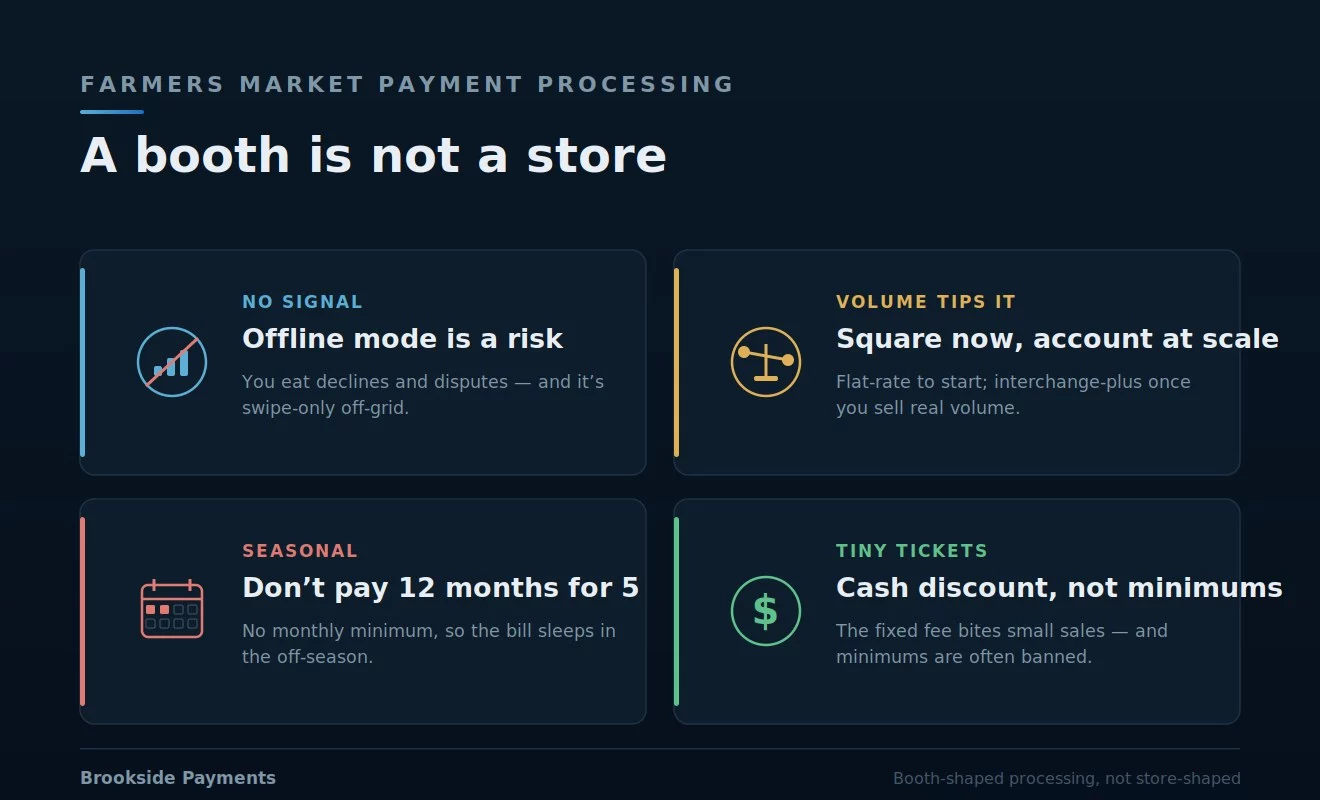
Take a card with no signal and you’ve accepted it without authorization — if it declines or disputes when it finally uploads, the loss is yours, and most readers only allow swipe (not chip or tap) offline. It keeps the line moving, but in farmers market payment processing it’s risk you’re carrying, not a free feature. Bring a charged phone, a signal booster, or a cash fallback for the dead zones.
Square Gets You Selling Today; Volume Is When It Costs You
Almost every market vendor starts on Square or SumUp, and for good reason — a free reader, instant signup, and offline mode in the box. For a vendor doing a handful of weekends, that’s genuinely the right call, and honest farmers market payment processing advice doesn’t pretend otherwise. The aggregator earns its flat rate by removing every barrier to getting started.
The math flips once you’re doing real seasonal volume across multiple markets. A flat percentage plus a fixed fee on every swipe is simple, but it isn’t cheap at volume — a dedicated mobile vendor merchant account on interchange-plus pricing routinely saves a busy vendor hundreds of dollars a season, and it removes the other aggregator risk: the sudden hold. Aggregators underwrite you by watching your transactions and can freeze a payout on their own read of risk, with a support queue instead of a phone call. For a vendor whose whole income is a few peak market months, one freeze at the wrong time is the season. That trade — frictionless start versus cheaper, steadier money at volume — is the core decision in farmers market credit card processing.
A few weekends a year? Square’s free reader and flat rate are the correct, no-overthinking answer. Selling real volume across a full season and multiple markets? Interchange-plus on a dedicated account usually saves hundreds and takes the aggregator-freeze risk off the table. In farmers market payment processing the question isn’t which is “better” — it’s which one matches how much you actually sell.
Don’t Pay Twelve Months for Five Months of Selling
A farmers market runs a season; a flea or festival booth runs weekends. Your costs shouldn’t run year-round when your selling doesn’t. Yet plenty of vendors sign a standard merchant account with a monthly fee and a monthly minimum, then keep paying both through the winter when the table’s in the garage. That’s the seasonal trap, and it’s one of the most common quiet leaks in farmers market payment processing — a year-round bill stapled to a part-year business.
The fix is structural: a setup with no monthly minimum and no year-round commitment, so your processing cost rises and falls with your selling instead of billing flat through the off-season. Pay-as-you-go aggregators handle this by default, which is part of their appeal for a short season. A dedicated account can match it too — but only if you ask, because the off-the-shelf version is built for a business that’s open all twelve months. The lesson the stationary seasonal merchant learns the hard way applies double to a booth that packs up entirely, which is why farmers market payment processing has to be priced around the calendar, not just the rate.
In farmers market payment processing, a part-year booth on a year-round merchant account with a monthly minimum pays for months it never opens. Either run pay-as-you-go, or structure a dedicated account with no monthly minimum so the cost tracks the season. The bill should go quiet when the table does — if it doesn’t, you’re funding the off-season for nothing.
On a $6 Jar, the Fixed Fee Hurts More Than the Rate
Market tickets are small — a $4 bunch of carrots, a $6 jar of honey, a $12 candle — and on small tickets the fixed per-transaction fee, not the percentage rate, is where the cost lives. A flat fifteen cents is nothing on a $90 sale and brutal on a $4 one. The instinct is to set a card minimum, but here’s the wrinkle specific to farmers market payment processing: many market vendor agreements flat-out prohibit minimums, and the card networks cap them anyway. So the lever you reach for first is often off the table.
The lever that isn’t off the table is a cash-discount or dual-pricing program: post the card price, give cash buyers a discount, and the card cost stops eating the small ticket — a structure that’s legal in all fifty states and increasingly common at markets, food trucks, and stalls. (The other market-specific wrinkle, SNAP/EBT, is usually run centrally by the market through a token system rather than at your booth — worth asking your market manager about if your customers use it.) The point is that flea market credit card processing and the farmers-market version live or die on the fixed fee, so good farmers market payment processing prices that first and offsets it where the rules allow.
Minimums are commonly banned by market vendor agreements and capped by the networks, so they’re a weak lever here. A cash-discount or dual-pricing program — card price posted, cash buyers get the discount — is the legal, market-friendly way to keep the fixed fee from eating a $5 sale. Price the per-transaction fee first; offset it with cash discount where allowed.
A Booth Needs Booth-Shaped Processing
The vendors who overpay aren’t careless — they’re using store-shaped processing for a booth-shaped business. Farmers market payment processing done well fits the reality: lean on offline mode knowingly, not blindly; match the aggregator-versus-merchant-account call to your real volume; structure the cost so it sleeps in the off-season; and price the fixed fee first, offsetting it with cash discount where minimums are banned. Festival booth, flea stall, or Saturday produce table — it’s all one farmers market payment processing playbook. Get the structure right and the card reader quietly pays for itself in the sales a cash-only booth waves goodbye to.
Frequently Asked Questions
The cheapest farmers market payment processing depends on volume. For a few weekends, a free Square or SumUp reader on flat-rate pricing is genuinely the cheapest, simplest option. Once you’re doing real seasonal volume across multiple markets, a dedicated merchant account on interchange-plus pricing usually costs less per dollar and removes the aggregator-freeze risk — and pairing either with a cash-discount program keeps the fixed fee off your smallest tickets.
It’s usable, not free. In offline mode you accept the card without authorization, so any transaction that declines or disputes once it uploads is your loss, and most readers only allow magstripe swipe offline — chip and tap need a live signal. Treat it as a risk you’re carrying for the convenience of keeping the line moving, and keep a cash fallback for dead zones.
Often no. Many farmers market and flea market vendor agreements prohibit minimums outright, and the card networks cap them where they’re allowed. The better lever is a cash-discount or dual-pricing program — post the card price and discount for cash — which is legal in all fifty states and keeps the per-transaction fee from eating a small sale — a core move in farmers market payment processing.
See What Your Booth Is Really Paying to Take Cards
Send Brookside one recent statement and we’ll show you your true effective rate on your market volume, whether your fixed per-transaction fee is quietly eating your smallest tickets, and whether you’re paying year-round for a part-year business. We’ll tell you honestly when Square is the right call — and when a dedicated account would actually save you. No switch required to find out. You can also review card payment protections from the CFPB.
Get Your Booth Rate ReviewedNo obligation • No pressure • Response within one business day
See what a statement review looks like →