Pest Control Payment Processing: The Recurring Revenue Leak
Pest Control Is a Subscription Business That Doesn’t Bill Like One
Pest control payment processing looks like a rate problem and is really a recurring-revenue problem. A pest control company doesn’t charge cards the way a retail shop does — the bulk of the money arrives as recurring autopay on quarterly and monthly service plans, billed to a card kept on file weeks or months after the customer last saw a technician. The headline rate your software quotes covers the part of the business that’s already close to competitive. The part that quietly costs you — the markup on that recurring stream, and the renewals that silently fail — never shows up on the quote, and it is the half of pest control payment processing that compounds.
That single fact reshapes how an owner should think about the whole setup. Get pest control payment processing wrong and you overpay on your largest, stickiest revenue stream and lose accounts you already won, one failed card at a time. Get it right and the same routes bill cleaner and cheaper without changing a thing about how you treat a house.
Your Pest Control Software Usually Picks Your Processor
Most pest control payment processing decisions get made by accident. Almost every operator runs a pest control software platform — FieldRoutes, PestPac, GorillaDesk, Briostack — and most of them ship with an integrated payments product that bundles or steers a card processor. FieldRoutes, now owned by ServiceTitan, sells FieldRoutes Payments with autopay built in; PestPac, part of WorkWave, does the same. The convenience is real: the work order, the autopay plan, and the one-off treatment all reconcile inside a single system, and there’s nothing separate to wire up.
The cost of that convenience is leverage. When the processor comes attached to the software, the rate is usually a single blended number — one percentage averaged across debit, rewards, and keyed card-on-file charges — and you rarely get to shop it without the vendor’s blessing. It means your pest control payment processing rate was set by whoever your software vendor partnered with, not by you. The incentive cuts against you too: ServiceTitan is a public company and payments is one of the fastest-growing lines it reports, so your processing margin is quite literally its revenue. As with any home services payment processing setup, the bundled processor is rarely the one you’d have chosen — and the only way to know whether the rate is fair is to put it next to an interchange-plus quote on your real volume.
A blended rate charges the same percentage on a low-cost in-person debit tap and a high-cost keyed card-on-file renewal, even though those cost the processor very different amounts. Interchange-plus breaks out the network cost and the processor’s markup as separate lines — the only view that shows what your recurring stream actually costs.
Your Biggest Stream Pays the Highest Rate on the Sheet
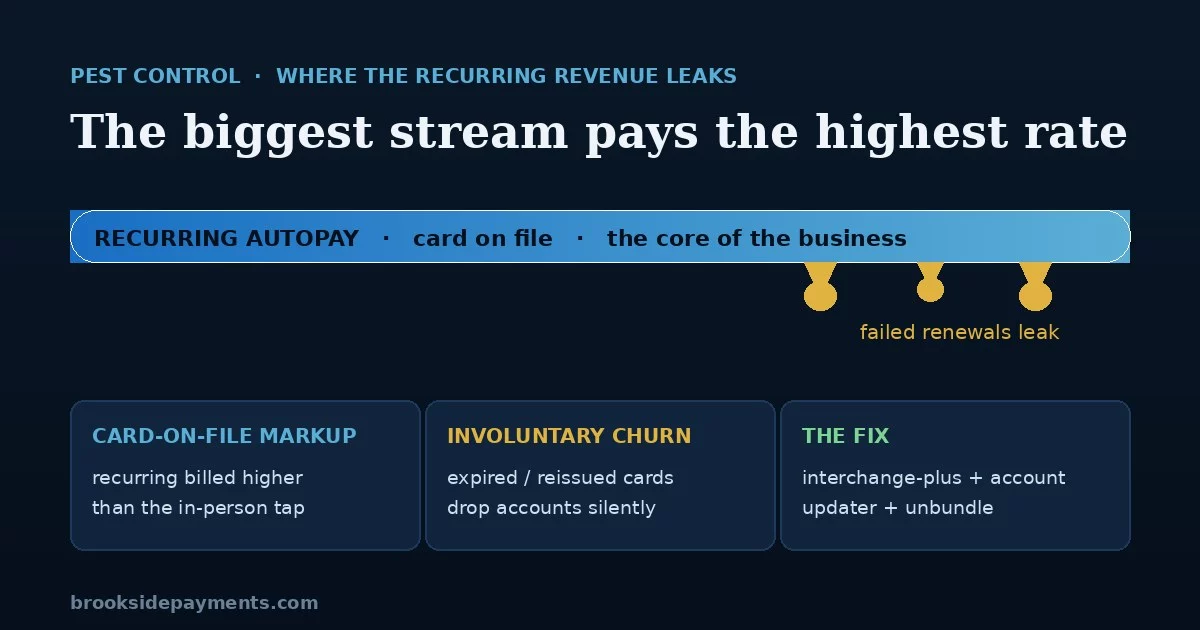
Here is the part of pest control payment processing a bundled price buries. The most expensive way to run a card is keyed and card-not-present — and that is exactly how a recurring autopay charge runs: no card in hand, billed from a card on file. In a pest control company that card-on-file stream isn’t a side channel; it’s the core of the business, because recurring plans are where the revenue lives. So the structure quietly bills your largest and stickiest revenue at the highest rate on the sheet, and a blended number folds it into an average you can’t see past.
Priced correctly, pest control recurring billing doesn’t have to carry that penalty. On interchange-plus the card-on-file rate is its own line you can read and shop, instead of an average you can’t interrogate. On a route of a few hundred autopay accounts the difference compounds every single month — the opposite of a one-time saving, and the reason pest control payment processing rewards a careful look more than most retail does.
Owners assume the autopay rate is simply what it costs to take a card. It isn’t — it’s a markup on the card-on-file rate that a bundled blended price makes invisible. On your biggest stream, a fraction of a percent recovered every month outruns almost any one-time concession you would negotiate elsewhere.
The Renewals You Lose Without Ever Noticing
The quietest cost in pest control payment processing isn’t a rate at all — it’s the autopay charges that simply fail. Cards expire, get reissued after a breach, or change numbers, and when the card on file goes stale the renewal declines. Nobody calls to tell you. The account just stops paying, the route revenue dips, and unless someone is watching the failed-payment report, a customer you spent real marketing money to win churns out over a dead card. The industry name for it is involuntary churn, and in a recurring business it’s often a larger leak than the rate ever was.
The fix is mostly plumbing. An account updater — Visa Account Updater and Mastercard Automatic Billing Updater — refreshes card-on-file credentials automatically when a card is reissued, so the autopay keeps running without the customer lifting a finger. Pair it with sensible retry logic on declines, and the bulk of involuntary churn disappears. Whether your processor includes account updater, and whether it’s actually switched on, is exactly the kind of detail bundled pest control payment processing never gets audited for.
Autopay feels like set-and-forget, but a card-on-file file decays a few percent a year as cards reissue. Without an account updater and a dunning process, those silent declines read as cancellations on your route — lost revenue that looks like attrition but is really a payments gap.
Card-Present in the Driveway, Card-Not-Present in the Office
Two more structural details decide what a pest control merchant account really costs. The first is where the card is run. A technician who takes payment on a phone or tablet at the door is running a card-present transaction, which prices lower; an office charge keyed from a card on file is card-not-present and prices higher. The more you can capture in the field at the point of service, the better your blended cost — so field service payment processing isn’t only a convenience feature, it’s a rate lever. It’s one of the few pest control payment processing levers entirely in your hands.
The second is your merchant category code. Pest control sits under MCC 7342, Exterminating and Disinfecting Services — a standard-risk classification with recurring contracts expressly common, so unlike a med spa or a pharmacy there’s no coding fork that can freeze your account. That’s the good news: the problem in pest control payment processing is almost never how you’re classified. It’s the rate structure on top of the classification — the markup, the leak, and the bundle — which is where the actual money sits.
What Actually Lowers a Pest Control Company’s Card Cost
The levers that move pest control payment processing are structural, not a tenth of a percent on the swipe.
- Move to interchange-plus so the recurring card-on-file stream — your biggest one — is priced on its true cost instead of buried in a blended average.
- Turn on an account updater (Visa Account Updater / Mastercard Automatic Billing Updater) plus retry logic, so expired cards refresh themselves and involuntary churn stops draining the route.
- Capture card-present in the field — let technicians take payment at the point of service so the cheaper rate applies wherever possible.
- Keep the processor shoppable — a pest control merchant account you control rather than one rented from your software — so the rate stays under your control as you grow.
Pest control payment processing is a recurring-revenue problem before it’s a rate problem. The owner who audits the whole account — the embedded rate, the card-on-file markup, the failed-renewal leak, and where the card is actually run — almost always finds more in the parts that never appear on the quote than in the one number that does.
Frequently Asked Questions
Not necessarily. A bundled processor like FieldRoutes Payments or PestPac’s is built for convenience and usually priced on a blended rate that averages your card types together. It may be competitive, but the only way to know is to compare it against an interchange-plus quote run on your real mix — especially your recurring card-on-file volume, which is where pest control payment processing quietly overcharges.
Usually because the card on file expired or was reissued and never updated. That’s involuntary churn, and it reads like cancellations on your route. An account updater (Visa Account Updater / Mastercard Automatic Billing Updater) refreshes those credentials automatically, and retry logic catches the rest — together they recover most of the silent losses.
No. Pest control falls under MCC 7342 (Exterminating and Disinfecting Services), a standard-risk code where recurring contracts are normal — there’s no high-risk fork that freezes accounts the way med spa or pharmacy classification can. The savings come from the rate structure and from capturing card-present payments in the field, not from a special account; pest control payment processing rewards structure, not classification.
Send Your Statement. We’ll Show You What Autopay Is Actually Costing.
If your processor came bundled with FieldRoutes, PestPac, or another pest control platform, send Brookside one recent statement. We’ll break it into an interchange-plus view by card type, show you what the recurring card-on-file stream is really costing, and flag whether an account updater is in place to stop failed-renewal churn. The review takes us about fifteen minutes. Learn more about payment processing consumer protections from the CFPB.
Send Your Statement for a Free ReviewNo obligation • No pressure • Response within one business day
See what a statement review looks like →