Veterinary Payment Processing: What Your Software Decides
Your Practice Software Usually Decides This for You
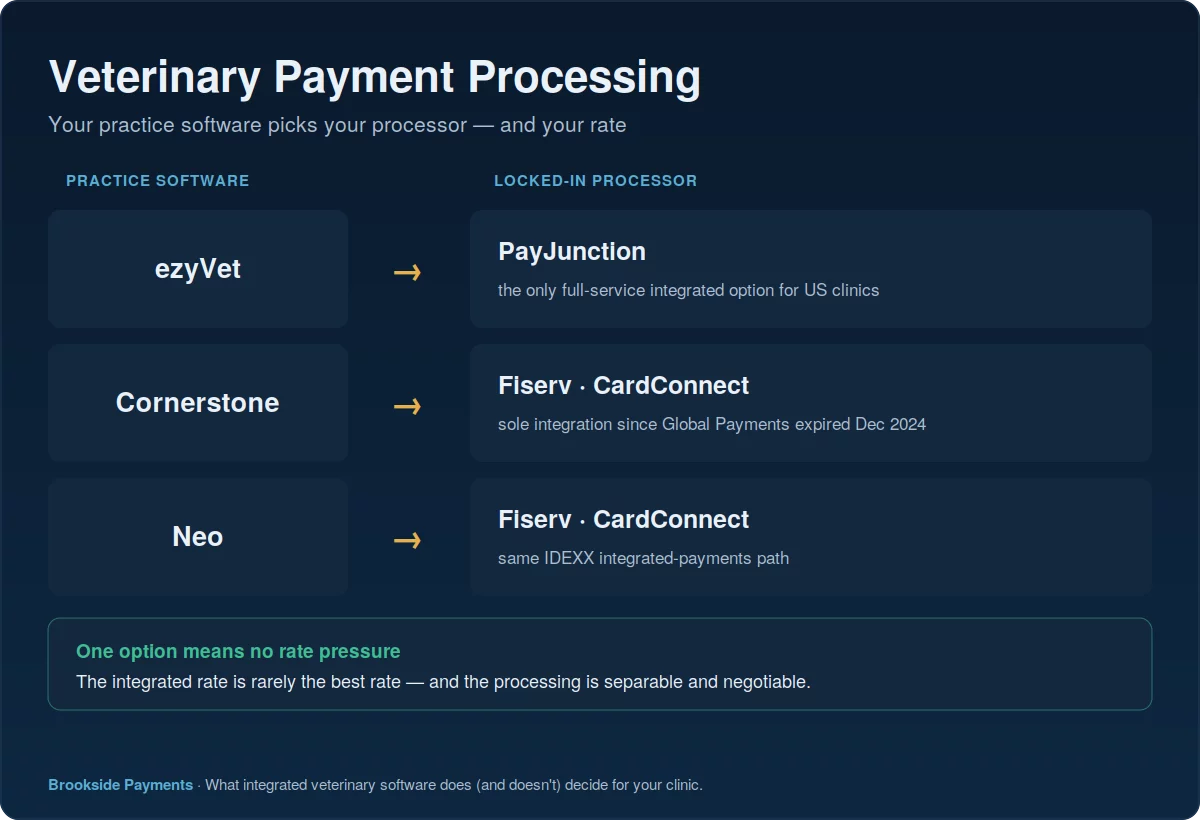
Veterinary payment processing is one of the few costs in your clinic that someone else tends to choose for you — your practice management software. ezyVet, Cornerstone, and Neo all offer integrated payments, and each one quietly funnels you toward a single processor. The convenience of that setup is real. The rate attached to it usually is not the cheapest one available, because you were never really shopping it in the first place.
That matters because processing is rarely a trivial line on a veterinary practice’s books. Between card volume on routine visits, surgeries, and the occasional large emergency bill, even a fraction of a percent compounds into real money over a year. The good news is that the rate is far more changeable than it looks — once you separate the software from the processing underneath it.
Your practice management system is software; the card processing is a separate service with its own rate. Bundling them so the invoice flows straight to the terminal is convenient, but the processing is still a thing you can shop, compare, and negotiate independently of the software you run.
One Software, One Processor, One Rate
Practice management systems offer integrated payments so a charge flows straight from the invoice to the card terminal and the paid status flows back — no double entry, automatic reconciliation. To get that, though, you have to use the processor the software integrates with, and lately that has narrowed to a single option per platform.
On ezyVet, the only full-service integrated processor for US clinics is PayJunction — Windcave isn’t supported here, and CareCredit and ScratchPay are client-financing tools, not full card processing. On Cornerstone and Neo, both IDEXX platforms, the integrated path now runs through Fiserv by way of CardConnect, after Global Payments’ older OpenEdge integration stopped being supported at the end of December 2024. One software, one integrated door — and one door gives that processor very little reason to compete for your business on price.
When only one processor plugs into your software, the rate you’re handed is rarely the rate you’d get by shopping. The processor knows it’s the only integrated choice, so the incentive to discount is weak unless you specifically push for it — and most clinics never do, because they assume the software’s rate is simply the rate.
The Convenience Is Real: The Rate Is the Question
Integration deserves a fair hearing, because it genuinely saves time. The invoice amount flows to the terminal and the paid status flows back, so your front desk doesn’t re-key totals or reconcile two systems by hand — IDEXX estimates the time saved at more than an hour a week. For a busy clinic, that is real labor cost avoided, and it is a legitimate reason to value an integrated setup.
But that convenience comes bundled with a processing rate, and the two are separate decisions wearing one price tag. The question is never simply “is integration good?” It’s “is the integrated rate competitive, and is the time it saves worth what I’m paying over a rate I could have shopped?” Most clinics never split those two apart, so they never get to ask the second half — which is where the money usually is. Looked at that way, veterinary payment processing stops being a fixed feature of your software and becomes what it actually is: a negotiable service you happen to run through your practice management system.
Integrated vs. Standalone: The Real Trade-Off
There are two honest ways to run veterinary payment processing, and the choice is a math problem, not a default.
Integrated gives you convenience and automatic reconciliation, but locks you to your software’s processor and whatever rate it set. Standalone means a separate processor you can shop freely — usually at a better rate — in exchange for staff re-keying the amount into its terminal and reconciling by hand. A higher-volume practice paying an uncompetitive integrated rate often saves far more than the integration is worth; a smaller, lower-volume clinic may genuinely value the time-savings more. On a clinic running $80,000 a month in card volume, even a half-point difference in effective rate is about $400 a month — nearly $4,800 a year — for the exact same swipes, which is often well beyond what the front-desk time savings are worth. And there is a third path most practices miss entirely: stay integrated, but negotiate the rate down — which you can do even when there’s only one integrated option, because the processor would still rather keep you than lose you.
Before you default to whatever your software set up, price the gap: what would a shopped, standalone rate cost versus your current integrated one, and what is the staff time of manual reconciliation actually worth? Two numbers, side by side, turn this from a guess into a decision.
How to Evaluate Your Clinic’s Veterinary Payment Processing
You can pressure-test your own setup in four steps, without switching anything:
First, find your effective rate — total card fees divided by total card volume for a month. That single number, not the headline rate you were quoted, is what you actually pay; here’s how to read it off your statement. Second, compare it against a transparent benchmark — interchange-plus pricing is the model to ask for, because it shows the markup instead of burying it. Third, ask whether your rate was ever actually negotiated, or whether it’s just the integrated default your software handed you. Fourth, weigh the real time-savings of integration against whatever rate gap you find.
The money is in two moves: knowing your real effective rate, and treating the card processing as separate from the software that runs your clinic. Most practices overpay for years simply because they never pulled those two apart — the rate rode in with the software and was never questioned.
Frequently Asked Questions
No. Integrated processing is convenient but optional. You can run a standalone processor and re-key amounts, or negotiate your integrated rate. ezyVet and Cornerstone each limit your integrated options to a single provider, but non-integrated processing is wide open — you are never actually required to accept the software’s default.
It depends on your volume and your rate. Integration saves staff time through automatic reconciliation, but it locks you to one processor’s pricing. It is worth it when that rate is competitive — and a quiet, recurring cost when you are overpaying just to avoid re-keying a number at the front desk.
Often because it was never negotiated. It’s your software’s default integrated rate, and with only one integrated option there’s little pressure on that processor to discount. Pull your effective rate and compare it to a transparent benchmark before assuming the number is just normal for the industry.
Send Us One Statement. We’ll Tell You If Your Software’s Rate Is Competitive.
If your clinic’s processing was set up by ezyVet, Cornerstone, or Neo, odds are the rate is the default that rode in with the software — not one anyone shopped. Send Brookside one recent statement and we’ll compute your real effective rate, tell you whether your integrated rate is competitive, and show what a standalone setup would cost so you can decide on numbers, not habit. The read takes us about fifteen minutes. Learn more about payment processing consumer protections from the CFPB.
Check My Clinic’s RateNo obligation • No pressure • Response within one business day
See what a statement review looks like →