Government Payment API: Real-Time Posting and the PCI Trap

What an API Setup Does That a Portal Alone Can’t
A government payment API is the live connection between the portal a citizen pays through and the tax, CAMA, or ERP system that actually holds the balance — and it is the reason a payment can post the instant it clears instead of waiting for a nightly file. Where electronic bill presentment shows a frozen snapshot of what someone owed at the last export, an integrated setup reads the balance in real time and writes the payment back the moment it is made.
That difference sounds small in a demo and turns out to be the whole game in production. It is also the harder of the two models to build, with a hard prerequisite most vendors will not raise until you have signed.
This post is the mechanics of the API model: what is actually being integrated, what your tax system has to be able to do, and the compliance trap that quietly puts an entire office on the hook. For the underlying choice — whether your office should integrate at all versus run a presentment portal — that decision belongs in the real estate tax payments overview, and the presentment side is covered in detail in the companion piece on electronic bill presentment. Here we assume you are leaning toward integration and want to know how it works.
A Government Payment API Is Really Two APIs
The single most useful thing to understand before any vendor call is that “integration” bundles two different connections doing two different jobs. Treating them as one is how offices end up surprised by both cost and compliance.
The payment API handles the money. It takes the card or bank details, sends them to the processor, and returns an approval plus a token. This is where payment-card compliance lives, and where the trap further down this page sits.
The tax-system API handles the record. It reads the live balance out of your CAMA, tax, or ERP system and posts the payment back into it the moment the transaction settles. This is the connection that makes a balance accurate and a receipt real-time.
A government payment API integration is the payment API and the tax-system API working together — one moving money and carrying the compliance weight, the other keeping the balance and the posting honest. When a vendor quotes “an API,” ask which one they mean, because a portal can have a slick payment API and still leave your office reconciling by hand if the tax-system side was never wired.
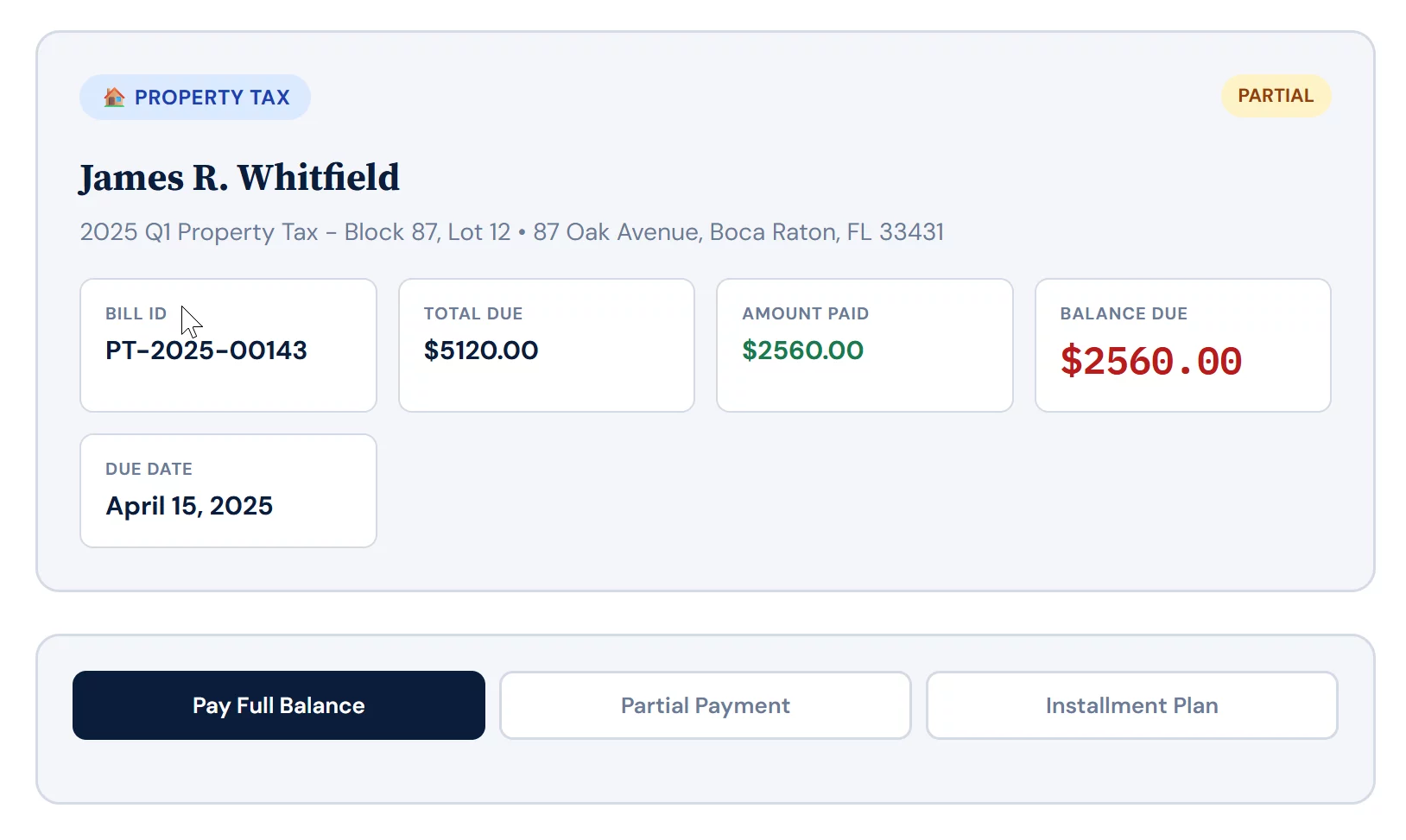
What Real-Time Posting Actually Buys You
When both connections are live, the failures that define the presentment model largely disappear. The citizen sees the real balance, not a copy from last night’s file. The payment posts as it clears, so the account is current the instant the receipt prints.
For real estate tax specifically, that matters most on delinquencies. Penalties and interest that accrue daily are correct in the portal because the balance is pulled live, not carried over from an export. And the single most damaging complaint in the whole space — a taxpayer who paid but still reads “delinquent” because the payment had not posted yet — stops happening, because there is no batch gap for it to fall into.
- Live balances — no stale snapshot between exports.
- Instant posting — the “paid but still shows due” gap closes.
- Accurate daily penalty and interest figures on delinquent accounts.
- Largely automated reconciliation instead of a nightly import-and-match.
What Your Tax System Has to Be Able to Do
Here is the part that decides most of these projects before the payment vendor is even chosen: the integration only works if your tax, CAMA, or ERP system can expose real-time APIs of its own. The payment portal cannot pull a live balance or post a payment instantly unless your system will answer those calls. Many older government systems can only export and import files on a schedule — and a file-based system is, by definition, the presentment model, no matter what the payment vendor’s brochure promises.
So the first call is not to a payment company. It is to whoever makes or maintains your tax software, asking a short list of questions.
- Do you offer a real-time API to read an account balance and to post a payment back?
- Is it read-and-write, or read-only? (Read-only still leaves posting manual.)
- How is it authenticated and secured, and are there call limits during peak tax season?
- If there is no live API, what is the fastest export-and-import cadence you support?
If the answer is that the system only does scheduled files, that is not a failure — it is simply a signal that presentment is the realistic path for now, and the presentment model is built to handle exactly that.
The PCI Decision That Can Engulf Your Whole Office
The payment API can be built two ways, and the wrong one drags your entire environment into the most demanding tier of payment-card compliance. This is the most important technical decision in the project, and it is rarely framed plainly.
In a direct API build, card numbers flow through your own servers on the way to the processor. That puts your systems “in scope” for PCI DSS at the SAQ D level — hundreds of controls, quarterly network scans, and the kind of dedicated security program a small treasurer’s office is not staffed to run. For most government offices, this path is a liability, not a feature.
In a hosted-fields or tokenization build, the card details go straight from the payer’s browser to the processor, which returns only a token. The actual card number never touches your systems, which collapses your compliance footprint toward the simplest tier (SAQ A) while still letting the integration post the payment and update the balance.
If a vendor proposes a “direct API integration” that routes card data through your office’s environment, that single design choice can pull your tax and ERP systems into SAQ D scope — the heaviest compliance burden there is. Insist that card data goes directly to the processor via hosted fields or tokenization, so a token, never a card number, is the only thing that reaches your systems. The integration still works; your scope stays small.
The mechanics of the payment-side API itself — endpoints, tokens, gateways — are the same technology any merchant uses; the generic version is laid out in the payment API integration overview, and the small-office compliance baseline is in the guide to PCI DSS 4.0 requirements. What is specific to government is the combination: pairing that tokenized payment API with a real-time tax-system API, scoped so the office gets live posting without inheriting a card-data compliance program.
Frequently Asked Questions
A government payment API is a live, two-way integration: it pulls the real balance from your tax system and posts payments instantly. Bill presentment shows a snapshot file and reconciles payments in batches. The API model is more accurate and immediate; presentment is simpler to stand up. Which one fits is the decision covered in the real estate tax payments overview.
Only if card data flows through your own systems. A direct API build that routes card numbers through your servers lands you at SAQ D, the heaviest tier. A hosted-fields or tokenization build sends card data straight to the processor and returns only a token, which keeps your office near the simplest tier, SAQ A. Insist on the tokenized approach.
It needs to expose its own real-time APIs — one to read an account balance and one to post a payment back. If your system can only export and import files on a schedule, real-time integration is not available to you yet, and the presentment model is the realistic path until the software supports live calls.
Tell Us What Your System Can Expose. We’ll Tell You If an API Fits.
A government payment API only makes sense if your tax or CAMA system can answer real-time calls — and only pays off if the payment side is scoped to keep card data out of your environment. Send Brookside the name of your tax software and a sentence on how payments post today, and we’ll tell you whether a live integration is realistic for your office and how to keep it at the lighter compliance tier. The assessment takes us about twenty minutes. For the authoritative source on payment-card scope, the PCI Security Standards Council publishes the SAQ definitions referenced throughout this post.
Check If an API Integration FitsNo obligation • No pressure • Response within one business day
See what a statement review looks like →