Her Garden Center Is Open Seven Months. The Card Fees Bill Twelve.
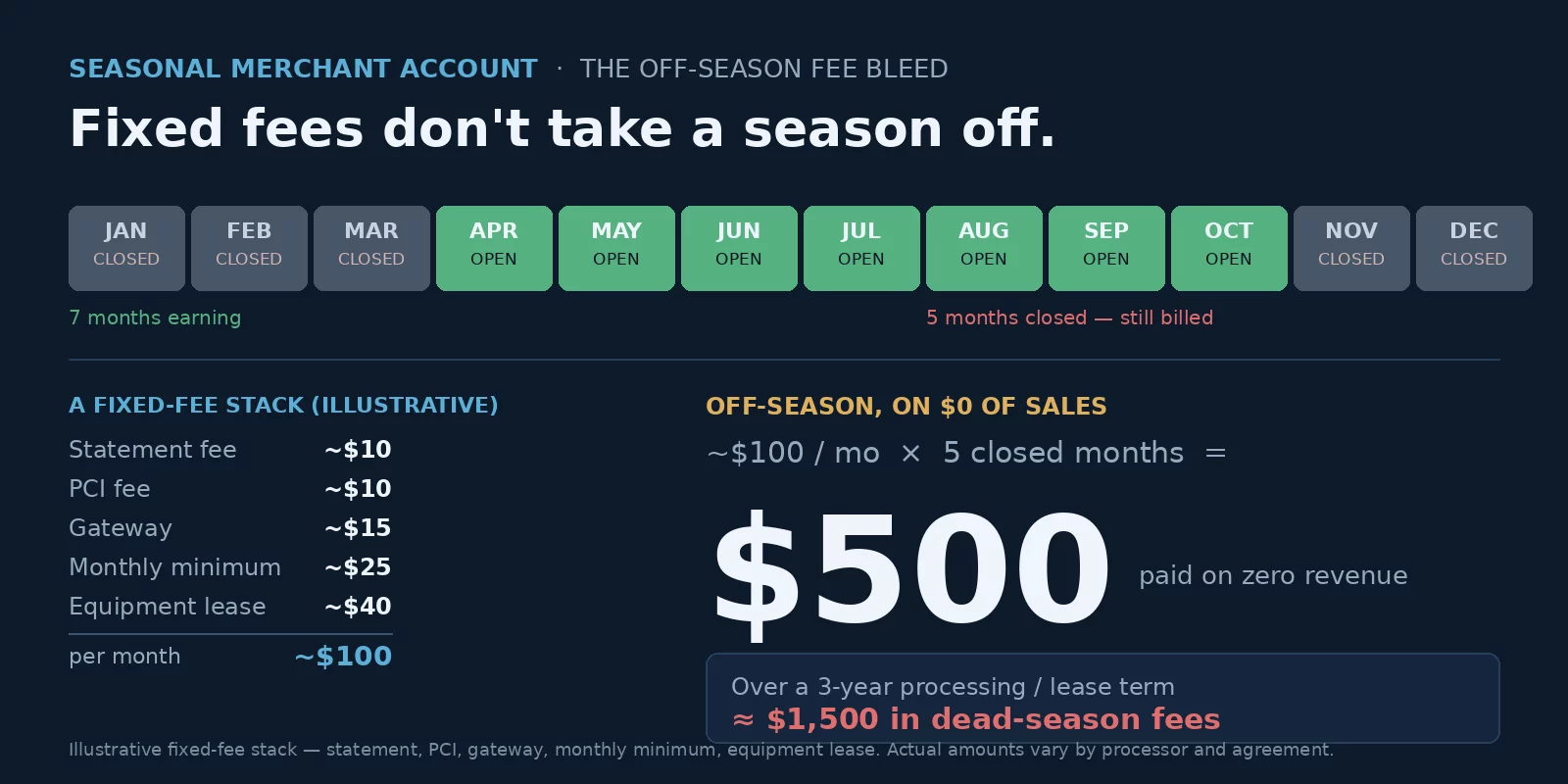
A Seasonal Merchant Account Kept Billing Denise After She Closed for Winter
A seasonal merchant account was the last thing Denise Pelletier expected to be paying for in November. Pelletier’s Garden Center, her nursery just outside Montpelier, Vermont, is open April through October — seven good months of bedding plants, mulch, and Saturday-morning crowds — and then the gates close until spring. So when the November statement landed showing roughly a hundred dollars billed against zero dollars in sales, her first thought was that someone had made a mistake. They hadn’t. The account had done exactly what it was set up to do: bill her every month, whether she swiped a single card or not.
Denise had never thought of the account as something she could change. Taking cards was just a cost of being open, and being closed, apparently, was a cost too. But the off-season bleed wasn’t a quirk of her statement — it’s the default outcome of putting a business that earns for five months on an account priced as if it earns for twelve.
Fixed Fees Don’t Track Your Season — They Track the Calendar
Most merchant account fees fall into two buckets. The first scales with what you process: the percentage and the per-item charge on every sale. When the doors close and volume goes to zero, that bucket goes to zero too — exactly as it should. The problem is the second bucket: the fixed monthly lines that bill the same amount in February as they do in June, regardless of whether you ran a dollar.
On a typical statement that fixed stack is a handful of small lines that nobody questions in season because real sales swamp them. Out of season, with nothing else on the page, they’re the whole bill:
- The statement fee — a flat monthly administrative charge for having the account at all.
- The PCI fee — a card-network-required compliance line, billed monthly or annually whether or not you’re processing.
- The gateway fee — a monthly charge for the payment gateway that lets you take cards online or key them in, idle or not.
- The monthly minimum fee — the one that stings most in the off-season, because it’s designed to bill you precisely when you’re not processing.
- An equipment lease, if there’s a terminal on a lease contract — and a lease bills all twelve months no matter how many you’re open.
Denise had all five. Strip away the in-season sales and her account was a fixed-fee stack of about a hundred dollars a month, billing straight through a Vermont winter.
The Fee That’s Built to Hit You in the Off-Season
The monthly minimum deserves its own paragraph because it’s the most counterintuitive line on a seasonal merchant account. A minimum is a floor on the processing revenue your provider collects: if your percentage-and-per-item fees for the month don’t add up to the floor — commonly around twenty-five dollars — you pay the difference. At a roughly 2.1% effective rate, you’d need to run well over a thousand dollars in card volume just to clear a twenty-five-dollar floor on your own. In peak season a garden center clears that on a single busy Saturday and never feels it. In January, processing nothing, you pay the entire floor for the privilege of having an open account.
A monthly minimum bills you the most in exactly the months you earn the least — so a seasonal business pays it five times a year on zero revenue, while a year-round business almost never pays it at all.
Closing the Account Is Rarely the Answer
The obvious move — close the account in November, reopen it in April — almost never works the way owners hope. If you process for even one day in a month, most providers count the account open for the entire month and bill the full fixed stack. And a fully closed account isn’t a light switch: reopening typically means submitting a written request and waiting a couple of weeks, which is its own problem if a customer wants to put a spring delivery on a card before the account is live again.
Some processors will pause or waive the monthly minimum during your slow months, or genuinely hibernate a seasonal account. It’s worth asking — but get it in writing, and watch the first off-season statement to confirm the waiver actually landed. “We can do seasonal” in a sales call and a clean off-season statement are two different things.
Price the Account So Cost Tracks the Season
The durable fix isn’t a discount — it’s a structure where the cost follows the volume down to zero when you close. For a seasonal business that usually means a few specific choices.
Start with the pricing model. Interchange-plus pricing keeps the processor’s markup visible as a transparent line on top of the true network cost, which makes it far easier to negotiate away the fixed extras — and it’s where you push to drop the monthly minimum entirely and trim the statement fee to as close to zero as the provider will go. A no-monthly gateway option keeps the online side from billing through the winter. And owning your hardware instead of leasing it removes the single largest fixed line: a lease is a twelve-month obligation by design, and the way out of one is usually worth more to a seasonal operator than any rate cut.
The other honest option is the opposite extreme: a flat-rate aggregator with no monthly fees at all. Flat-rate pricing charges a higher percentage per sale but bills nothing when you’re closed, which can win for a very-low-volume stand or a popup. For a real garden center doing meaningful in-season volume, though, the math usually favors a merchant account with the fixed fees stripped out — you keep the lower per-sale cost during the seven months that matter without paying for the five you don’t.
No monthly minimum. A statement fee at or near zero. A gateway you can leave on without a monthly charge, or none at all. Hardware you own, not lease. Interchange-plus pricing so the per-sale cost is honest in season — and a near-zero bill in the months the doors are shut.
The Off-Season Statement Tells You Everything
The fastest way to see your own bleed is to pull a statement from a month you were closed. Every line on it is a fixed fee, because nothing else could be there. That single page shows you the real annualized cost of the fixed stack — multiply it by your number of dead months and you have the number that’s leaving on zero revenue. For Denise, that exercise turned a vague “winter is expensive” feeling into a specific figure she could take to a renegotiation: roughly five hundred dollars a year billed on nothing, before the lease was even counted.
Frequently Asked Questions
Sometimes — some processors will waive the monthly minimum or hibernate the account during slow months — but it has to be arranged in advance and confirmed on the statement. Fully closing the account is usually impractical, since reopening means a written request and a wait of a week or two, and processing even one day in a month typically triggers the full month’s fixed fees. The more reliable fix is to price the account with no monthly minimum and a near-zero statement fee so the off-season bill is small to begin with.
A statement fee is a flat administrative charge for having the account — you pay it every month regardless of volume. A monthly minimum is a floor on the processing revenue your provider collects: if your percentage-and-per-item fees don’t reach it, you pay the gap. In a busy month real sales clear the minimum and you never feel it; in a closed month you pay the whole floor. Both are fixed lines that hurt a seasonal business, and both are negotiable on the right pricing model.
It can be, if your volume is low. Flat-rate aggregators charge a higher percentage per sale but bill no monthly fees, so they cost nothing when you’re closed — a fair trade for a small stand or popup. For a seasonal business with meaningful in-season volume, a merchant account with interchange-plus pricing and the fixed fees stripped out usually costs less overall, because the lower per-sale rate during your active months outweighs the now-minimal off-season cost.
Send Us One Off-Season Statement. We’ll Show You the Fixed-Fee Bleed.
If your account bills the same in your dead months as your busy ones, the fixed stack is the whole problem — and on a seasonal merchant account it’s almost always fixable. Send Brookside a statement from a month you were closed and we’ll separate the network costs from your processor’s markup, show you exactly which lines bill on zero revenue, and tell you whether a restructured account or a different model would stop the bleed. The read takes about fifteen minutes. You can also review payment processing consumer protections from the CFPB.
Get a Free Off-Season Statement ReviewNo obligation • No pressure • Response within one business day
See what a statement review looks like →