Gym Payment Processing: Why Recurring Costs You More
The Rate That Hurts a Gym Is the One on Auto-Pay
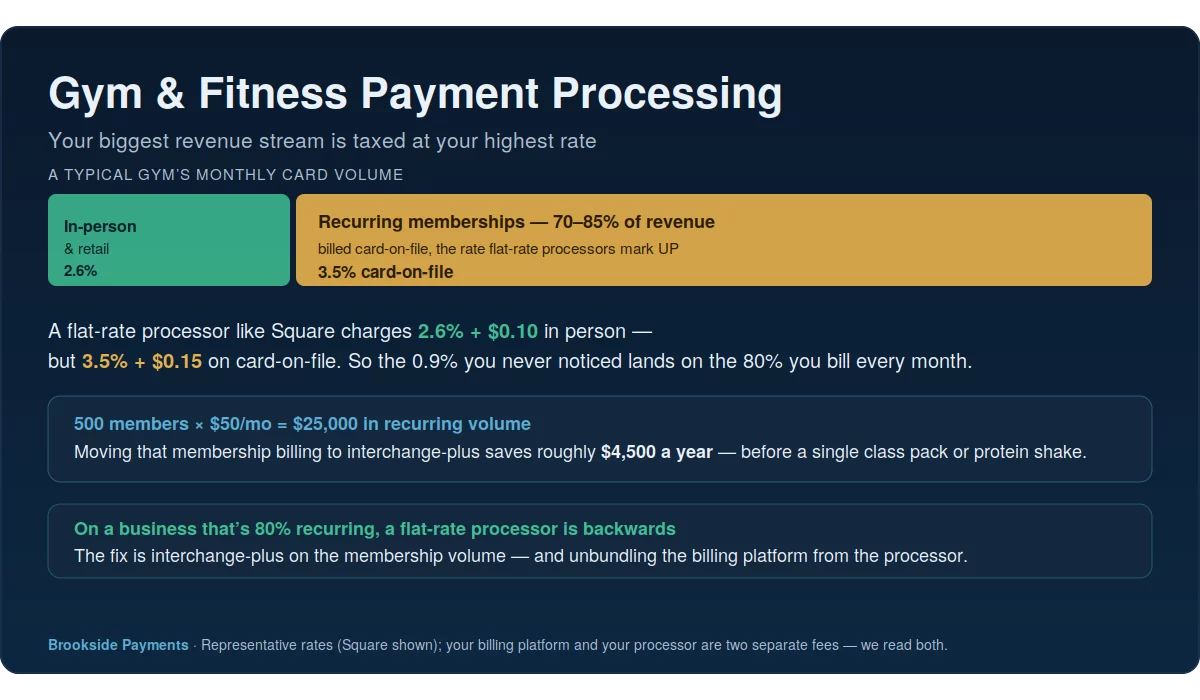
Gym payment processing has a quirk that quietly costs fitness businesses thousands a year: the bulk of your revenue runs on recurring card-on-file billing, and that is exactly the transaction type a flat-rate processor charges the most for. A gym or studio typically pulls 70 to 85 percent of its card revenue from automatic monthly memberships — so the rate that matters isn’t the one at the front desk, it’s the one hitting hundreds of stored cards on the first of every month.
Most owners never see this, because the number they were quoted describes in-person swipes while their actual volume is recurring. Add a billing platform that bundles the processing, and a stack of small declined-card losses on top, and the gap between the rate you think you have and the rate you actually pay can be a full point or more — multiplied across every member, every month.
“2.6%” usually describes a card swiped in person. Memberships are billed card-on-file, which flat-rate processors treat as higher-risk and price higher. On a business that’s mostly recurring, the quote and the reality describe two different things.
Recurring Memberships Bill at Your Highest Rate
Here is the mechanics of it. A flat-rate processor like Square charges roughly 2.6% + $0.15 on an in-person swipe but about 3.5% + $0.15 on a card kept on file — the recurring rate. That difference looks small until you remember which one carries your volume: the card-on-file rate is doing the work on 70 to 85 percent of your revenue, while the cheaper in-person rate only touches walk-ins, retail, and class drop-ins. The markup didn’t land on a corner of your business; it landed on the main thing.
The fix is structural, not a discount you beg for. On a recurring-heavy business, interchange-plus pricing charges the true cost of each card plus a fixed, visible markup — so a stored-card membership charge isn’t penalized for being recurring. For a studio running 500 members at $50, moving that membership billing off a flat recurring rate onto interchange-plus is commonly worth several thousand dollars a year before you count a single retail sale.
A point of markup on your in-person sales is a rounding error. The same point on your recurring memberships — the 70 to 85 percent of revenue billed card-on-file — is the single biggest controllable cost in gym payment processing.
Your Billing Platform Isn’t Your Processor
Most gyms run on a membership-management platform — Mindbody, ABC Fitness, Jonas (Club OS), ClubReady — that handles sign-ups, recurring billing, past-due collections, and often the front-desk point of sale. What owners rarely realize is that the platform and the processor are usually two separate businesses charging two separate fees, bundled into one statement. The platform’s built-in payments are convenient, but the rate baked into them is rarely competitive, because it was set for the platform’s margin, not yours. It’s the most fixable line item in gym payment processing.
You can almost always bring your own processor to the software you already like, keeping the member experience identical while the recurring charges run at a real rate. If your gym is on Mindbody specifically, the math and the steps are worked through in our guide to reducing Mindbody payment processing fees — the same pattern applies to the other platforms.
Failed Payments Cost More Than the Rate
On a recurring business, the rate isn’t the only number that bleeds. Stored cards expire, get reissued after fraud, or bounce on insufficient funds — and every failed membership charge is revenue you earned but didn’t collect, plus the staff time to chase it and the member who quietly lapses. This involuntary churn is one of the most underrated costs in the fitness industry, and it has nothing to do with whether a member wanted to leave.
An account updater — which automatically refreshes expired or reissued card numbers behind the scenes — recovers a meaningful share of those charges before they ever fail, and a sensible retry-and-dunning sequence catches more. The same failed-payment problem shows up on the monthly retainers a bookkeeping practice runs. When you evaluate a processor, the recovery tools deserve as much weight as the headline rate, because a slightly lower rate that loses more memberships to declines is a worse deal than it looks.
An account updater and a smart retry sequence can recover more dollars than a tenth of a point off your rate ever will. On recurring billing, collection rate and processing rate both belong in the comparison.
How to Find Your Real Gym Payment Processing Rate
The number that matters is your effective rate across everything — total fees divided by total volume over a month, with recurring, in-person, and retail seen separately so the card-on-file markup can’t hide in the blend. Pull the pieces with the calculator and your processing statement, then ask three things: what does the recurring rate actually cost versus interchange-plus, is the billing platform bundling the rate, and is an account updater switched on? Broader membership organizations — clubs and associations — share some of this profile but run a different mix; this is the fitness-specific version.
Get the recurring volume onto interchange-plus, unbundle the processor from the billing platform, and turn on card-updating. Those three together move a gym’s real cost far more than haggling over a flat rate ever will.
Frequently Asked Questions
The one that prices your recurring memberships well, since that’s most of your volume. In practice that means interchange-plus pricing on card-on-file charges (where flat-rate processors mark up), an account updater to cut failed-payment churn, and the freedom to run your own processor inside whatever billing software you use. The headline swipe rate matters least.
Because most of your revenue is recurring, and flat-rate processors charge more for card-on-file than for in-person — often around 3.5% versus 2.6%. On a business that’s 70 to 85 percent memberships, that markup lands on the majority of your volume, so your real effective rate runs well above the number you were quoted.
It’s convenient, but rarely the cheapest. Platforms like Mindbody or ABC Fitness bundle a processing rate that’s set for their margin, not yours, and it’s usually above interchange-plus. You can almost always keep the software and bring your own processor — so compare the all-in cost before defaulting to the built-in option.
Send Us One Statement. We’ll Price Your Recurring Volume.
Most gym owners have never seen what their membership charges cost on card-on-file versus what interchange-plus would charge instead. Send Brookside a recent statement and your billing platform’s payout report and we’ll compute your real effective rate, separate the recurring markup from the rest, and show whether unbundling the processor and turning on card-updating would keep more of every membership. The read takes us about fifteen minutes. Learn more about payment processing consumer protections from the CFPB.
Check Our Gym’s Real RateNo obligation • No pressure • Response within one business day
See what a statement review looks like →