After the Visa Level 2 Sunset, Bad Enhanced Data Costs More Than None
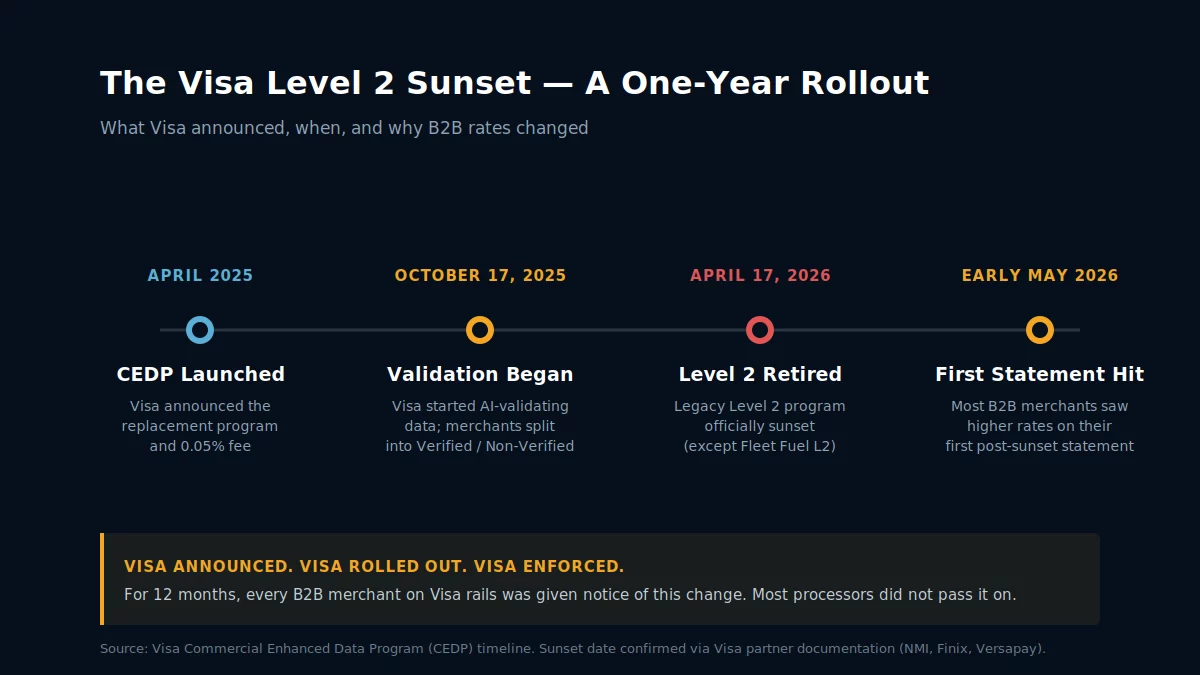
On April 17, 2026, Visa officially retired its Level 2 interchange program. The Visa Level 2 sunset ended a B2B savings tool that thousands of contractors, wholesalers, professional service firms, and government suppliers had relied on for over a decade. It was announced a year in advance. It was rolled out in phases. And most merchants who were affected still have not been told it happened.
The first statement reflecting the change arrived in early May. B2B merchants who had been qualifying for Level 2 discounts saw their commercial card transactions priced at higher rates — the difference often running 50 to 100 basis points per transaction. On a contractor processing $80,000 a month in card volume, that is roughly $400 to $800 a month, every month, with no warning.
Here is what changed, why your processor probably did not mention it, and what to do about it now.
What the Visa Level 2 Sunset Eliminated: And Why It Mattered
For more than a decade, B2B merchants who processed commercial credit cards (small business cards, corporate cards, government purchasing cards) could qualify for reduced interchange rates by submitting additional transaction data — most commonly a sales tax amount and a customer code. This was Level 2 data. The reduced rates often saved B2B merchants 30 to 75 basis points per transaction on every commercial card swipe.
Level 3 data went further — line-item details including SKUs, quantities, unit costs, and freight charges — and unlocked the lowest available B2B interchange rates. Level 3 was harder to set up but produced bigger savings, especially on large-ticket transactions.
The system worked like this: the more structured data you sent with each commercial card transaction, the lower your interchange. Level 1 was basic transaction data (no discount). Level 2 added tax and customer code (modest discount). Level 3 added line-item invoice detail (largest discount). Most B2B merchants ended up at Level 2 — because Level 3 required tighter integration with their accounting or ERP system, and most processors made Level 2 the default path.
What Replaces Level 2: CEDP and Product 3
Visa replaced the Level 2 / Level 3 system with a single program called the Commercial Enhanced Data Program (CEDP). Under CEDP, the only path to discounted B2B interchange rates is a new category called Visa Product 3 interchange — and Product 3 has substantially stricter requirements than the Level 2 program it replaced.
Three things changed:
Under the old Level 2, processors only checked whether required fields were present. Under CEDP, Visa runs every transaction through an AI validation algorithm that checks whether the data is actually accurate and complete. Placeholder values like “9999” for tax (a known industry workaround) no longer qualify. The data has to be real.
Visa now grades every B2B merchant on the quality of the data they submit. A Visa Verified Merchant — one who consistently submits accurate, complete, validated data — qualifies for the lowest Product 3 interchange rates. A Non-Verified merchant pays standard commercial card rates, which can be 50 to 100 basis points higher. Most merchants started in Non-Verified status by default on April 17 — Finix confirms every merchant and partner begins Non-Verified until Visa validates the data.
Acquirers participating in CEDP are charged a 0.05% fee on each qualifying transaction. This fee is typically passed through to the merchant. Even merchants who qualify for Product 3 rates pay this 5-basis-point participation fee on top of the discounted interchange — though the savings still net out positive for fully Verified merchants.
The structural change is not subtle. The bar for B2B interchange savings just got significantly higher — and most merchants have not adjusted their data flow to clear it.
What the Visa Level 2 Sunset Means for Your B2B Rates
The financial impact splits cleanly along the Verified / Non-Verified line. There is no middle ground.
B2B merchants who were already submitting Level 3 data and pass Visa’s accuracy validation may actually save money. Product 3 rates are slightly lower than the old Level 3 rates for some categories, and Business Credit cards (small business cards) are now eligible for Product 3 — a category they could not access under the old system. Net effect for fully Verified merchants is typically a small improvement, partially offset by the 0.05% participation fee.
B2B merchants who relied on Level 2 — the simpler tier requiring only tax and customer code — and have not upgraded to full Product 3 data submission now pay standard commercial card interchange. The difference is typically 50 to 100 basis points per transaction. A change effective January 24, 2026 widened that gap further: Visa raised Level 2 interchange on small-business credit cards by 75 basis points, making Level 2 more expensive than sending no enhanced data at all — a deliberate push toward Product 3. On a contractor processing $80,000 monthly in B2B volume, the rate increase translates to roughly $400 to $800 per month — $4,800 to $9,600 per year — every year going forward.
Under CEDP, transactions that initially qualify for Product 3 can be downgraded retroactively if Visa’s validation later flags the data as inaccurate. These adjustments typically appear 10 to 15 days after the original transaction. Merchants may see surprise debits on statements weeks after the fact, with no clear explanation unless they know to look for it.
Visa Publishes the Line That Proves It
Most of what is written about CEDP comes from processors describing the program. The clearest evidence sits in Visa’s own interchange schedule, in two consecutive rows of the Corporate and Purchasing table.
Visa created a separate fee category for enhanced data that fails validation — and priced it identically to sending no data at all.
Commercial Product 3: 1.75% + $0.10
Commercial Card Not Present: 2.70% + $0.10
Non-Qualified: 2.95% + $0.10
Non-Qualified with Data: 2.95% + $0.10
Read those last two rows again. A transaction that carries no enhanced data and a transaction that carries enhanced data Visa rejected land on exactly the same number. The data bought nothing.
Then add the participation fee. Since April 2025, Visa applies 0.05% to commercial transactions submitted with the enhanced-data flag — and the flag is set by the submission, not by the outcome. A merchant whose data fails validation pays the same interchange as a merchant who sent nothing, plus five basis points for the privilege of having tried.
Partial or sloppy enhanced data is now the worst of the three options. Clean data qualifies for Product 3. No data pays the base rate. Bad data pays the base rate and the participation fee on top — which means a half-configured integration costs more than no integration at all.
This is the part of the Visa Level 2 sunset that nobody is being told. The conversation merchants are having with their processors is about whether enhanced data is switched on. The question that actually decides the bill is whether the data passes.
Level 2 Got More Expensive Before It Disappeared
The sunset was not a clean switch-off. Three months before Level 2 ended, Visa repriced it — and the direction is worth understanding, because it tells you what the program is now designed to do.
Effective January 24, 2026, Visa raised Product 3 interchange on Small Business cards by 65 basis points, and raised Level 2 on the same cards by 75. Corporate and Purchasing card rates were left alone. For a stretch of roughly three months, Level 2 on a small-business card cost more than submitting nothing at all — the optimization every processor had been selling for a decade became a penalty, and then the category was retired entirely in April.
What survives is narrow. Product 3 on Business credit now runs from 2.40% to 2.75% plus a dime depending on the card’s spend tier, against Business Product 1 at 2.65% to 3.00%. The saving is real but thinner than the Level 3 economics merchants remember, and it only arrives if the data clears validation. Corporate and Purchasing cards are where the program still pays properly: Product 3 at 1.75% against 2.70% for the same transaction without qualifying data.
One further mechanic deserves attention, because it changes how you read a statement. Interchange under CEDP is no longer final at settlement. Visa validates data after the fact and adjusts, which means a rate you were granted can be reversed weeks later if the submission is judged to be junk. A good month can be clawed back, and the adjustment shows up as a debit with no obvious explanation attached to it.
If most of your commercial volume is Business credit rather than Corporate or Purchasing cards, the arithmetic is no longer automatic. Product 3 still beats the base rate, but the margin is narrow enough that a configuration which qualifies only some of the time can wipe it out. Measure what share of your transactions actually clear validation before assuming the program is paying for itself.
How to Tell if You Are Affected by the Visa Level 2 Sunset
Three quick checks will tell you whether your business is going to feel the change. If your business does not accept commercial cards from other businesses (B2B), you are not affected. If you do, run through these:
If any of these checks turn up red, every statement since May shows the impact. The cleanest way to see the actual dollar difference is to calculate your effective rate from a statement dated before April 17, 2026 and your most recent one — the gap is the cost of the change.
The Three Actions That Restore B2B Interchange Rates
The fix for B2B interchange changes 2026 is not complicated, but it does require coordination between your processor, your gateway, and your accounting system. Three steps cover most merchants.
Identify what data your current setup actually sends to the network on each B2B transaction. If your gateway or ERP integration uses placeholder values to “qualify” for Level 2 — a common practice for years — those workarounds will not pass CEDP validation. The data has to be accurate or it does not count.
Major gateways have rolled out CEDP-compliant features — tax field validation, line-item template support, AI pre-validation that flags data errors before they hit Visa’s network. If your gateway has not been updated for CEDP, no amount of merchant-side data quality will help. Your processor should know whether your gateway is current.
Verified status is earned over time — Visa reviews data quality monthly. Even with all systems in place, it can take 30 days of clean transactions to get verified. Start sending accurate data now and the next statement may not be perfect, but the one after it will reflect the improved status.
For B2B merchants in contracting and trade industries — the heaviest commercial card users — the work pays back fast. A typical commercial HVAC, electrical, or plumbing contractor running $50,000 to $150,000 per month in B2B volume saves $3,000 to $18,000 per year by maintaining Verified status under Product 3 versus paying Non-Verified rates.
The Question Worth Asking Your Processor
Visa announced CEDP in October 2024. The replacement program launched in April 2025. Validation began October 17, 2025. The Visa Level 2 retirement was scheduled and confirmed publicly at every step. None of this was a surprise to anyone in the payments industry. Every processor with B2B merchants on their book had clear advance notice of who would be affected.
The processors knew. Their compliance teams knew. Their pricing analysts knew. The question worth asking is why most of them did not write to their B2B merchants saying “this is happening, here is what to do, here is whether your account is ready.”
The answer is consistent across the industry: a non-trivial number of processors quietly benefit from rate increases. When network costs go up, the increase passes through to the merchant. When the merchant does not know why, there is no negotiation. When the merchant does not know it happened, there is no churn. The Visa Level 2 sunsetting was a textbook case of this dynamic — a major change that disadvantages merchants by default, with a path to remediation that requires the merchant to push for it.
If you have noticed your processing rates rising recently without any explanation from your processor, the May statement will probably make it explicit. The line items on a CEDP-impacted statement are different from the ones that came before. If that conversation does not happen, then it is worth asking why — and what else is going unsaid.
There is a structural option the Level 2 sunset does not touch: moving B2B payments off cards entirely. ACH bank transfers carry no interchange at all — no Level 2, no Level 3, no CEDP qualification to chase. For B2B merchants whose customers are other businesses paying invoices, collecting by ACH sidesteps the entire interchange-tier problem. ACH B2B volume grew 11.6% in 2024 as more firms made exactly this shift. It will not fit every transaction, but for recurring or invoiced B2B revenue it is worth evaluating alongside interchange optimization. The other temptation — passing the higher cost on as a surcharge — backfires with B2B buyers more often than retail; here is why a B2B surcharge can cost you the account. Why your B2B clients shouldn’t pay by credit card walks through the full cost-gap math.
Frequently Asked Questions
Yes. Effective April 17, 2026, the Visa Level 2 interchange program is officially sunset for all categories except Fleet Fuel. Visa announced the change in October 2024, launched the replacement (CEDP) in April 2025, and began full validation in October 2025. The sunset is documented in Visa’s published partner guidance and confirmed by all major processors, including NMI’s CEDP timeline.
For B2B merchants who were qualifying under Level 2 and are not yet submitting full Product 3 data, the typical rate increase is 50 to 100 basis points per commercial card transaction. On $80,000 of monthly B2B card volume, that is roughly $400 to $800 per month going forward. The first statement reflecting the change arrived in early May 2026.
Only if your data is accurate and complete on every transaction. Verified status is earned, not assigned — Visa reviews each merchant’s data quality monthly. Most merchants need a CEDP-ready gateway, an updated point-of-sale or virtual terminal, and disciplined data entry to stay verified. The classification can take 30 days of clean transactions to achieve.
If your B2B rates went up after April 17, your statements show it
Send us a statement from before April 17, 2026 and your most recent one. We will identify the exact rate categories that changed, calculate what the Visa Level 2 sunset cost you, and show you what it would take to get classified as a Verified Merchant under Product 3.
Get Your Free Statement ReviewNo obligation • No pressure • Response within one business day
See what a statement review looks like →